I know, that's why I started looking initially. Having regulation riding on a failed standard would have been a really stupid idea, so seeing it very much alive is encouraging.
The thought crossed my mind earlier and now I can't shake the feeling that la Marseillaise would make an outstanding anthem for a House of the Klingon Empire. (Paging @trekonomics.)
This is the spokesperson for adtech once again telling journalism and its readers "it's our way or the highway."
Media will do much better when browsers stop enabling wiretapping.
Indeed. There are ways to mitigate fingerprinting, and there's a strong case that it's illegal under the GDPR to boot. First party sharing also has some limits when it can't be backed with third party.
Panspermia is the problem with a discovery of life "just" on Europa or Enceladus, though. The emergence of life could be extremely rare yet it could still have spread through these three over meteorites.
“Because it's difficult for web users to keep track of who they're dealing with. Now, the Chrome team says it's time for a massive change.”
So, is that saying that Chrome is going to start protecting its users’ privacy?
Outstanding work showing that while some browsers and extensions do better than others, there are circumventions for all browser privacy protection mechanisms in play today: “Who left open the cookie jar?” blog.acolyer.org/2018/09/05/who…
Yes, it’s unquestionably the superior option. And I’m not sure what to do with their listing of redirects. I mean, yes, they are certainly used for tracking but short of looking into the future it’s hard to defend against.
The #OpEd is just a senior Republican patting themselves on the back for doing barely one tenth of what should be expected from a half-decent public servant.
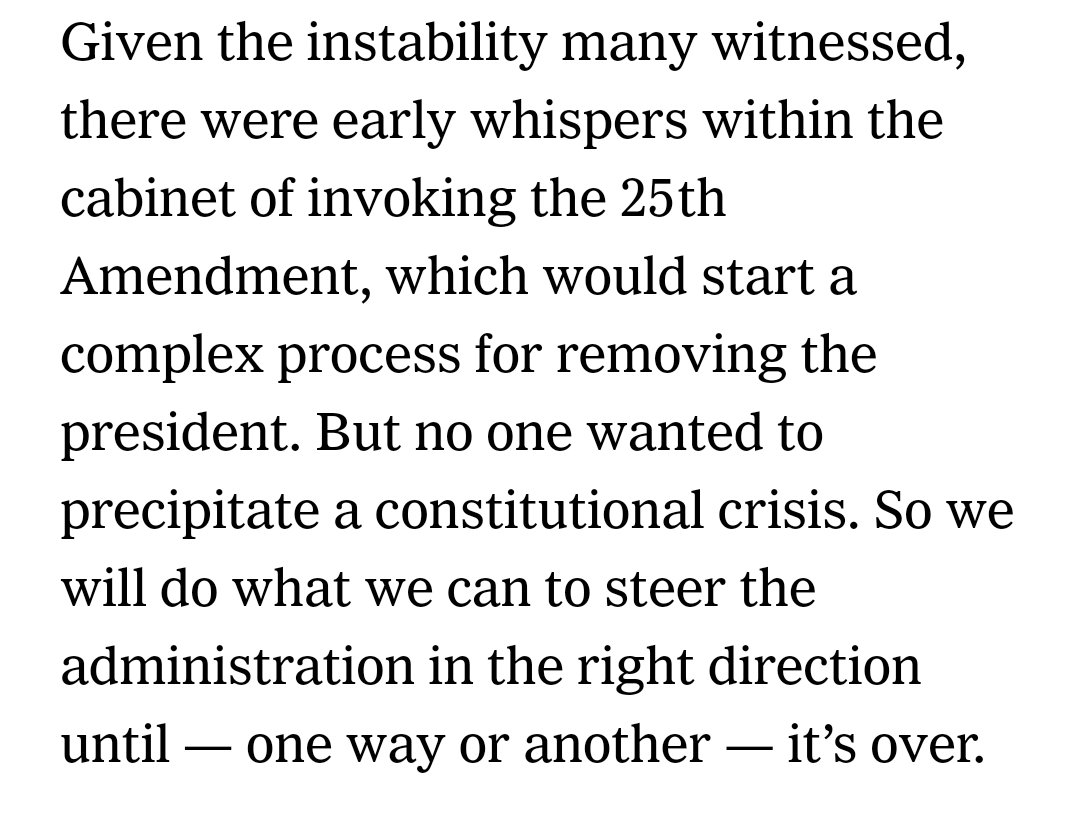
And containing POTUS without authority to do so is a much graver constitutional issue than invoking the 25th.
Outstanding work: “Public By Default“, visual storytelling of just how much stuff you can guess from Venmo’s data being public by default.
publicbydefault.fyi
1) Performance is hard.
2) It's a slippery commodity such that it tends to degrade in small increments that boil the frog.
Budgets help. Graphing performance of the codebase over the time can also be a great way to show the loss adding up.
This plays well with research showing that politically polarised Wikipedia pages produce high quality output. It doesn't work on social media because you don't collaborate there.
I'm a few months short of 42, but I know that feeling: I passed the same milestone fifteen years ago. Hang in there 🤗
And science needs some serious governance; it can be fixed!
Do you use an outliner? Are there any good ones? I love the idea and outline constantly on paper, but the software versions I've tried have all seemed terrible.
I am not much into biographies, but @platobooktour's "Incompleteness" is a great read, good writing unafraid of the technical. She makes even some of Gödel's weirder aspects make sense.
The GDPR places strong data protection requirements upon personal data controllers. Granting an access request with insufficient validation is indeed a breach of @Spotify's GDPR obligations. If I were them I'd be begging you not to sue.
Having said that it's hard, there's no standard of verification and you have to balance the risks to the person against not making the process so hard you're preventing them from exercising their rights.
Actually, by contract they usually claim to be data controllers. In either case the processor/controller distinction is established by facts and not by contract so it wouldn’t matter: they’ll be controllers.
Replying to @yoavweiss and @JibberJim, @AmeliasBrain
Signature-based SRI would be great; but to be honest if embedded third parties were forced to communicate with us when they update their code (and explain what the change is to motivate us to upgrade) that would be a feature. A big feature, actually.
Part of the problem is that package deals help to block new entrants (who can't make attractive packages), leading to monopolistic issues (high margins but also low quality of service, that software hasn't been upgraded). I wonder if a co-op model wouldn't work for packages.
The lack of standards also doesn't help, it means that you have to get the full pipeline of services from a single source instead of going to the best for each step. That's fixable but publishers have little incentive. Regulation maybe?
I’m very encouraged to see the progress of the /e/ mobile operating system, it’s moving much faster than I thought it would. I hope to load it up on a test device soon! hackernoon.com/leaving-apple-…
Replying to @LeonieWatson and @ChanceyFleet, @ugly_chimp, @lukOlejnik
Ah, that’s a good question — and the answer is, of course, “it depends”.
If it’s detected client-side (or with very minimal processing, eg. a redirect) I don’t see that it would constitute a violation. At least, the case would be hard to make, I would think.
Replying to @LeonieWatson and @ChanceyFleet, @ugly_chimp, @lukOlejnik
If, however, that information were stored or used in any way beyond just adapting the site’s behaviour then that would be processing special-category data (here health/biometric) and doing that without the user’s express informed consent would be dodgy as hell, v. likely illegal.
That is true but in fairness they have high costs because they're not trying hard to be efficient. It's not a justification for the prices they practice.
This is an excellent point. I'm considering switching back to an iPhone for the privacy, even though I find the user experience poorly designed and the price excessive. It's a bit like going back to Linux, except at least the WiFi works without recompiling the kernel.
Replying to @JibberJim and @LeonieWatson, @ChanceyFleet, @ugly_chimp, @lukOlejnik
I don't think that looking at it in too black & white terms helps. If your access logs are only processed as logs, accessible to a limited group, and have limited retention I would call it fine. The rights and freedoms are okay, as we say.
For behavioural profilers, the biggest issue is that they have access to the same information that allowed detection of a screen reader in the first place. That's scary. Browsers are a huge walking Article 25 violation, they should be taken to task over that.
But that's the thing: I don't think that current Gaia is self-aware, some various bits are. I'm also not sure that consciousness is relevant when comparing to terraforming like the Great Oxygenation Event or the 40 million years during which nothing could biodegrade trees!
I am also not convinced that self-awareness is better than self-regulation, we might want to look for ways to improve the latter seeing how poorly we're doing improving the former.
I feel the 2.0 label misses the opportunity to take a deep history view of the problem. Refreshing the Gaia concept is certainly useful, but I think the way to go is to make it deeper and to show just how many Gaias there have been - and how they survived.
First, I would refrain from considering social media as the Internet's final form. Social media is heavily rooted in an economic model that is very dependent on a set of technological assumptions that are a major ongoing battleground. Whoever carries that will change social media
To your question though, I think it helps foster multiple overlapping identities. I think the mainstream identities are more uniform (everyone makes cat jokes, worldwide), but the smaller ones are more diverse because they can have communities that were impossible before.
Replying to @null and @SimonDeDeo, @TheAnnaGat, @LarsESchonander, @webdevMason, @rivatez, @micsolana, @tylercowen, @nytdavidbrooks
"Mountain" sounds a bit drab, it might catch on better as "les Montagnards". You can almost see the knife held between gritted and grimly determined teeth.
I'm hesitating. On the one hand I have a novel idea that I could really outline in time, on the other there's another project I kinda want to do more...
"Convenience Store Woman", by Sayaka Murata. A great short novel, I found it stomach-churningly relatable. It's a wonderful inside depiction of life amidst normal people when you're not quite the same.
"Convenience Store Woman", by Sayaka Murata. A great short novel, I found it stomach-churningly relatable. It's a wonderful inside depiction of life amidst normal people when you're not quite the same.
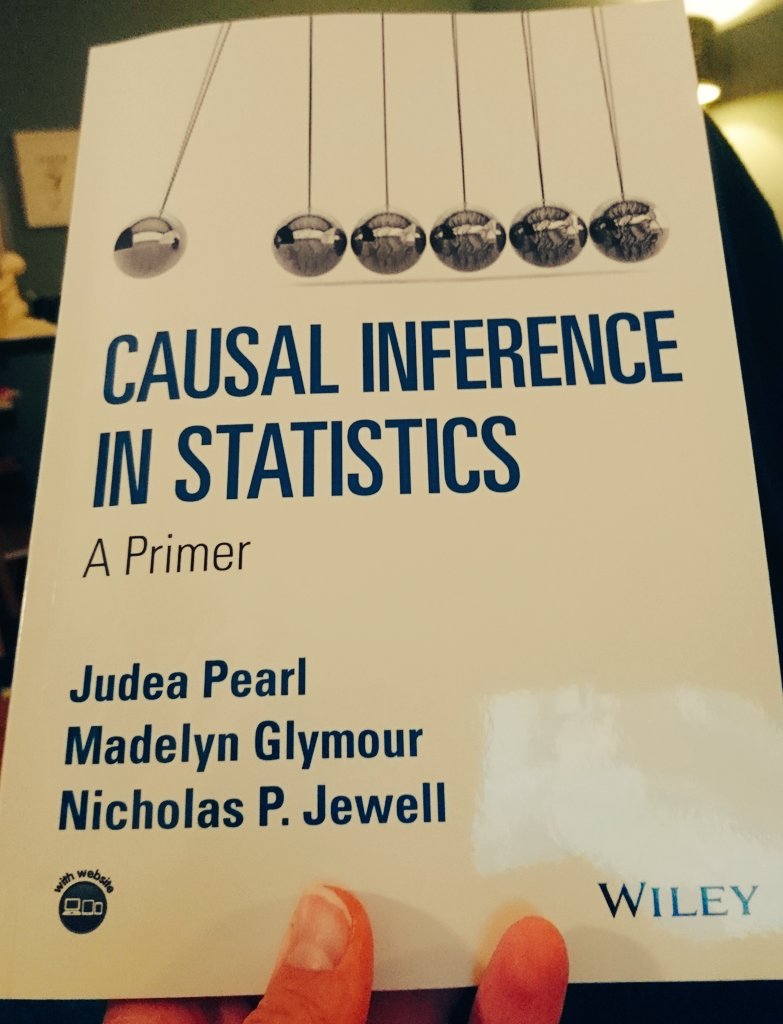
"Causal Inference in Statistics", by @yudapearl, M. Glymour, @NP_Jewell. More technical than "The Book of Why", less daunting than "Causality". It covers a lot of ground clearly in little space, definitely worth reading!
If you see some deliberate disinformation being spread ahead of the US midterm elections, the @nytimes would like to hear from you through its dedicated tip line: nytimes.com/2018/09/17/tec…
Analytics demographics are notoriously crap. They tend to infer based on online behaviour and there is little actual incentive to really improve them because marketers can only verify accuracy so well anyway. Before I killed tracking most thought I was a woman.
"How To Exercise The Power You Didn't Ask For", by @zittrain. A very good description of the fiduciary approach to privacy. It is worth noting that under the legitimate interest regime the #GDPR has many aspects of a fiduciary approach. hbr.org/2018/09/how-to…
Companies went crazy with consent instead because they saw the chance to abdicate responsibility to the user (for processing they can't possibly understand). That won't last long. Prepare for what's coming. Set up a corporate IRB-equivalent, work your ethics muscle.
There are risks with this approach, notably that it be toothless. I certainly would not trust the current administration with anything involving ethics. I mean the thought itself is sadly comical. But the conversations should be started now. I know we have.
This sums it up: "Restaurants must meet minimum standards for cleanliness, or (ideally) they’ll be shut down. We don’t ask the public to research food safety before grabbing a bite and then to “opt out” of the dubious dining establishments. No one would rue being deprived of..."
...the choice to eat food contaminated with salmonella. Similar intervention is needed in the digital universe."
If you're interested, get in touch! The NYT data governance team loves to share!
I have friends who want to keep using @googlechrome but also are tired of @Google selling them downriver to advertisers. What extension do you recommend to make Chrome a modern user-first browser?
Replying to @dontclickonthat and @KristenLarski, @googlechrome, @Google
I use Firefox with TP enabled so I’m not too familiar with what Chrome users would do. @julien51 suggested Ghostery which looks like a good option indeed.
Replying to @thurrott and @stshank, @googlechrome, @Google
Switching browsers can be a PITA. I’m sticking to Firefox despite the loss of Tab Mix Plus making it almost unusable UI-wise, it’s still less painful than switching.
Replying to @dontclickonthat and @KristenLarski, @stshank, @thurrott, @googlechrome, @Google
Yes, a lot of Google’s “web” stuff is almost Chrome-only. They claim it’s not on purpose but it’s pretty obvious they’re not trying to fix that either.
Replying to @othermaciej and @googlechrome, @Google
Chrome is certainly very pro-tracking but I wasn’t aware that even extensions couldn’t fix that. Do you have specifics? That would be *very* interesting fodder.
Replying to @stshank and @thurrott, @googlechrome, @Google
I believe I’ve voted on most, but no one at Mozilla seems to care. Just a few days ago I saw that the tab ordering issue was classified P5 (Mozilla won’t do, community can).
Replying to @mikewest and @othermaciej, @googlechrome, @Google
Well at the very least it actively sustains third-party tracking — that much is deliberate support for tracking as a feature. But I’d be interested in hearing what Maciej had in mind regarding that not being extension-preventable.
Am I the only one reading this Chrome whitepaper and counting the GDPR violations? There is no world in which Google isn’t an independent data controller here with no legal basis to stand on. google.com/chrome/privacy…
Michelle Alexander has started writing for @nytopinion and it is the smartest, truest thing on the Internet today:
"Donald Trump’s election represents a surge of resistance to this rapidly swelling river, an effort to build not just a wall but a dam.(...)
nyti.ms/2Dss8sq
Replying to @ehsanakhgari and @mikewest, @othermaciej, @googlechrome, @Google
You're entirely right, but at this point it is sadly clear that no matter how nice people on the Chrome team may be they really don't give the last damn about privacy. So as long as people want to use Chrome it's worth helping them at least a bit.
Replying to @othermaciej and @ehsanakhgari, @mikewest, @googlechrome, @Google
I know those people too, am fond of many. But every time I take a look at Chrome I'm ashamed that this is the Web to most people. I know these choices can be hard, I often wonder why no engineer whistleblew in the VW emissions scandal. No doubt some cared about the environment.
Replying to @othermaciej and @ehsanakhgari, @mikewest, @googlechrome, @Google
And even forgetting ethics it's almost certainly illegal. If they are being instructed to keep fighting privacy, or prevented from supporting it, that's a clear violation at least of GDPR Article 25. We have a tipline, I got Signal, it's all ready to help.
Replying to @null and @sneakdotberlin, @__apf__, @matthew_d_green, @quinnnorton, @robocallaghan
So the idea is that Chrome is treating Google Web properties preferentially, in the same way that Google Web properties are made to work just with Chrome. I guess it is a good time to milk the Trump administration's lack of interest in antitrust issues for all it's worth.
Any chance that you could stop publishing articles in that way? It's a horrible experience on mobile and it's aggressively hostile to people with accessibility needs, for no obvious gain beyond the gimmick of mimicking paper.
Considering that *animal* life is over half a billion years old, I really hope that some form of the Silurian Hypothesis is true. The reverse is sobering and a touch depressing.
"Asking companies whose business models revolve around exploiting data-based consumer-influence techniques to explain their privacy policies seems about as useful as asking sharks to hold forth on veganism." nytimes.com/2018/09/22/sun…
That is entirely true. I mean, I reckon we could have another Bronze Age, but it would not involve mining, more finding our stuff. But that all assumes our path is the path. A conscious predecessor would likely have been aquatic: they'd be less about fire.
I don't think that's fair. Media have a gun to their head: do it adtech's way (and serve as cover for them with users) or die. Heckling them won't change anything. The system is enabled exclusively by browsers and mobile platforms: that's the one key.
took a stand for what's right despite this position presenting a direct existential threat to them; you're playing armchair purist on Twitter going after them for it. They've opened a much more useful conversation than you have.
I'm not preaching, I'm pointing out that you're policing someone trying to help. And if you don't understand why they are facing the contradictions they are I don't see how you can help.
Replying to @alexanderhanff and @podehaye, @PrivacyMatters, @newrepublic
Well Alexander, this was a polite discussion until you joined. I didn't say he had done nothing more than armchair purism, only that that's what I was seeing right there in that thread. I guess that makes for less grandstanding though.
Replying to @alexanderhanff and @podehaye, @PrivacyMatters, @newrepublic
I'm not new to privacy, either. And yes: I'm tired of seeing otherwise highly intelligent advocates attacking the symptoms and giving the root cause a pass.
Replying to @alexanderhanff and @podehaye, @PrivacyMatters, @newrepublic
As for my job, I might not have "the balls" to "stand up" and make revenue out of thin air as you seem to expect but this isn't my first rodeo and I have reason to hope that when I'm done we'll all have much better privacy.
Replying to @alexanderhanff and @podehaye, @PrivacyMatters, @newrepublic
Again, read back, it was entirely within the context of this conversation, not some lifetime achievement award in armchair purism.
If you have feedback beyond testicle-related injunctions I'd love to hear it, otherwise I suggest we both have a better Sunday elsewhere.
Replying to @PrivacyMatters and @alexanderhanff, @podehaye, @newrepublic
I'm sorry if I hurt your feelings, its was not my intent. I just sincerely do not think you're helping by attacking people who are trying to help, no matter how imperfect their current situation may be.
Replying to @alexanderhanff and @podehaye, @PrivacyMatters, @newrepublic
Yet again, I did not mean to insult and apologise de if I did. But maybe spending five minutes understanding the situation of media would help more to find a solution? Calling it hypocrisy shows a clear lack of understanding.
Replying to @PrivacyMatters and @alexanderhanff, @podehaye, @newrepublic
The left picture is a conversation that will change the right picture. It's not the only approach, but it's one prong. I don't have magic to make that move faster.
Replying to @alexanderhanff and @podehaye, @PrivacyMatters, @newrepublic
I have 25 working on the Web, nevertheless sometimes I'm wrong and I don't take it as an insult when people think I may have missed something. Have a great Sunday!
Replying to @PrivacyMatters and @alexanderhanff, @podehaye, @newrepublic
We don't need more time, but rather focus on what will effect actual change. For consent I'm looking at ways to bring DNT back to life. It'll make people laugh for a while before it work, though 😏
Replying to @alexanderhanff and @McDapper, @PrivacyMatters, @podehaye, @newrepublic
Contextual is what we want to bring back. For that to happen we need to fix the current game theoretic structure of the ad industry. I'll expand more on that when I get home.
Replying to @alexanderhanff and @PrivacyMatters, @podehaye, @newrepublic
What are you proposing that's better? AdTech actually pushed hard to make sure that DNT would be a meaningful signal rather than a default. I cannot wait to use that to bite back.
Replying to @podehaye and @alexanderhanff, @McDapper, @PrivacyMatters, @newrepublic
I do not believe for the one second that the press needs an exception regime. I do however believe that without a free press we won't be have any kind of privacy for long. We *absolutely* can make this work and the press must help. Attacking it just solves nothing IMHO.
Replying to @alexanderhanff and @PrivacyMatters, @McDapper, @podehaye, @newrepublic
Journalism has been ad-supported for a long time. Then the ad industry changed, and I agree no one reacted fast or well enough. But now we have the means to change it back.
This is a good question: what is the root cause of the lack of privacy online today? Why does media track so much? My personal take is that it boils down to browsers and mobile platforms. Not only is that the master fix, but it is within reach. Follow the thread❗👇
First, I have some assumptions that I want to ensure you know:
1) Without a free and well-funded press before long we'd have no privacy at all. This does NOT justify an exception regime for media, but it constrains the solution. Getting rid of media is not the right option.
2) I do not buy into strict deontologism. It's not enough to make a rule, we need to make it work. If you force people into a choice between the law and survival, don't be surprised that they at least bend the rules. If you incentivise defection, expect defectors.
Replying to @alexanderhanff and @PrivacyMatters, @podehaye, @newrepublic, @PrivacySurgeon
I just replied to Paul’s earlier question about the root cause with a broad spectrum option. But until such a time as we’ve made that work, I’ll take something imperfect over nothing at all, no?
Well sure, people had been trying to optimise paper-based targeting for a while too but the scale was nothing comparable. Also, it was mostly in the US rather than a global issue. Privacy law existed in many other places. In the US just for the public sector…
I’m not sure why you would point me to the source code for those. In Chrome, they would reject the change. In Firefox, the fix is already on the way (at least the early stages) because like they decided to align with Apple in following the law.
That’s a question I’ve been wondering about and I’ll be honest: I don’t know. The incentive to sustain a team as expensive as, eg, the Chrome team without income is not obvious. Maybe we should pay for browsers? It’s not an insane idea!
As I said in the thread, you can (and should!) apply the same reasoning to mobile platforms. I just didn’t want to make the thread longer by doing that twice.
Thanks for the recommendation, I’ll definitely read that!
Yes, there already exist a number of options worse than cookies. I believe that browsers have the means to shut down a lot more than they do. But I don’t think that giving up is the answer to it being possibly worse, no?
I’m sorry but I’m not sure what you are describing exactly. When was that long time ago, what happened exactly, what documentation do you have about those events?
That solution is so radically impractical I don’t even know if I understand what you’re proposing. You want the NYT to make a fork of tracking browsers and then what happens? What’s the path to a billion installs?
You do have a point. And there’s a risk that innovation in browsers would stop, they’re big and painful beasts to maintain, a real hard task for open source.
But the current model is unsustainable too — we need a way forward.
I think we can debate an exact attribution of causality (as in @yudapearl’s ftp.cs.ucla.edu/pub/stat_ser/r…) but it is an enabling cause at the very least.
I know there’s more to do; one mole at a time!
No offense but that’s the kind of «just» that is just missing so much detail it can’t possibly work. There are privacy-friendly browsers, why don’t they «just» get a better marketshare?
What software is here «on its own». It didn’t just decide «on its own» to be this way. By your reasoning if I install a photo editor that reports everything about my life it’s not subject to protection.
The modern abuse potential is not by design; for cookies we knew it was a problem in the mid-90s and went ahead anyway. I would argue the case is different there.
I believe we can tighten up the platform quite a bit, though I worry the changes may be too drastic to be acceptable
It’s not so much about creepy — it’s about Google using Chrome to treat Google properties preferentially. The next step is that sites that use Google SSO can be logged into more easily… and then it’s the one profile for the Web.
For creepy there’s google.com/chrome/privacy… 🤗
Ditching him means admitting they fucked up and nominated a rapist, weeks from the midterms. How credible would they be with anyone, really? Plus evangelicals want this rapist.
Agreed. I'm starting to wonder how many weeks' worth of revelations are left and at what point they'll just confirm anyway. The longer it goes on the more toxic it is.
I have actually made proposals along those lines, yes (except more practical). You keep being aggressively hostile with your conspiracy theory "you guys" so this is my last response. Bye.
Oh, I did not mean to imply that this was the only thing that needed be fixed everywhere for all things. To boot, there are problems (as you note) in the ad ecosystem that go well beyond tracking.
But the influence of this tiny entry point on the data market is huge.
To stay within an ecosystem metaphor, blocking at the browser level has a massive incidence on the food web.
Also, changing a browser’s behaviour isn’t an engineering fix, it’s heavily political ;-)
The decision from the browser to share personal data is itself processing. It involves maintaining a data store, deciding to attach the information on an outbound message, etc.
This doesn’t absolve downstream from compliance — but the decision to share is the browser’s.
I think the semantics can be debated up to a point, notably depending whether they are provided to first parties or third parties. But Safari is doing much good in this area anyway, it’s not sharing!
There’s a lot that’s quite fuzzy and could easily end up toothless in there; but in fairness there are good things.
The points on territoriality and data exports at the end seem tailored to try to reduce GDPR applicability, though. I’d watch those.
This is a tricky part. Detailed consent is user-hostile and easily gamed, you end up with users having to fight an army of the best and nastiest UX designers. There are compliance/fiduciary alternatives but they have all the downsides of corporate responsibility.
If I were trying to make the case (say, eventually, to the WTO or some such institution) that data protection law should not be extra-territorial, those are pretty much the arguments I’d be marshalling.
Well yeah, that is my actual opinion — but it doesn’t read like that’s Google’s from that document.
The notion of a court in Helsinki going after a mom & pop Web shop out of Kansas is absurd, but it’s a good scare story.
This could have been a serious threat to the Web; thankfully no one has wrapped it in a React component yet so malicious developers aren’t sure how to use it.
I would argue this one isn’t user-hostile, it’s Web hostile: this is Chrome giving preferential treatment to Google properties. It’s not the first time (they document many other case in google.com/chrome/privacy…) but it’s increasingly brazen.
Oh yeah don't even get me started on those people... I did have a grand time being the crazy Frenchman who was going to sue them if they kept spamming though. 😏
Replying to @null and @SimonDeDeo, @LGcommaI, @sfiscience
I wish conferences made use of blackboards more often. I once spoke at a CNAM amphitheatre in Paris, deep 19th century circular pit, huge blackboards, no need for sound amplification despite it being a huge volume. It was amazing.
Christina Boyce-Jacino and @SimonDeDeo used a @nytimes crosswords dataset to identify what makes a question hard, advancing applied erotetics in the process.
“Opacity, Obscurity, and the Geometry of Question-Asking“ arxiv.org/abs/1809.08291
“We don’t really have good accountability for JavaScript.” — Martin Thompson, #permissions
It’s almost like the declarative and Principle of Least Power people weren’t _entirely_ wrong.
Yes, to clarify: this is in the context of people being accountable for Web features. I think that generally on the Web there’s just too much toothpaste to put back to get general accountability for JS.
But realms show great potential, eg. to sandbox third parties.
Helen Nissenbaum shares her excellent take on consent and privacy over at the @HarvardBiz. She’s also proof of just how practical philosophical framework can be when done right.
“Stop Thinking About Consent: It Isn’t Possible and It Isn’t Right”
hbr.org/2018/09/stop-t…
My experience is that making them shorter makes them more interesting. Speakers have to stick to the strong points and not go into their pet digression.
Confused about what the theft of 50 million tokens from Facebook means? Look at what @nytimes folks were able to get by using just *one* such token.
You read that right.
I'm hearing quite a few people saying there can't be a fine unless there's negligence. Folks, if it can be established that they did not properly minimise data collection that's negligent.
This is Facebook. How good would you guess they are at only collecting the data they need?
There is so much that Mozilla screwed up developing identity, it's almost like they wanted it to fail... I wish someone would pick it back up, it had some nice properties.
To show a link to the #FermiParadox it is not really relevant that it's hard to match the efficiency because evolution can optimise that over huge time spans, the tough question is whether it is hard to bootstrap. Is that the case?
Abiogenesis may be hard, yes, but photosynthesis comes later. It's not obvious (to me) that it is hard to kick-start photosynthesis (perhaps anoxygenic) for example next to volcanoes.
Yes, but don't those precisely show that life is resilient as fuck? You can turn the Earth into Hell, wipe 96% of species out, and it still bounces back.
I promise I won't! It just, I don't know, it felt like it was constantly trying to force enthusiasm when the topic is exciting on its own and doesn't need cheerleading. I gave up a couple of chapters in 😔
Paying is a plus, it means you're the customer. I'm pretty happy with Evernote, it handles thousands of notes well. I also use it to scan my paper notes, its document mode is decent. That said for just snipping stuff off the Web I also use Pocket.