You never know, I sometimes read regulatory decisions for fun 😏 But PPs are tedious affairs indeed, they are wrought with dark art; one's instincts will feel the evil magics and try to ward you away.
I beg to differ. At times it's consent, but relying on consent systematically is taxing to users & that will fast erode their agency. Sometimes privacy is being responsible *for* others. I highly recommend Helen Nissenbaum on this, too. Cc @SarahJamieLewishbr.org/2018/09/stop-t…
But it's consent really the best tool to reduce dataflows? To take a concrete example, as you know the dominant browsers are actively privacy-hostile. Would fixing that not already do more than asking all the users in the world for consent?
I feel that people shouldn't even have to think about whether they their browser is a monitoring device. But maybe that fits in your view of consent? It's an annoyingly overloaded word.
Replying to @null and @polite_netizen, @TheAnnaGat, @latimes
No, it’s more complicated than that. Greater privacy in the ad ecosystem actually favours first-party publishers (like the LAT) over Google and Facebook as it returns the premium to context over surveillance.
Replying to @null and @polite_netizen, @TheAnnaGat, @latimes
I can’t speak for the @latimes but the push to GDPR happened at the same time as they were being sold by Tronc. It could be that starting a major project in the middle of an acquisition was ruled out, and then they needed time to set up a new strategy.
What’s particularly beautiful about this specific part of the never-ending Facebook shit show is that it was delivered on a silver platter by Google’s blatant disregard for anything resembling even a modicum of data protection.
I hope this means I will never hear «but Google has done so much for security!» ever again.
They took your call and text log, and they just gave it to anyone.
For two billion users.
Is it, or is it just they we give up faster because we've seen it? Sarkozy and Hollande ran the country as if it were a small local politics dominion, Chirac and at least Mitterand's second term they were in the wrong century. All in over their heads.
Yeah. I just built an app, it doesn't need to be crazy fast as it's internal only so I was just minimally careful to make sure it didn't blow up. I can't seem to get it to grow much larger than 30k...
The worst part is that that's one of the nicest things she says in that interview.
I mean, she compares having the UK in EFTA to inviting a drink-spiker to your Christmas party. Sadly deserved, but ouch.
I won't spoil it for you but the end of the season almost gave me hope for that show. I say almost because they went where I was hoping they would (you'll agree) but at the very last minute they seem to hesitate to have the actual courage to do it for real.
The Internet Dunbar Number is the number of people for whom you can remember which messaging platform to reach them on.
Recent estimates place its limit around 8.
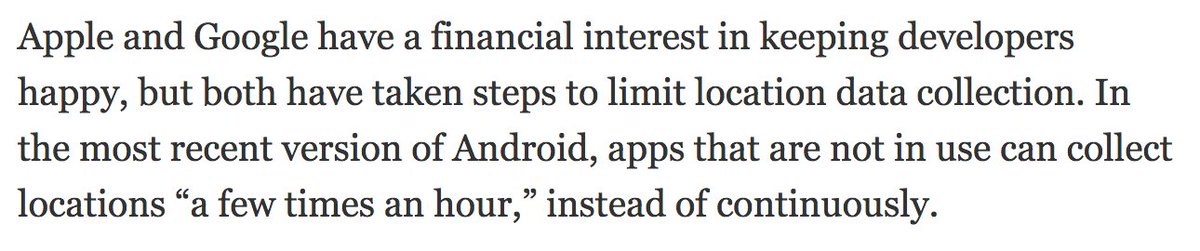
Do you feel better knowing your location is only tracked several times an hour instead of continuously? How often do you change location?
The root cause here is that Apple and Google simply don't care about putting you at risk of stalking. They'll tell *anyone* where you are.
The classic defence is to claim this data is "anonymous". Is it okay if I know where you live and work, who you hang out with, what time you wake up at, which doctors you go to, which gatherings you attend... but not your name?
One thing I'd like to know is how much this data costs. I suspect a lot less than you'd think.
If I were into organised crime, I'd see a way of making burglary a lot more effective.
If I worked in terror... several of those yellow dots must occasionally spend a couple hours at a hotel or house without their spouse, or must visit a casino, or AA/NA…
Finding targets at such a facility used to be a major surveillance op; now it's off the shelf!
I don't have funny GIFs for this thread. The situation defies alarmist characterisation.
Adtech has been promising self-regulation for decades now. Who out there still believes them?
I half expected him to start crushing some skulls with it. I mean, it *is* a mace. Making that available in the middle of disagreeing people seems to be begging for an accident to happen.
I’m particularly interested in item (2) below. Every family deserves dad jokes, so it should be a more inclusive term.
I’m struggling to find a good gender-neutral one, though the motherly version should be a “bon mom”.
I don't understand the "crisis of meaning because decline of organised religion" people. I can't even find time for all the meaning there already is...
More cynically, the process is:
• Propose thing
• Devs love it
• Browser folks don’t see the point, won’t engage
• Drop it
• Time passes
• Browser folks rant about why JS devs keep adding all these libraries that make things slow.
I highly recommend taking a few minutes to read @julien51's excellent "The End of the Ad-Supported Web — What if we got the business model of the web wrong?" medium.com/unlock-protoco…
You're no doubt used to arguments about ads being an active and growing threat to privacy — which is true — but Julien asks a different question: are ads even good business? He makes a good case that they aren't.
To begin with, the adtech world is spectacularly bad at effective self-regulation. Because of that, it has failed to enforce effective control over the simple problem of ad resource consumption. Without even looking at privacy, adtech is basically encouraging ad blockers.
The @PrivacyPros have published a rather surprising take on the Vectaury decision: "The Vectaury decision is not an obituary for digital advertising" iapp.org/news/a/the-vec…
I'll skip over debatable points about accountability under the TCF (saying Vectaury violated terms of the TCF is meaningless without also explaining why the TCF failed to be enforced) and focus on just one item that I find surprising…
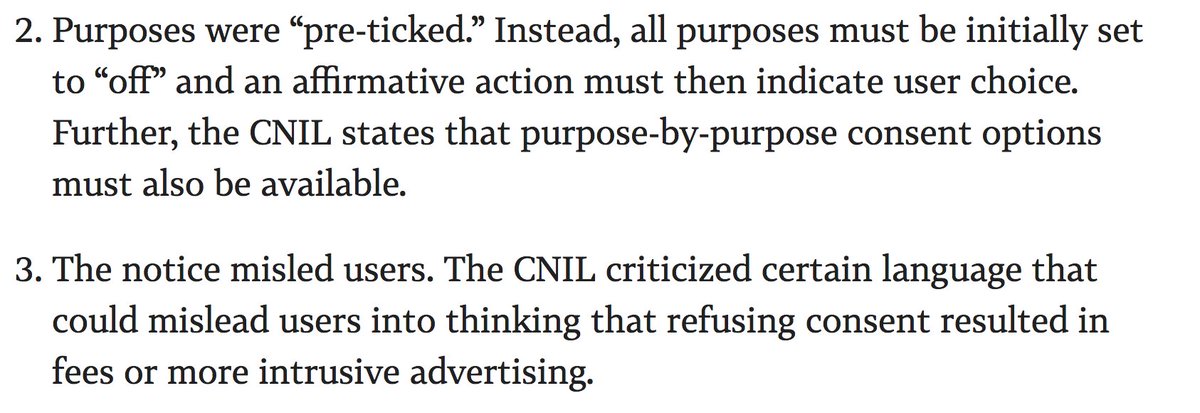
They list what TCF controllers need to do in order to comply with the @CNIL recommendation, including:
• You can't pre-tick purposes.
• You can't mislead users.
I agree. What I find surprising is that they draw no consequences from those requirements.
Those are certainly interesting arguments, but I am not sure that I am convinced. Or perhaps I feel that they are naïve in their own way too :)
First, the commoditisation of privacy isn't a progressive tax, at best it's flat, and it could become regressive.
By which I mean: only the rich will be able to afford privacy, the rest will have to have everything about them tracked so that they can afford anything at all. We're really only a few wrong turns away from that, it's not science fiction.
Second: advertising is highly inefficient. If it were a redistribution from companies with products to companies with attention, you might have at least part of a point. But most of the profit goes to the intermediaries. It's a whole lot of parasites with little value.
Finally, other business models (eg. even just subscription to be simple!) can do price differentiation for instance by geography. In fact they often do. I'm not saying it's perfect or easy, but I don't buy that ads are the best option there. No bandwidth anyway!
I don't believe they've shown that at all. When you dig into user experience and expectations it's obvious they have no idea of the scale of what's going on.
It varies *a lot* depending on what you’re serving, what type of targeting, etc.
Report coming out soon shows that behavioural targeting brings 4% bump to publishers but 500% bump to marketers. Who’s getting the difference?
I am precisely *not* vilifying all advertising. On the contrary, I am of a small group who think that another way of doing ads is entirely possible — and that we should not just because it’s right, but because it’s sounds business.
That’s because they’re not consent dialogs, they’re dark patterns meant to give an impression of consent. And the law has pointed that out in several cases already. Stuff in this article is consented to as “Personalisation”… nytimes.com/interactive/20…
And what is remember should pass the “Shop Test”: roughly, it’s okay to be targeted/remembered/served in the same way that a shop owner would if we went there regularly, ie. just from clear and direct interactions with them, decaying over time.
That’s waaay too underspecified a problem! There are many ways to personalise ads, some are privacy safe and some are not. I’m okay with those that are safe.
I do not, however, think that privacy should be monetised.
I’m super happy about ITP2. The lack of privacy helps Google and Facebook to the detriment of publishers and a free press.
Publishers actually want better privacy.
Ah, but it does not cost 4%. That is what it would cost if it applied to one publisher and not others (actually much more due to bundle effects). But since it applies to all equally, and ad budgets don't vanish, it does not adversely impact us.
On the contrary, the less tracking there is the more valuable our inventory as it becomes valued on content quality rather than surveillance-based targeting.
We honestly cannot wait for Chrome to start protecting its users' privacy!
I somehow saw it in a bookshop and read it as my first "serious" computer book after having taught myself barely enough to be dangerous. It was interesting (if bloody drab) but it didn't teach me much that ever came in handy, and I wouldn't recommend doing the same!
I completely agree with this, but I'd love to understand why @nytopinion supports de-indexing data brokerage but opposes de-indexing irrelevant past convictions, often as harmful if not more.
Two things are missing from this (good) @Recode article:
* Is this not an admission of GDPR noncompliance?
* Facebook is actually strengthening its browsing history tracking game by switching to first-party tracking so as to circumvent ITP.
What's even worse than providing that level of access is that I actually believe those companies when they say they didn't ask for it or even knew they had it. Someone at FB just switched that on on a whim, and never switched it off.
The carelessness is almost worse than the deliberate misdeeds. Their tool must have had no oversight. I envision a UI in which it's faster to "Select All" permissions than to pick specific ones.
I mean it! I was dreading having to do some client-side stuff again but that stuff brought me back. Simple, fast, orthogonal. It feels like using JS rather than being shoehorned into a lib. Thank you, and to the others!
I would contend that's actually selling (under the CCPA it is). Providing in exchange for an advantage is selling even if the advantage is not monetary. Same as it would be for instance for bribery.
Well it would have to be transitive, right? Influence one person who does something big is worth more than influencing many who do nothing. From there you're straight into the fun madness that comes with the eigenmorality framework 😁
Replying to @fatemehx2 and @JustinBrookman, @JulesPolonetsky, @jason_kint
I would be very curious as to whether it varies with retention (using location on the spot vs by knowing your every move), number/type of intermediaries, how much the data is reshared, etc.
Replying to @jason_kint and @fatemehx2, @JustinBrookman, @JulesPolonetsky
Yes, relevance is a problematic framing, you can't even ask the reverse question ("Would you do X to get more irrelevant ads?") so it has to skew positive. And how much more relevant? Is it still worth it if one in twenty ads is better?
Replying to @fatemehx2 and @jason_kint, @JustinBrookman, @JulesPolonetsky
Yes, I have zero concerns over methodology, only conceptually about whether relevance is the right concept to roll up to. It feels hopelessly skewed, but that might just be from me trying to extract some truth from too many adtech companies. They use it like punctuation.
The what and how matter. To take a basic example, until a few months ago when you logged in to a site using your Facebook account that site received your gender and age range without ever asking for it. Users certainly did not expect that.
Facebook was just throwing around user data to try to gain an edge in online identity, because lots of marketers want those demographics so it's an incentive to favour Facebook.
Having users use their data is evidently fine, on fact right now Facebook does not let users get all of their own data back. Throwing around people's data without their say-so for competitive advantage is unethical, and in some places illegal.
Just because you're Advocate General to the Court of Justice of the European Union doesn't mean you can't have a sense of humour. Read Michal Bobek's opinion on embbedding Facebook: eur-lex.europa.eu/legal-content/…
"Future Ethics", by @Cennydd. I could spend a while telling you how good this is, but frankly just go read it! If you're in tech, data, product, adtech, marketing of course, but also if you're in philosophy. This is what ethics in the trenches looks like.
A deontologist is just someone who's never had to wait hours for a delayed flight alone with two young, tired children amid throngs of grouching French people in an overheated airport.
Ah, la joie de voyager avec @airfrance. Tu as 4 places parce qu'ils ont refusé de t'en rembourser une, mais comme le quatrième voyageur n'est pas là ils réquisitionnent son siège.
Là pour prendre l'argent, partis pour le service. Un bon vol, en somme.
Replying to @RickByers and @johnwilander, @stratechery
I think that article significantly oversimplifies what can be put under "open" (it's not a one-dimensional value), it also misses the importance of purpose limitations under the GDPR. The differential profit point is correct but it's what we already see, it's not new!
"Coin Locker Babies", by Ryu Murakami. I usually find growing-up/coming-of-age stories boring, but this one is very enjoyably fucked up (and excellently written).
Replying to @RickByers and @johnwilander, @stratechery
I think that depends on what you see a tradeoff; we haven't seen that many but you could construe some choices as tradeoffs. The exemplar is browsers have a choice between favouring first-party+user expectations or third-party+market concentration (as Chrome and Edge do).
Replying to @RickByers and @johnwilander, @stratechery
Part of the central problem though is that the most important point of control - the browser, the OS - are by volume most often working for those who benefit from the sharing. That's not a balanced situation by any reckoning.
Replying to @RickByers and @johnwilander, @stratechery
Much of my day-to-day is occupied with privacy issues that aren't black-and-white, I'm well aware that it's not simple in many cases! But for this specific case I have yet to hear an argument, even tweet length. I don't see the analogy with the @stratechery piece, help me?
I always hesitate to recommend this book. Much of the content is excellent, but Unger's half is painfully poorly written, it feels like a rambling set of brilliant but repetitive, unedited notes. (Smolin's is outstanding.) This great summary might help you decide!
If you believe in set gender roles then you believe that men are just like that. You teach your daughters that it's the natural order of things and how they should navigate rather than fight it.
It might be a weird way to look at it but do you need to get rid of it? Can you turn it into fuel, cancel out the painful bit and feed on the rest? I haven't been able to make it work with everything, but with dread yes. It has fire to it.
"Women Invent The Future", an anthology of short sci-fi stories by and about women, published by @doteveryoneuk. Consistently strong writing, I want to read these authors in longer form now! The book is almost free, too. (discovered via @histoftech)
I've been out of the loop in standards and not tracking W3C elections for a while now, but you'd have to be crazy not to want @sundress on the TAG. t.co/XnNKPJ38tn
I'm not sure that transcribing it as "culture/academia" is necessarily correct: it mentions *media*. There may be a sense that controlling the media is controlling all the things in a liberal democracy.
"In The Miso Soup", by Ryu Murakami. Follows a strange American and his young nightlife guide on a walk through the grottier side of the Tokyo sex industry; in turn meditative, surprising, and gruesome.