July 2019
201 tweets
"PITAaaS" (you can figure out what it means) is how @chrishwiggins defines ethics work and I love it.
Quoting a tweet by @pacoid ↗
♥ 1
So many lovely details in this article. nytimes.com/2019/07/01/sci…
♥ 1
Google now allows you to automatically delete data you didn't want them to collect after its primary advertising shelf life has expired. businessinsider.com/how-to-delete-…
♥ 9↺ 3
♥️♥️♥️
♥ 1
The pictures on this one...
nytimes.com/2019/07/01/wor…
♥ 1
"Getting the world to mistake direct marketing for real advertising is one of the great magic tricks of all time: a world record for misdirection in business." @dsearls is spot on: "behavioural targeting" isn't advertising, it's just online telemarketing.
blogs.harvard.edu/doc/2019/06/28…
♥ 10↺ 2
Need to mark up a document but can't find the right HTML element? Elizabeth Warren has a <span> for that.
Quoting a tweet by @zoe_samuel ↗
♥ 10
That hurts, man.
Never.
♥ 1
I recall targeting IE 3.02 and Netscape 2. IE 6 was a piece of cake.
♥ 3
Nothing will quite match not having to support Netscape 4 though!
♥ 2
It only gets so commoditised. First, the data isn’t. Neither is the ability for a smaller site to control its own destiny in online advertising. For Google, enabling sites to go faster means more interactions means more ads and more data — they win either way.
♥ 2
Second, the kind of ruthless dedication to performance that will get you the returns that @MattHindman talks about is still hard to get. You need either an excellent engineering team, or an excellent designer that can pare things down to the bone.
♥ 1
Third, I don’t think any off-the-shelf CMS is good yet.
And ML engineers, if you want someone who actually gets stats rather than cuts and pastes modelling from StackOverflow then it’s still expensive and tough to hire.
♥ 1
I don't think that what Brave is doing is what Tobie suggested though. He talked of taking Chromium to an open governance model, evidently this would have to remove it from Google, not to involve working downstream.
♥ 4
There is no doubt that it would be difficult, but I feel the question is worth asking seriously. It is not clear that users or the web are benefiting from competition at the engine level, they would possibly benefit more if those resources went into competing higher up the stack.
♥ 5↺ 2
There is also no doubt whatsoever that Google owning Chrome is severely detrimental to both the web and its users. Moving it out would be a net win.
♥ 3↺ 1
It would certainly be difficult and adversarial, and it would need a hell of a solid governance structure with uncompromising leadership, and that's just the first year.
But it's worth at least *thinking* about.
♥ 1
Exactly. I know the 2009 and the 1999 reasons why it was a bad idea, but the world is very different today and *if* it's a bad idea today it's worth knowing why.
♥ 2
Oh, yeah, I think it is obvious that this is not something that Google would do of its own free will. But Chrome is the most regulator-visible abuse of dominance, no matter what they do they screw several of users, adtech, other search engines, publishers, and the law.
Getting rid of it before they're made to might be a smart move, getting rid of it when they're made to is better than other options on that table.
I'm not sure what ML services you have in mind? For analytics stuff if you don't know how to read the results you're basically blind. Unless you mean stuff like image rec as a service?
Everyone is getting more data, there are no diminishing returns to maintaining a killzone.
Almost?
Those that write the most about privacy aren't the least affected. Journalists aren't pushed away from these topics. The problem isn't the reporting.
The problem is building a viable alternative. Some are trying; suffice it to say it won't happen overnight.
♥ 2
Oh wow. I think us tech folks are used to Antonio's takes being ridiculously disingenuous but this is a new low.
♥ 2
I'm not qualified so I there's no point in being envious but getting paid to explain to people that you don't understand email, threat modelling, and the data economy sounds pretty sweet indeed!
Wow. Much losers.
One classic approach is someone quote-RTing you to draw the mob in. Block that person and you stop at least that source.
Also, people are not giving away their privacy. 89% of users don't expect their browser to share data with third parties. That's a lot of Chrome users being tricked.
♥ 3
Developers and Web experts are part of the problem though in that they are often woefully ignorant of how money is made on the platform, often even by their own company. That prevents serious, informed pushback.
♥ 4
The people who gave Ivanka Trump an "Internet Freedom Award" are now running propaganda to "Keep The Internet Free" at keepinternetfree.com. The freedom to surveil and the freedom to put kids in cages team up at the @InternetAssn.
California lawmakers: is this your freedom? t.co/bk3JJ0UWN6
♥ 1
Some do, others play with privacy extensions. But they tend to become much stronger advocates when they understand how things work.
The vast majority of the tracking that Facebook does is not from when people use Facebook, it's when they use other sites. And they don't know that.
Pirates are pretty fucking awesome and so is their actual history (via @ZombiePaisible).
lakefronthistorian.com/2014/06/24/rev…
That's easy to solve.
America might often suck at democracy, but it's heartening to see that it can also suck at totalitarianism.
Quoting a tweet by @meredithllee ↗
♥ 22↺ 2
In fairness I wouldn't be unhappy if I somehow made myself read all the books I wanted myself to read, either.
♥ 6
Construire, c'est toujours plus compliqué.
♥ 1
The République actually fell and was rebuilt quite a few times already. And I'm not necessarily happy that the French suck less at asinine displays of useless might.
♥ 2
First job: I freelanced to build Web stuff for small companies, people don't look at your college for that.
Afterwards: open source helped, the break was ability to understand & participate in standards, and knowing the actual tech not just libraries.
♥ 1
I almost made it under 4min!
Une partie du problème est que les médias (en ligne) ne contrôlent plus seuls l’accès à leurs audiences puisque les plateformes et tout l’écosystème publicitaire les identifient aussi.
Du coup l’incitation est à faire du traffic et non plus à fidéliser.
Pour faire du traffic, il faut faire du volume plutôt que de la qualité et de l’accroche plus que du fond. Il n’y a plus ni confiance ni satisfaction à la fin d’un article. Au pire c’est faux, au mieux c’est creux.
La confiance est un rapport mais le rapport n’est plus rentable.
freemarketpolicestate.com is totally my next startup.
♥ 2
Google makes most of its revenue by collecting massive amounts of information about people and then convincing marketers that that’s required to reach audiences.
This only works because both Chrome and Android are actively hostile to privacy.
♥ 1
Everyone expects that if Chrome were managed by a company that doesn’t profit from surveillance, it would be at the forefront of protecting its users instead.
♥ 1
How so? You asked about architectural differences that would make sharing a codebase harder, those are good examples. I guess you could feature-flag the protections so that Chrome could keep building with tracking on but that would get ugly fast.
They’re pretty open about it! They just don’t have a massive team of evangelists to say “Look! We made Incognito undetectable! Privacy!” while shovelling identifiers to arbitrary third parties by the boatload.
♥ 1
Oh, absolutely, I do believe that Apple should do more outreach. I’m just pointing at the *current* dynamics.
♥ 1
Where… where can one get ahold of these? I’m… asking for a friend.
(via @temptoetiam)
Quoting a tweet by @LukeReesEdu ↗
♥ 1↺ 1
The right to sell personal data is one of those ideas that starts out sounding great, and then gets worse the longer you dig into it. @sarahjeong takes you on the first steps there.
nytimes.com/2019/07/05/opi…
♥ 6↺ 6
Has anyone calculated the carbon footprint of programmatic advertising?
♥ 32↺ 5
Yeah, it's hard to assess these things properly, but it should be possible to get at an order of magnitude. It's a lot of data, processed a lot of times. It's got to amount to a pretty big total.
Plus the footprint of fraud!
♥ 1
No, no, just the bidding, that's probably already a lot.
Many thanks to @KenjiBaheux for finding this paper. It doesn't specifically break out the impact of RTB but it has lots of other interesting tidbits of information about the climate cost of online advertising.
Quoting a tweet by @KenjiBaheux ↗
♥ 2
A few noteworthy bits:
- Online advertising uses up a lot of energy.
- Two big contributors to this cost are pervasive tracking and how normal low-performance ads are.
♥ 3
Online advertising displaced direct mail, but programmatic is displacing direct-sold ads. The latter are far more energy-efficient.
♥ 1
Surely it can't be worse than the HTML WG at its worst.
♥ 1
I don't know of any numbers for print, but it's probably worsening fast. As volume drops, distribution channels are carrying fewer and fewer papers while consuming just as much energy.
♥ 1
I won't say it too loud for fear of summoning @slightlylate but it's not like there isn't room to improve web performance in online news, though...
♥ 1
Yeah, Hadoop is a common source of concern on the IPCC.
Superhuman was just one instance. Email clients are rarely as brazenly anti-user but most are complicit.
The problem is user agents: Android, iOS, Chrome, voice assistants, email clients. Who should they work for?
Quoting a tweet by @zebulgar ↗
I didn’t say *all* were complicit, for instance Thunderbird and Aquamail aren’t. But many, including non-webmail, will just load anything.
It’s, as always, a fair bit more complicated than that. Programmatic encompasses several things that are used in different ways. Open programmatic is indeed usually filler but not all programmatic. (The privacy properties also vary quite drastically.)
In terms of effectiveness, that’s even more complex. For whom, etc. There’s a whole world of yield management; I don’t think people are happy with it in general right now.
Oh yeah — I’m not looking for altruistic behaviour, I’m just interested in the idea of improving two things at once :)
Oh yeah, I wasn’t curious as a policy question, I’m more wondering about whether there are other measurable benefits from greater limitations here.
No idea, I haven’t used Apple Mail in a long time, but it would be interesting to check!
That’s pretty cool!
"Prepublication peer review should be abolished." Now *that* is how you kick-start your abstract.
Quoting a tweet by @lastpositivist ↗
♥ 1↺ 1
Merci beaucoup!
♥ 1
Thanks a lot!
How is that bad?
♥ 1
We already had “pivot to apps” for that!
♥ 1
But it looks so friendly! And "future applications include giving executive teams more in-store visibility to improve operations." I'm sure that can't be creepy!
♥ 2
She has nothing on Japanese kids, though.
spectrum.ieee.org/automaton/robo…
Now I'm sad and disappointed.
♥ 1
I think it can shift back, but we don't seem to be at that point yet. Privacy, not as tools for secrecy but as socially-shared norms on the appropriate flows of data in the digital era, probably has to be the next big innovation.
Without that we will hit a wall with data in which it is just too dangerous and damaging for the technology to become more embedded. But that's not baked yet.
Regarding the shift you described upthread: @shoshanazuboff captures it well in Surveillance Capitalism.
There are arguments that the GDPR rights can work as privacy rights but I find them tenuous. Rights to your data are inalienable. If someone buys your data, you can have them delete it, and they can't discriminate against you for it. Property's different.
♥ 1
I don't think that's enough of a plus side to tilt the balance on this.
Sorry but I have no idea what you're talking about. I am not anthropomorphising anything and the normative issues and threat model of privacy today would have made no sense thirty years ago, let alone two hundred.
Haha no worries!
Depending on how NLP you want it to be, this might be of interest?
open.nytimes.com/how-does-this-…
Yeah, they're really bad. Their website is a train wreck, it's buggy even compared to the rest. And when there's a hiccup you get stranded right away.
♥ 1
"Privacy is what enables all that they do on the Dark Web, really terrible things."
♥ 3
"These identifiers are anonymous." 🤔
♥ 3
"They have no technology in Europe."
♥ 3
Sadly I can't credit this one since it was said behind closed doors, but you have to admire: "This existential threat has great benefits!"
♥ 3
THIS.
You might find this convenient collection useful: nytimes.com/2019/05/23/opi…
♥ 5
10x tweeting. Thank you.
♥ 2
I just can't get you out my head...
Here's a variant to change the earworm 😘 open.spotify.com/track/3n8um4Sr…
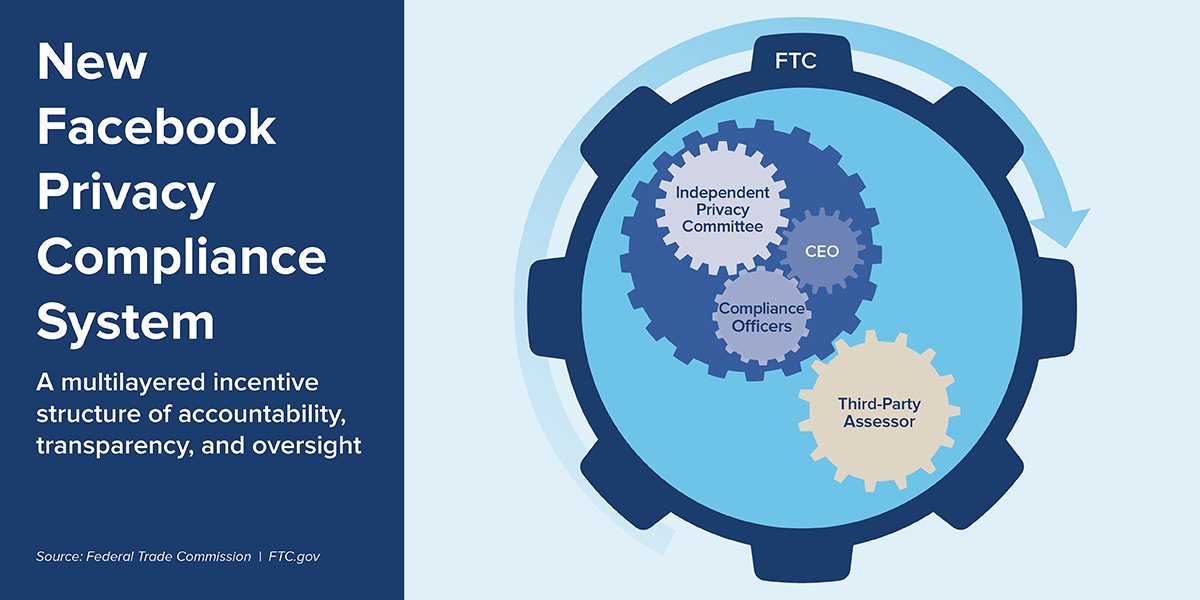
Serge is exactly right. It seems pretty clear that the FTC has sold out to Facebook with their slap on the wrist. Sadly, this does not bode well for their work on antitrust.
Quoting a tweet by @v0max ↗
♥ 3
Excellent news for those who seek to understand how modern British conservatism came to be: @C_Berthezene's "Training Minds for the War of Ideas" is now available in paperback!
♥ 1
It's hard to disagree with that!
♥ 2
They are strange animals.
I think toddlers can figure out how to catch you off guard in any context.
♥ 1
This needs no comparison to be excellent, but I nevertheless feel compelled to say that it is SO much better than the article that initially annoyed you.
It makes me wonder what a jeu de paume meeting in today's America would look like 😁
♥ 1
The majority of those renewables are polluting, like biomass burning.
Hey folks, how did we not think of this earlier?! @GOPLeader has this AMAZING idea to solve all our privacy issues: it's called "The Blockchain!"
Is it not great to have elected leaders who aren't woefully clueless about technology? What an incredible and bold proposal.
Quoting a tweet by @PrivacyProject ↗
♥ 2
It’s not racism if it happens on a distributed ledger, Dave.
♥ 1
You think? :)
♥ 1
You're right I'm sure, I often get a bunch of first-degree RTs when making fun of the blockchain 😀
“Foolproof” is a dangerous way to think about it, too. It doesn’t need to be foolproof to be safer. I would wager that a confluence of image and comments analysis, and engagement patterns could drive human moderators to problem content fast.
♥ 1
I don’t even…
I'm not convinced that this is an issue forever. They will alienate some of their users if it becomes costly enough for them not to act. We're overdue for an overhaul of Section 230.
♥ 2
Wait, I'm not sure I follow? If they get penalised in a few major markets for harbouring unsafe content, would this not have an effect?
To wit: look at how effective they've been at eradicating porn or in fact anything remotely sex-positive.
♥ 1
I will blame my being French for my lack of clarity 😁
♥ 1
Odds are I'll be at the event, but LMK if you want to drop by The Times.
♥ 1
Following the reference shows just how unfounded it is: "Another potential mechanism increasing bargaining power for women is the increase in privacy, given that the transfer was less observable to other household members."
I mean it might be true, I can imagine a case for it, but in Suri 2017 it's clearly a speculation.
Oh dear. I never knew it, yet have desired this forever.
♥ 1
Are negative Mars results that strong? I thought there were a few results showing CML to happen relatively easily.
Related to incuriousity but I wonder if the hard step isn't actually the transition to cultural evolution.
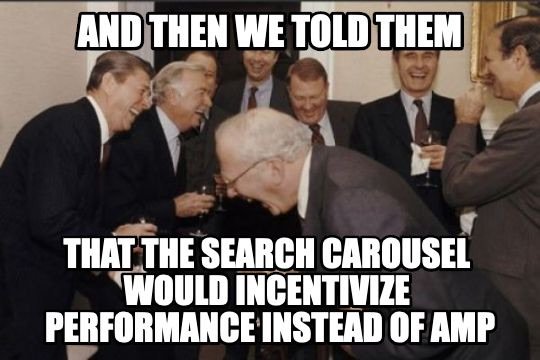
The #ESCAPE workshop, which looks at issues of content aggregation for publishers, is taking place tomorrow. The stakes are AMP, content distribution, and major changes to the architecture of the Web. So, you know, the small stuff.
Positions here: iab.org/activities/wor…
♥ 7↺ 2
There are quite a few strong positions for the #ESCAPE workshop, but if you read only one make it @triblondon’s: trib.tv/2019/05/28/cak…
♥ 2↺ 1
I don't think that's Andrew's point, but I'll let him comment.
Maybe some of us care about those countries enough to want to avoid having their democracies run off choices made in the Google search carousel.
♥ 4
Fair, but it might clarify the role that those entities are playing in the discussion. If the *only* goal being discussed were improving access where it needs to be, I'd be all in. But there are other issues, as I'm sure you know.
♥ 2
I don't know, honestly.
♥ 1
It's basically what's been promised for AMP forever.
Thanks, haven't read that one, will give it a shot.
Note however that AMP being useful to anyone other than Google Search is not a well-researched conclusion either (that I've seen). The Internet Trap, by @MattHindman has some details why.
I feel seen.
♥ 2
That's not how you spell it 🙄
♥ 2
I've been thinking about privacy models to match user expectations that their behaviour on a site stays with that site for a while now; I want to sincerely thank Jay Friedman for naming that the "Vegas Rule". 💯
Quoting a tweet by @PrivacyProject ↗
♥ 4
Except the bit about twitter making people neurotic, I'm pretty sure @can gets the causality wrong on that one.
can
That... I wouldn't even begin down that path. But you don't come to twitter for a sense of balance. None of us do. There is self-selection at work in this population.
"It is even possible that Mr. Trump could win while losing the national vote by as much as five percentage points." nyti.ms/2Y7SdX9
♥ 1
The (excellent) discussions at the #ESCAPE workshop have made me wonder: if you're using AMP, and you would definitely still be using it if the Google search carousel didn't force you to, would you mind sharing your use case and experience? Thanks!
♥ 3↺ 2
OK, but that doesn't seem to require AMP so much as good practice, no?
Sure, but aren't there better ways to get there than to force people?
Sorry, but I'm not sure I follow the indirection. If we want a battlefield resilient web let's build that. That's a use case. What you're describing isn't a use case, it's a side effect of coercive systems such that the trains run on time.
♥ 1
No, my question wasn't rhetorical but I haven't heard an answer. Very few people use AMP components because they like them, that I've seen. If the idea is to look for high-level components to standardise, there's a whole world with far more (intentional) traction.
Interesting. Do you have examples? How do they do retargeting?
Foreheads are the best, pity those without!
♥ 2
I'll admit that "let's make a Constitution but one that ONLY works on virtuous people" is not a political philosophy that I was previously aware of.
♥ 1
You can do it right, too, by only listening when the "voice" button is pressed. The old Star Treks actually had it right.
The conference programme looks insanely good as well, so far. Not at all jealous.
♥ 1↺ 1
Fair, but that need not be the default.
Congratulations to all of you, lots of ♥!
♥ 2
Perhaps the only person who can make #Brexit any worse now will have the means to. Surely there has to be a bottom to Britain's pit, right?
nyti.ms/2LBnWKf
♥ 1
I love the intent of this bill (thanks!), but I have questions (some of which may be for rulemaking):
• What is the status of IP addresses (which can be used to locate but are necessary for connection) and of WiFi identifiers (which aren't location but can be used as such)?
♥ 2
• Whose responsibility applies if an embedded third party not controlled by the app (or site) carries out the sale and collection? This can happen with ads, SDKs, etc.
• The terms can seem to exclude laptops and web sites — is that the intent?
♥ 2
• Why exonerate the operating system? Android collects location for Google continuously. digitalcontentnext.org/blog/2018/08/2…
At any rate, many thanks for pursuing this!
♥ 1
If you're a privacy nerd looking for @JustinBrannan's NYC bill to ban the sale of mobile location data, you can find the details here: legistar.council.nyc.gov/LegislationDet…|
♥ 20↺ 7
Of course, it's in @nytimes if you want a gentler introduction: nytimes.com/2019/07/23/nyr…
♥ 4
Aram, you probably want to see my questions in
I love the intent of this bill (thanks!), but I have questions (some of which may be for rulemaking): • What is the status of IP addresses (which can be used to locate but are necessary for connection) and of WiFi identifiers (which aren't location but can be used as such)?♥ 2
♥ 2
Totally do it!
But that doesn’t hold if new facts are uncovered, right?
Sure — but there’s a difference between it being possible and it being ruled out.
It looks like Facebook somehow managed to bury the announcement of a new data breach under the announcement of the FTC settlement, while the Mueller hearing is one.
Masterful.
Quoting a tweet by @WolfieChristl ↗
♥ 10↺ 5
Thoughtful considerations about unethical lawsuits in the accessibility space, I wonder what we could learn from it for a privacy-related private right of action.
lflegal.com/2019/07/ethics…
♥ 2↺ 1
I watched the first thirty minutes of @netflix's new sci-fi show "Another Life" so that you don't have to: dreadful writing, casting made by an Instagram influencers agency, and the fake science is beyond cringeworthy.
♥ 1
Yes — I really like how @Skye_Cleary writes :)
♥ 1
I'm actually quite surprised it even got produced, it's bad enough that it must have been obvious early on.
I agree with @baekdal that publishers shouldn't worry about Incognito. People who use it to circumvent paywalls weren't going to subscribe anyway.
Claiming that Incognito is about privacy is stretching it, though. It's not. It's Privacy Theatre.
Quoting a tweet by @baekdal ↗
♥ 14↺ 4
Google is only closing the Incognito loophole (and having its evangelists make noise about it as if it were a big win) because they're desperate to make it look like Chrome cares about privacy.
♥ 2↺ 1
If you want privacy don't use Incognito. Use a browser that isn't designed around Google's business model.
Think I'm exaggerating? You can count the ways: google.com/chrome/privacy…
♥ 5↺ 1
is right that people care, though, and that publishers need to do more. They are scared: I've heard some smaller publishers worry that Google would stop working with them if they supported the CCPA. But that's all the more reason to act.
♥ 2
The GDPR reasoning in the article is a little too simple. What the WaPo is doing was found bad by the UK data authority but OK by Austria's. There is no consensus.
I think pay-for-privacy is a bad look, though.
(Also, for the thousandth time, GDPR isn't about consent.)
♥ 2↺ 1
So let's not worry about Incognito but let's not give Google any credit for faking it and trying to convince people that the browser they deliberately engineered for surveillance helps with privacy.
After all, the primary reason people feel they need Incognito is... Google.
♥ 7↺ 3
There are six legal bases, consent is only one!
Right - I agree that people use Incognito because they *think* it improves privacy. But the fact is that using literally any browser other than Chrome will do much more for your privacy than going Incognito.
♥ 3↺ 1
People get profiled as pregnant not just from reading about pregnancy, models can infer that from unrelated signals (as in the Target case). Using Safari, Firefox, Brave can help prevent that. Chrome's purpose is to enable it.
♥ 1
Oh sure, I can't really disagree given that that's literally my job.
But we can't get there without a solid understanding of privacy. Incognito shows that people care, I'm just pointing out that it's a make-believe solution.
Same! It's a much better experience of the web.
♥ 1
It's not over yet.
Right, they've told me that they don't like my argument that user agents can be data controllers because it would put Siri in scope.
Well yeah. That's kind of the point.
♥ 5
Will there be video and recordings?
We thought that competition stemming from the reputational risks and the (supposed) ease of taking your business elsewhere on the net would address that.
And to a degree it worked (while there still was competition), but as a governance model it was abjectly naive.
♥ 3
But @GreatDismal had it!
♥ 2
It's very easy for people to subscribe, too. I don't really see what the population is that understands the value, has the money, but chooses to actively circumvent.
♥ 1
Science publishing badly needs a future; quite a few steps to like in here.
Quoting a tweet by @mbeisen ↗
♥ 3
I'm all for sustainable and purposeful businesses, but the idea that Marmite doesn't make the world a better place is clearly insane. #SaveMarmite
Quoting a tweet by @went1955 ↗
♥ 2
Kill The Poor, by the Dead Kennedys is always an interesting choice, even if the disaster is deliberate! m.youtube.com/watch?v=sgpa7w…
♥ 4
Je lis l’arrêt “Fashion ID” et je ne comprends pas bien pourquoi le navigateur n’est jamais mis en cause: dans la transmission que décrit la cour, c’est une partie qui détermine indépendamment le traitement, sans contrôle de l’utilisateur. (curia.europa.eu/juris/document…).
C’est encore pas trop mal; non pas que j’ai fait ça souvent mais quand j’ai reçu la notification pour mon dernier article paru j’ai mis bien cinq minutes à me souvenir de ce dont il retournait…
♥ 1
Oui, mon commentaire se plaçait par rapport à la moyenne — aucun doute sinon que le domaine de la publication scientifique doit être démantelé jusqu’aux fondations, brûlé, salé, enfermé sous caisson, puis entouré de message de la Human Interference Task Force.
♥ 1
Great writing, heartrending stories.
washingtonpost.com/lifestyle/maga…
Yes, I, uhm, same question, please.
♥ 1
This is the kind of quality content that we come here for. (via @histoftech)
Quoting a tweet by @BrianMFloyd ↗
♥ 6↺ 2
This is amazing, thank you.
♥ 1
For anyone?
Looks like they shipped AMP for email.
I'm not a big fan of AMP, but HTML email is such a mess that it's good that they're trying something.
“Linked Research on the Decentralised Web” — a great example of how a PhD thesis does not need to be in a dead, meaningless, graphics format like PDF or LaTeX. That’s the direction of travel!
Quoting a tweet by @csarven ↗
♥ 10↺ 5
Excellent use of interactivity to describe a grim situation. nytimes.com/interactive/20…
♥ 5
Funny, I wonder how come they haven’t thought of that one.
♥ 1
FFS the new @Twitter camera experience is such a confusing crock of shit it's hard to understand how it could ship.
♥ 2