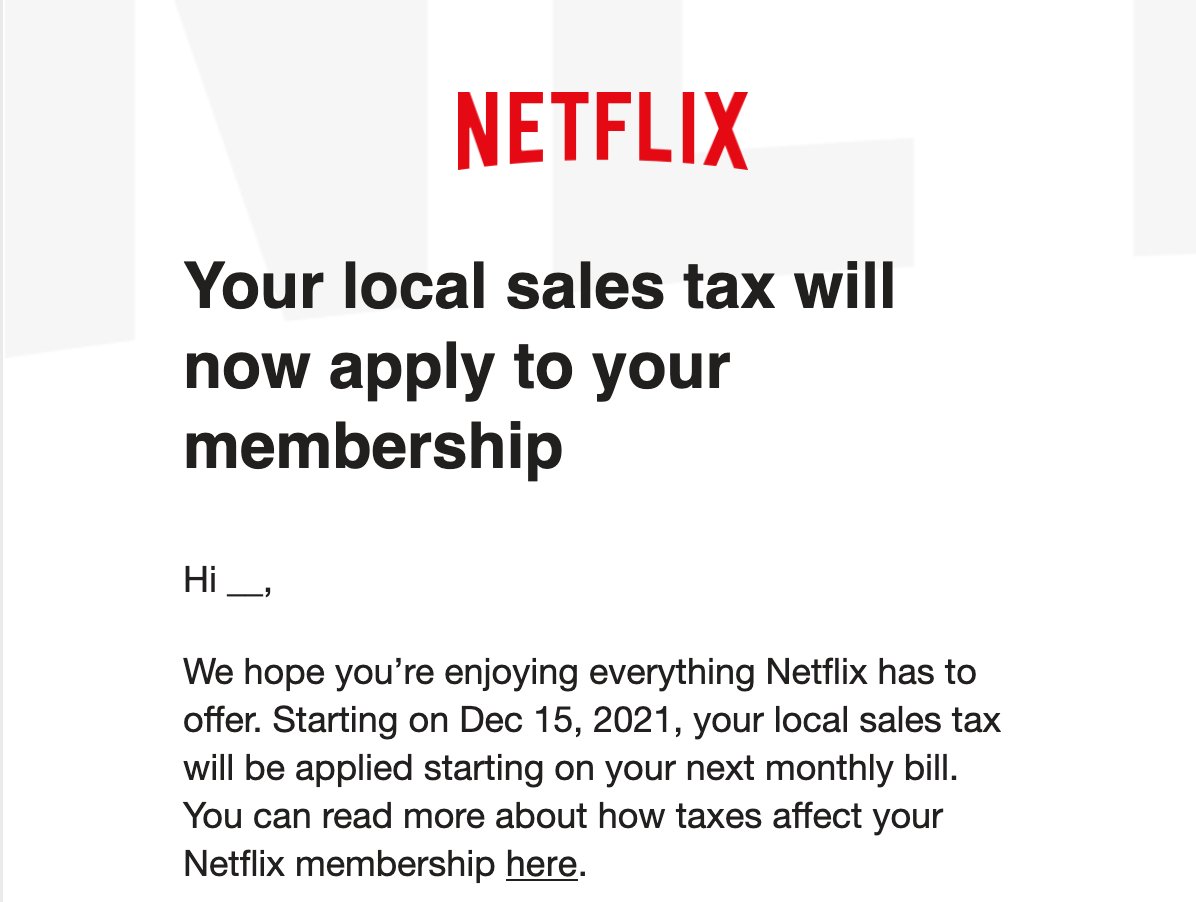
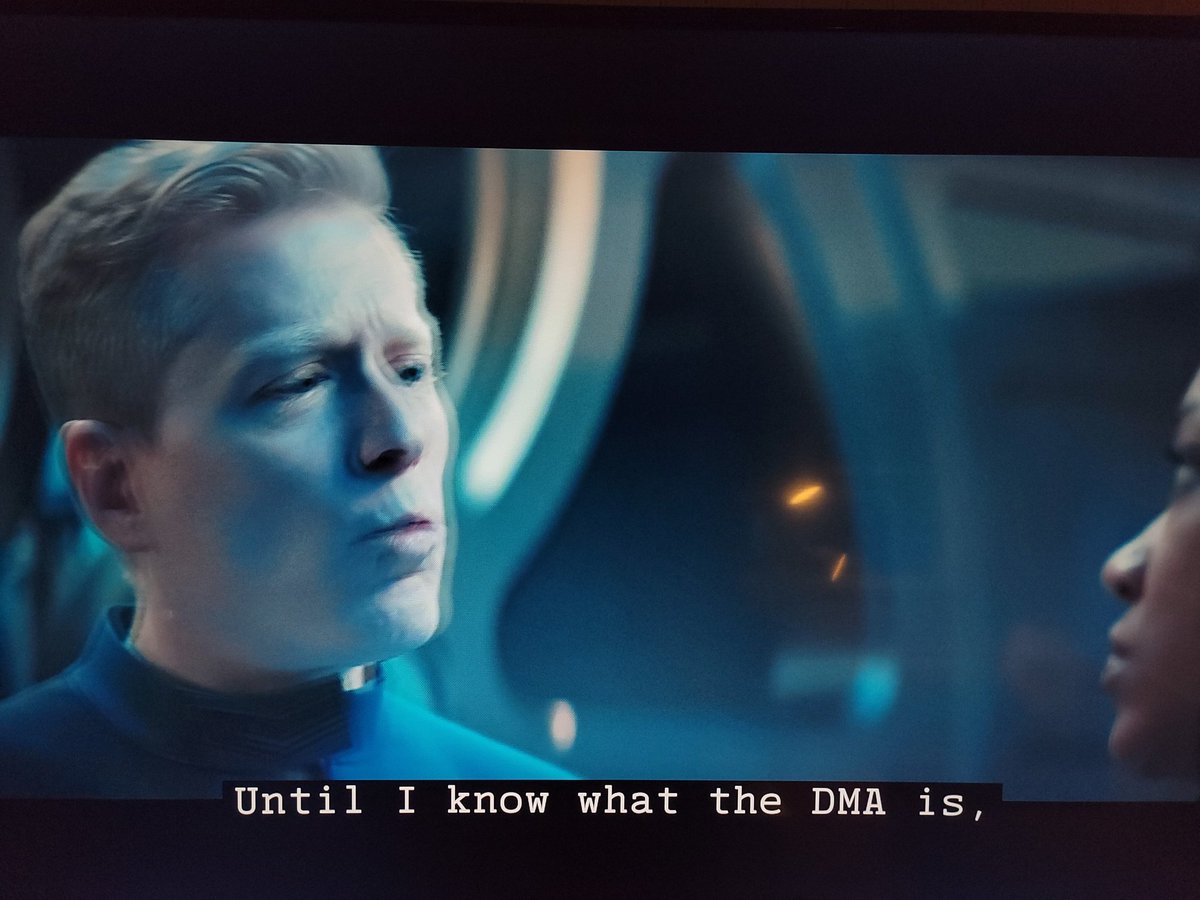
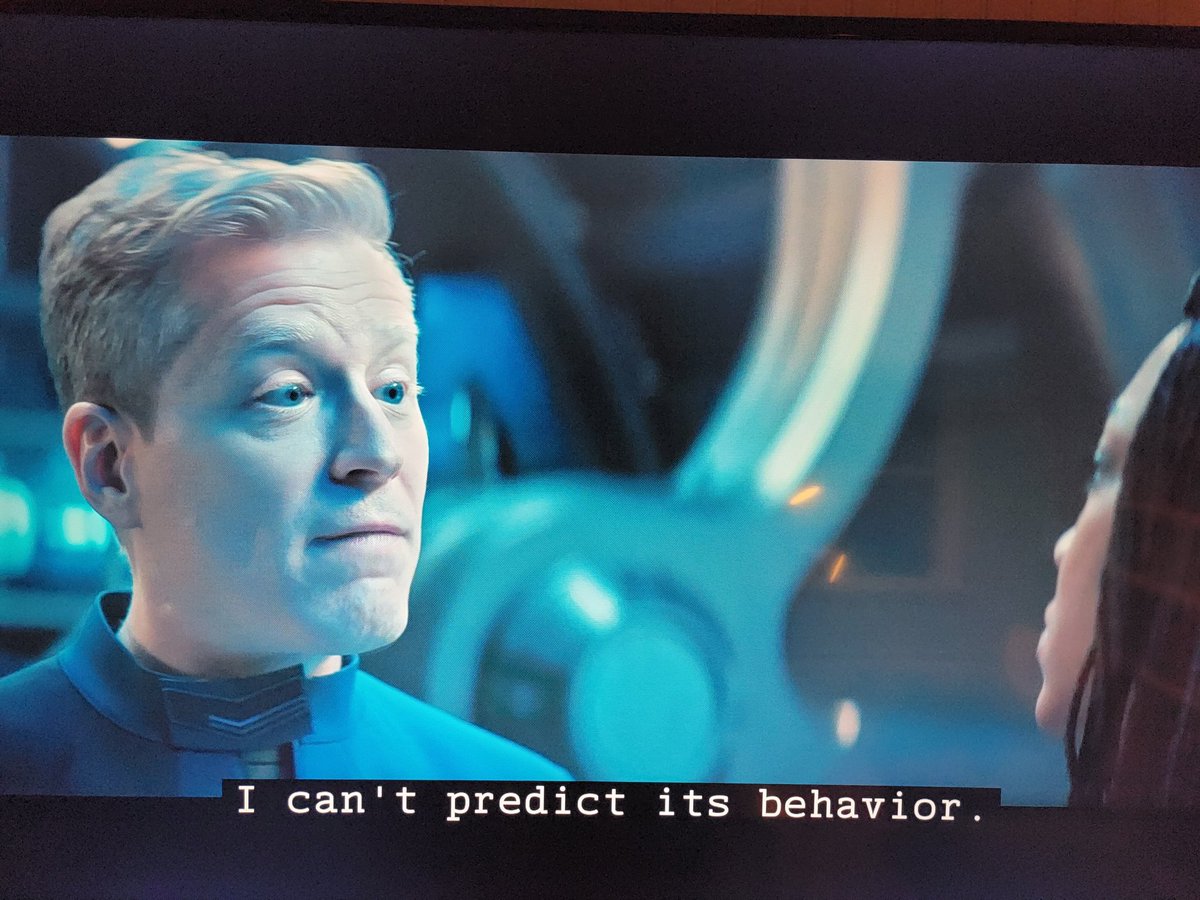
To anyone who feels bad after putting an embarrassing bug in production, just remember that it happens to everyone. Here we have @netflix blasting the classic "Hi NAME_VARIABLE!" out to no doubt millions of users.
Le CA des GAFAM est de l'ordre de 1000 milliards d'euros par an. 1 milliard d'amende étalés sur 3.5 années de RGPD, ça équivaut à deux heures de CA.
Et l'idée selon laquelle leurs comportements changent est une vaste blague pour quiconque doit travailler avec eux.
Web people! I have a question for you. The WICG has existed for a little over 6 years now. How do you think it is doing as an institution to help democratise Web standards?
The reason I'm asking is this: it was created to make access to the standards process easier for developers, with the explicit hope of balancing some of the power of browser vendors.
I hoped to build a polity of web devs who get real-world problems better.
No such polity has emerged, that much is clear, but the WICG could still be useful regardless. I'd like to hear from people if they think that's the case, if it should be changed in some way, or if we would be better without it.
Be candid! It was meant *for* you.
(I will return later to how naive it is to think that opening access is the same as democratising and that decentralisation eliminates the concentration of power. In the meantime, you can make fun of 2015 me to your heart's content!)
You mean that there exists a small group of people such that it works well for them, or that it works for specs that only interest a small group (each)?
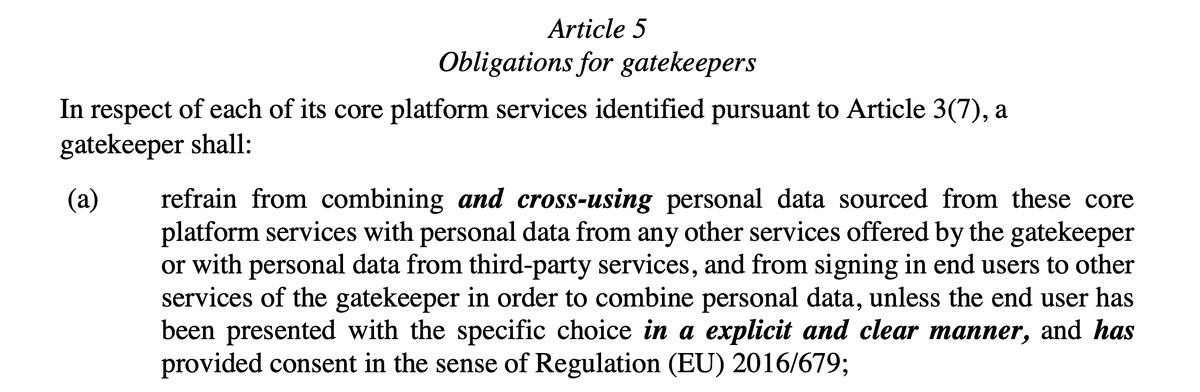
I'm re-reading this part of the DMA, and frankly it makes no sense whatsoever. This kind of cross-context data sharing is bad for privacy and for competition.
Competition is a *collective* issue — why allow the individualistic pathway that is consent to undermining it?
Care to expand a bit? Google services selling data to one another probably accounts for most of the world's privacy violations, so if that gets effectively prevented it's pretty good, no?
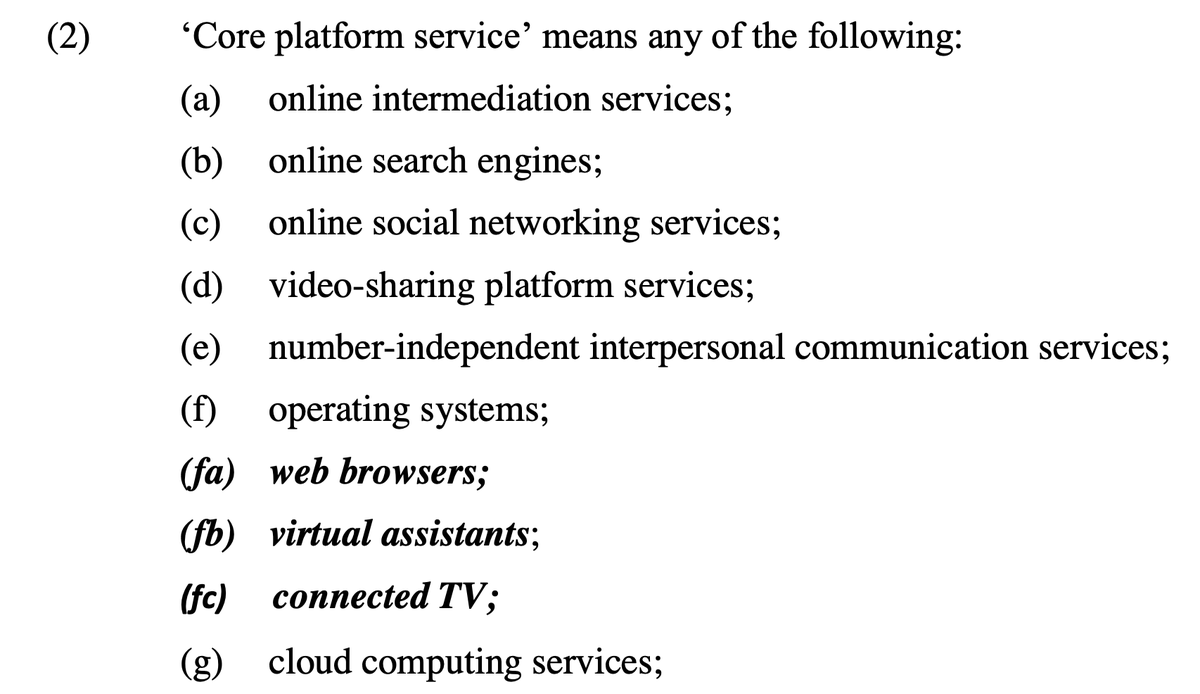
DMA friends: rather than making amendments to list every single type of user agent I would suggest defining what a user agent is in general terms and applying the rules to that. There's a lot of good we can do from understanding and specifying the roles of user agents!
On this specific issue, I don't. Part of the issue is that the Web is completely captured right now, so the value of developer participation is very low. Either you work for Google or your voice mostly doesn't matter. Hard to build on that.
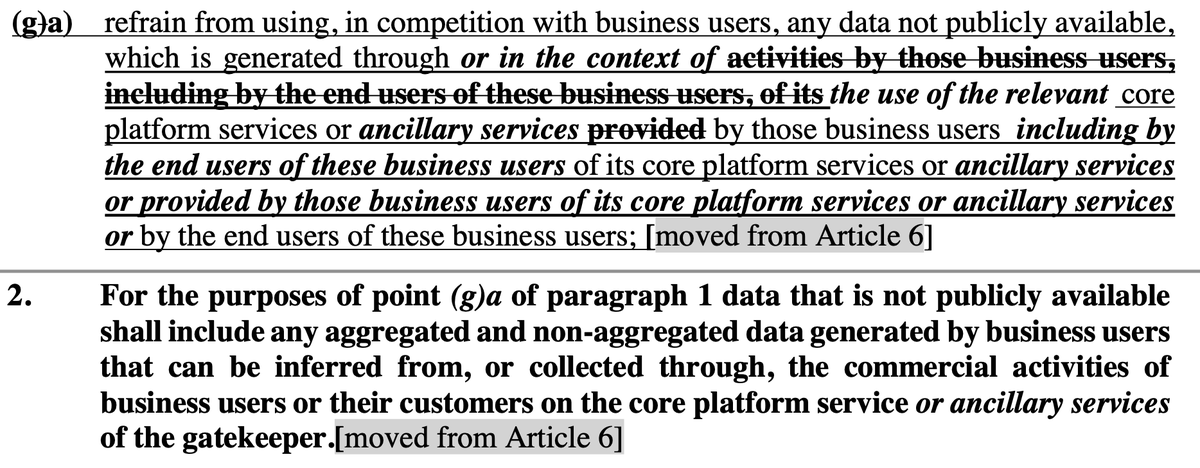
Question for DMA experts: this reads like it outlaws leveraging user systems to appropriate trade secrets, à la Chrome Sync. Do I read it right? If so, it seems that the DMA will bring big privacy benefits on top of the competition value. (From Am.E but mostly there prior.)
I'm not sure that this is required for consistency with the GDPR, though? Like, you wouldn't make insider trading or economic espionage based on personal data legal just because subjects consented to the processing!
What I recall as the goal was to do what the RICG had done — build and ship developer-driven specs when vendors largely wouldn't listen — across the board, continue the NextWeb work, etc. Removing browser vendors from the critical path to innovation was a big topic.
That entirely depends on how the stack is built and on what we consider the scope of web standards to be. There was this "Extensible Web" movement at some point that sought to make it easier to build things (that could be standard for other reasons) atop but without browsers.
Also, non-browser standards have been left by the wayside for way too long, which has contributed to only a fraction of the Web being standardised and entire areas (search, social, chat, etc.) left open for enclosure.
You can't remove browsers from the *eventual* path but you can remove them from the critical path. A lot of the ideas back then had to do with proving viability/populatiry with polyfills, the idea being that you can't argue with widespread popular usage (à la RICG).
We don't know because it didn't work (or hasn't worked yet, for the optimists). A typical example would be markup that's standardised so as to be useful for interchange (eg. with authoring) but just uses Web Components and so doesn't need browser support.
I'm sorry Jeffrey but all they did was learn from Google that hounding users into switching and using the browser UI for business objectives is fair game. You can't show that playing dirty works and then complain that it becomes the norm.
SSO integration and the cleartext Sync funnel come to mind as pretty clear examples? Using the tab restore prompt to get people to opt into telemetry also raises questions.
Yeah, I didn't mean to imply that it hasn't worked at all, but in the context of Alex's question I think so far WCs (for example) haven't seen enough adoption to justify much standard work at that layer, no?
It's really not clear to me that this is user-centric; in fact, the way in which the integration works on Chromebook is extremely frustrating. It also makes users recognised with a single identity across most of the Web which is very user-hostile.
It's a direct competitor to other identity systems, including that of websites, and using the browser to boost an SSO in a way that is detrimental to user privacy isn't great.
Sure — I know that well first-hand. But it helps to acknowledge where that comes from. "Sad to see Edge joining Chrome in gross behaviour" might have been a better way to capture that.
I was focusing on WC because that's a place where I can see reason to build higher-layer standards. I don't see that as easily for pure-JS thing if that makes sense?
Replying to @0x21376B00 and @SharkPatterns, @jyasskin
And in Chrome, no matter how many times you click "Never" when it prompts you to enter the Sync funnel (eg. password save), it will ask again. Passwords are encrypted automatically by default, but to encrypt your behaviour you need a "passphrase," etc. It's not subtle.
Yeah, every time I see this dialog I wonder how far we are from Chrome rebranding as just "Google" and concluding its trip towards just being an in-app browser 😔
En même temps, sur juste le sujet privacy, ce n'est pas Apple qui me fait le plus de soucis! Je serais même tenté de te dire que RGPD n'a pas changé grand chose parce qu'ils faisaient déjà pas mal de choses avant.
It's not just that, it's the idea that design can be data-driven. That's just a terrible idea on every level. Calling upon data so that designers can know what's going on is good; using data to drive decisions is bad for designers, users, and accountability all at once.
Even when it doesn't rain, the sky somehow manages to maintain a deep and heavy shade of gray that feels as if it's close and pushing down on you. London weather is nothing like that!
I don't think we're better off in gatekeeping. Gatekeeping was never about deciding what got published, you could always start a fanzine. It was about what got amplified. We've switched from a too elitist, not diverse group in the 10^6 range to just two gatekeepers. Not a win!
Is there any evidence that it isn't mostly the same people reading online? When I was a teen pre-web, you could read a ton about Palestine in the anarchist, Trotskyist, etc. small newspapers that people made and circulated.
Yes — but get a motorised one, otherwise if you're anything like me you won't do it when you need it most, which is to say when you're a bit low on energy.
There are a few random strays (eg. accept-charset) but the foo-bar convention is normally used by SVG specifically when including CSS properties as attributes. But otherwise colspan, rowspan, accesskey, contenteditable, usemap, tabindex, novalidate… and more!
Replying to @null and @rawrawrmonstar, @matthewcp, @brianleroux
Yeah, and kebab matches SVG — which is still case sensitive — when it conveys attributes meant to be DOM props (viewBox, gradientTransform, pathLength, etc.). So YMMV!
Replying to @brianleroux and @matthewcp, @rawrawrmonstar
Having foobar reflect as fooBar is pretty typical in the HTML DOM, so that'd be neat. Reproducing the data-* behaviour beyond that, I'm less sure about. It has some weird cases, eg. with numbers.
Did it die? I left after it corrupted my data. I switched to @NotionHQ. They don't fix bugs but at least they add features so I reckon they must be alive.
You can plan scale-free structures (eg. road networks, for some measure) but is there any reason to believe that that will (help) produce a complex community? I'm not aware that we've figured out how to engineer complexity yet.
I don't think it proves that the opposite is true, but it does show that it's not sufficient. Put simply: complex system produce scale-free structures, this doesn't entail that scale-free structures produce complex systems. See also:
bookshop.org/books/the-deat…
Hahaha, I love these! I have actually seriously considered buying one. I reckon if I ever get to be a proper grown up i intellectual, I'll have to get one 😁
I think that if you have the login SDK it gets hit no matter what... Preventing Facebook from using SDKs to side-track people is an interesting challenge.
Thank you Braedon!
I would be curious to hear more about your reluctance with respect to privacy-preserving alternatives. Admittedly, it's a big bag, some of which is good and some bad. I can see a whole bunch of issues with FLoC, but PP attribution would seem fine?
Right, I think I agree with the broad strokes of your position, but I'm interested in carving out what works. I also think that the distinction between capture and surveillance might matter here.
There is no state of no influence (other than death), the question is what's OK?
I think that basic retargeting that doesn't share information is fine if it's like: you checked out a product, the site stored an ad (or equivalent) on your browser with rules to show it later, and at some point it gets shown. No one learns, and you are "just" reminded.
But there are plenty of failure modes with the potential birds. I think we need to dive deep and find principles. I hope to do that in the PATCG as part of documenting what "good ads" are. Fun but hard! I hope you chime in!
For attribution, there's a new proposal coming. I think it might hold promise.
For Trust Tokens, I definitely see both issues and value. I would like to take a step back and write down what identity on the web should be (including proving statements about oneself).
Re browsers, I'm more worried about their incentives not being aligned with high quality ad systems since they make no money directly. We might have to fix that but that has other problems...
That's partly true, but there are limits to that approach. It only works so well when repeat offenders also own significant infrastructure, notably browsers and OSs :)
Not necessarily a bulletproof explanation, but perhaps worth considering: porn is also suffering from massive monopolisation. This isn't the crazy innovative porn of the 90s, you can't cut out the middle man if MindGeek isn't driving traffic to you in the first place.
Thanks a lot! I agree, I'm excited to try to figure out how to understand data properly. I think a lot of the right pieces exist, we have to figure out how to put them together.
It's a tough question, we really need a fiduciary regime to back it up. But fiduciaries can spend time making sure they make some money. More generally, we've thought of UAs as individualistic but we need to look out for the Web commons. That works if under collective governance.
It's also one of the most painful features of Google Docs, you have to learn NEVER to autocomplete a person's name, otherwise it turns them into a chip. I've lost good colleagues that way.
Exactly. I don't use it because many of the people I've discovered here who didn't already have a significant platform with one of my communities were from thoughtful replies to hard topics. I wish I could hide bad replies though.
Do you think that the latter could update the former? It's not just that I could eat a leftover quarter chapon with my fingers in yoga pants in front of the open fridge, but I wouldn't feel culturally out of place sharing the experience 😁
A very good summary of the workshop on Social Media as a Crisis Discipline that ran recently. We barely scratched the surface, of course, and I look forward to more.
medium.com/rebooting-soci…
The statement would have been more believable with a picture of an @EU_EDPB group hug :-D
That said, they have a point. When you establish a group as consensus-driven, that specifically means that people are meant to disagree a lot.
Replying to @GerardARudden and @RobertJBateman, @EU_EDPB
Oh, I'm aware — I was commenting on the general idea. It always bothers me when people equate disagreeing with dysfunctional, especially in consensus processes.
The DPC… is a whole other level.
"If there’s ever a future where we can begin to reimagine the internet as a commons, rather than a shopping mall with a handful of big-box platforms that extract our data and our time, building our own network may be a good start." —@aprilaserlogicmag.io/bodies/another…
For all the tut-tutting, web3 is mostly an overcorrection (plus the usual grifters).
We have a web fully controlled by a few megacorporations that seek to intermediate everything, preventing sovereignty & governance. And many useful architectures don't have a business model.
Overindexing on governance and sovereignty, and financialising everything is almost certainly not the solution. But we need to make collectivity and money work. If we play this right, there's a great baby in that murky bathwater.
I don't know if and when we'll get there, but blunt rejection isn't the answer.
In the meantime, I find the overlap between the people who don't see why anyone would be interested in these problems and the people who don't see fault in the current system quite revealing.
I don't know about that. Restricting the Web to browser APIs got us where we are, and a lot of the promising ideas (notably in ILP) are outside browsers.
There's obvious BS to leave out and clear things to include like WebMon, but I think in between it's more complex.
Excellent in-depth research showing that the IAB TCF is basically ignored at scale.
It's time to ditch the TCF and double down working on adtech with effective governance.
I would suggest framing the first one differently. We still don't know what the scope of the Web is, so it seems weird to expect that to be answered for Web3. I'd focus on "what should be done differently, what is the problem space."
What's missing from this is governance models.
There is a degree of regulation that can be done without direct regulatory support. Basic example: you can only get addresses in the `g.rhea` ILP 'hood if you abide by certain rules; if you fail to abide you lose the ability to receive payments
That goes beyond protocols, etc. but ties directly to them. It can be standardised in the same way we standardises processes, registry management, etc.
Other similar things can be back by laws, eg. rights reservation protocols.
Actually, Google's behaviour is key in preventing publishers from monetising. Their approach to ranking (and search monopoly) means that publishers must do significant Google-specific work (eg. AMP) in order to get traffic. AMP CPMs are very low and there's no header bidding.
The model in which a search engine indexes content in exchange for driving traffic was nice; it's also dead, and trying to understand the digital economy from this perspective is bound to fail. Systems like AMP or Showcase keep pushing for greater intermediation.
Publishers are essentially being pushed out of their relationship with readers, simply because one party has excessive control over discovery. This drives revenue down, which makes pubs more dependent on traffic, which means they can't negotiate revenue terms, etc.
That's an entirely outdated understanding of how it works. With AMP or Showcase, the content is entirely served directly by Google. The publisher is never visited or involved.
As you so eloquently put it, publishers are not compensated for AMP.
As Hal can explain, Showcase pricing is at the kind of level you can expect when sellers make a deal at economic gunpoint - and that's before factoring in discounted future value of direct relationships...
On top of that, I would add that involuntary participation is a good indicator of underpricing. I'd also recommend reading the @Adlc_'s work on Showcase if it has been translated.
Two years ago, @netflix: Hey, we know everyone hates autoplay video even though it fakes engagement numbers SO GOOD, so there's now a convoluted process to switch it off, if you must.
Everyone: Yay!
@PrimeVideo: Good news! We'll now ram autoplay down your throats too!
Oh, I'd forgotten @YouTube still had videos under their "SIGN UP NOW" prompts!
Everyone's gotta fake their numbers the same way I guess, otherwise the SEC might do something about it.
I think either they get the same kind of publicationworthiness and fact checking as news, or they should be junked as just something that you can get free from randos on the Internet. I think there's real value there, but it has to be ruthlessly high quality.
Hmm, I'm not sure what examples you have in mind. I was thinking about that guy who wrote all that nonsense about Kant being antirational or some choice columnists we have. People who'll say random stuff with no intellectual rigour.
True, but that's actually something that I think would make sense. "We put as much care into making sure our opinions aren't BS as we do with the report" is a promise I'd listen to, specifically because rigorous opinion is hard.
The entirety of UID2 is predicated on having a governance structure that could prevent participants from mapping the hashes back to emails when they're not supposed to. All the crypto in between is useless without that part and... last I looked, it was still TBD.
I'm not a podcasts person but I need to entertain a family for a drive. Any recs for history or science documentary podcasts, preferably not sensationalised things (eg. not like American TV documentaries)? Needy is good, my kids are used to it. Thanks 😁
Not at all, I very much enjoyed it. I felt it did the much-needed work (for me) of putting many privacy ideas in a better order. I've started rewriting stuff already 😁
Don't Look Up is painfully real, written on a knife's edge between rage and hilarity that it then stabs you with.
And small detail, but the lyrics to @ArianaGrande's song in it are lit.
youtu.be/X6SuW5HhQoc?t=…
Reach out to people you think are interesting or might be interested in your work and ask if you can have a zoom call. It doesn't always work, sometimes people are busy, so don't take that personally, but you should get some hits.
What terrifies me is here is that I don't think that Notion particularly encourages this. It doesn't feel like this comes from the app as any manner of coercive structure.
I've been meaning to read more fundamental texts and Ellul is on my list, but I'm unsure where best to go. Any recommendations? I'm looking at L'illusion politique and Le système technicien.
The way you describe it confirms my feeling trying to orient myself in his work, which is that it seems hard to get into some of it without pulling the whole thing in.
I guess I can just make one big list of all his works and rank them with life-improvement points 😁
I saw! I'm not usually into theology, but I stumbled across "le christianisme, envisagé dans son rapport à la politique, dispose à l’insoumission, à la dissidence, à la récusation même de tout pouvoir" and it made me curious about that too.
Thanks, I'll check that out!
There was nothing good five years ago when I looked into the same issue while at science.ai. Sadly didn't get around to it. The fact that GitHub adding copy to all code was considered amazing gives an idea of the state of play!
Completely selfishly, I would be very interested in papers about factors that prevent the emergence of collective intelligence. It's a concern I have (see berjon.com/stewardship/) that I wish to understand much better.
There is nothing technodeterministic about this. Sure, governance is another option, but it would have to be accountable and collective. Otherwise it's just an intermediary holding data on a pinky promise. It's just like the Chrome problem, that's not governance.
I see what you read, but my RT was about trust. Governance is also a way not to need to trust a given entity, the idea being that there are checks and balances to compensate for the vulnerability.
The really funny part is that there is a company out there (can't recall which) that sells stripping that as a service. They have a whole website about unifying identity and all.
To complement what Max said, browsers can't tell which cookies are essential and which are not. (Or more precisely, where it's possible to tell, most browsers that aren't Chrome will already block them.) That's why we need regulation of the kind Max points to.
We also need some sort of social consensus as to what "essential" data processing is. That's actually a tricky question, though we should tackle it if we want an online that doesn't suck.
Replying to @MaxGendler and @alextcone, @Chronotope, @harrybr
It's altogether too often understood to mean the strict minimum necessary from the view of just one participant. That's not the best starting point but it's where approaching privacy through individualistic ideals like "consent" naturally leads!
I think this is both true and slightly unfair. Participation in governance needs some form of stake. It's often based on things like "living there" where the stakes are clear (or would be if we had fewer nationalistic morons to contend with).
I totally get the thought that, hey, if we have something monetary, we can use that as a stake to anchor governance from. It's IMHO wrong, but it's not stupid.
The heart of the problem is that we don't see that we have a huge stake in our online lives because we don't own them!
If we remember that we should own what we share here, that we should be paid for all that we create, that we should decide what gets recommended to us in search and social, etc. then it's obvious that we live here and that is reason enough to deserve voice.
Because infrastructure ought to be governed as a commons, it's the only way. Collective cognitive infrastructure just as much.
Anyway, I could rant for a while. Bits of blockchain can be useful, but it's not cryptocurrency that we need.
I think that the debates around crypto are obscuring the fact that we do need better monetary options if we want to keep data from being the chief currency. But that should be very very separate from governance rights!
Reading legal docs is fun! Also, I find that once you get used to the formalism they get faster to read. And having an understanding of the subject matter means you see things the lawyers couldn't guess.
That's true for templates, but what I have in mind goes deeper and I suspect it's enough second nature to lawyers that they no longer see it. I'm thinking of the essential components of contracts, eg. terms, or-else clauses, etc. It's similar in that to standards.
Right, we have the same for standards (defaults must be specified, errors must be handled, etc.). I think an intro to those things would do me a world of good.
I'd suggest just reaching out for a chat to those whose work intersects with yours. I've found these exchanges amazing, and I get a sense that they also benefit from the ability to ask about what we know industry-side. I wish I had time to do more of these exchanges.
It's worse: the protection system in iOS shows that they *did* think of the ways in which it could be abused, devised a highly imperfect mitigation, and shipped anyway.