"Hostage" sounds like it's necessarily bad or at least does more harm than good. That's quite a bias to start from! Yes, it probably means that we regularly fail to improve *individually*, but are the social trade offs bad?
Imagine the level of individual expertise (and the time, even for experts) required to properly evaluate a paper of any useful complexity. Deferring to a community has benefits. Avoiding the pitfalls requires good societal properties: diversity, and equality.
(The former for viewpoint variety, the latter to avoid the distortions from power in epistemic democracy.) There's a good treatment of some of this in "Bad Beliefs" from Neil Levy, and related contemporary concerns in berjon.com/stewardship/.
Agreed, the issue is in the gap between our expectations of epistemic individualism and reality. Addressing that issue is certainly difficult given how deeply anchored it is, even when knowing that it doesn't hold.
Did you know about this overlooked French delicacy, "le hot dog américain"?
Half a baguette, a frankfurter, Dijon mustard, and melted cheese. Let it cool down and dry up a bit, then microwave to within an inch of its life. Yum!
Objection: this is from Lyon, the staple there is offal, they eat andouillette, and babies get crushed blood sausage in their bottles. It hardly counts as French.
I'd totally eat that, though 😁
I don't actually think that it's a boil the ocean approach. Je makes a good case that we need to be ambitious, and that it's possible. (Read the book!) It's interesting that Piketty is basically saying the same thing.
Totalitarians and corporations (esp. tech ones) have postnational plans of truly global scope. Unless the democratic, egalitarian folks do too, we won't even show up for the fight. (Arendt already made that point and she was right.)
Because it's just not part of our imaginaries? I see the same problem in advertising, media sustainability, search quality, etc. People have all kinds of proposals to layer rules (mostly restrictions) atop the existing system, but never seek to shape the infrastructure.
It's kind of maddening. I think it's part tech determinism, part that the infrastructure is complex and invisible, part that the people who understand how valuable it is to own the infrastructure are paying think tanks to look for solutions everywhere else.
Does anyone understand why @NotionHQ is the only app in the universe that can't update itself but must instead send you to a help page to fix your installation every other week? Is there a workaround?
Replying to @swodinsky and @catthekin, @MaxGendler
So, the way I look at that system is more as an inspiration than anything prescriptive. I took the advice but then turned it into something simpler that works for me.
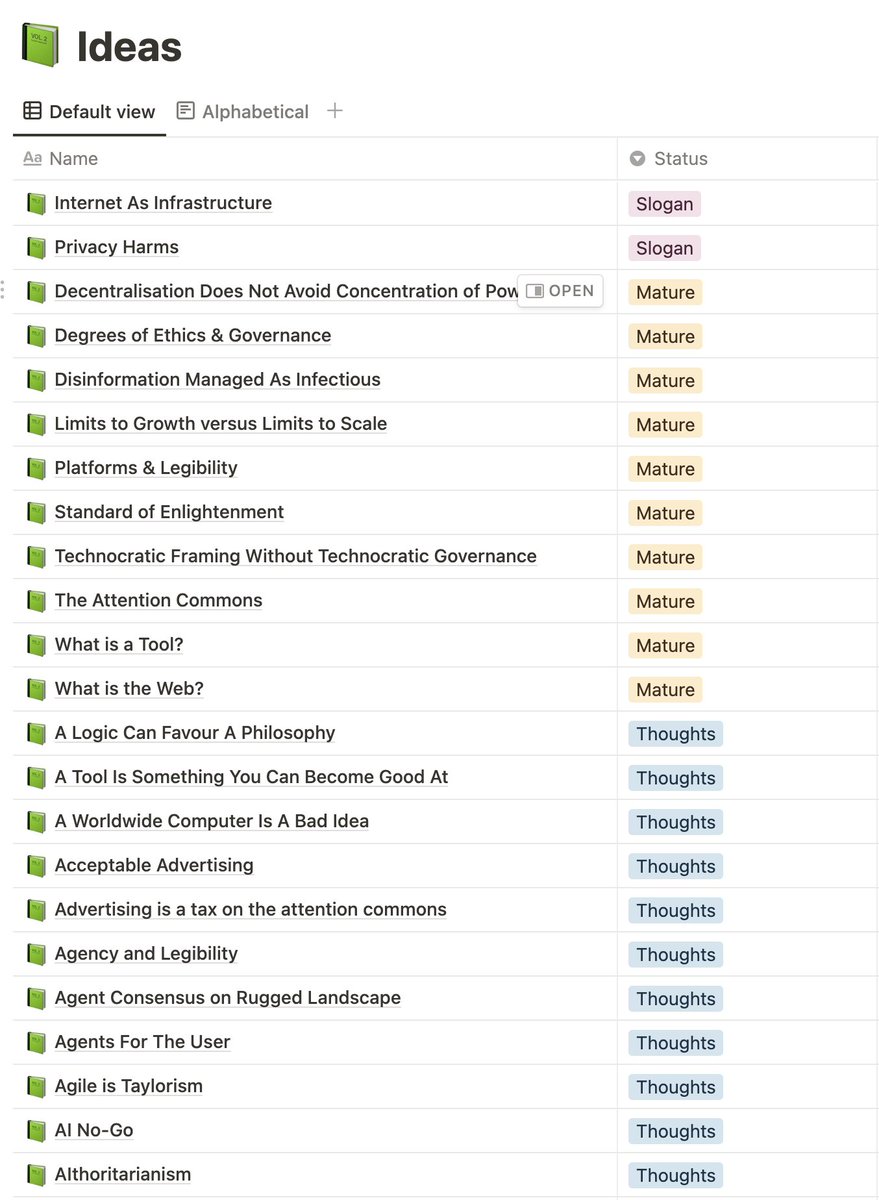
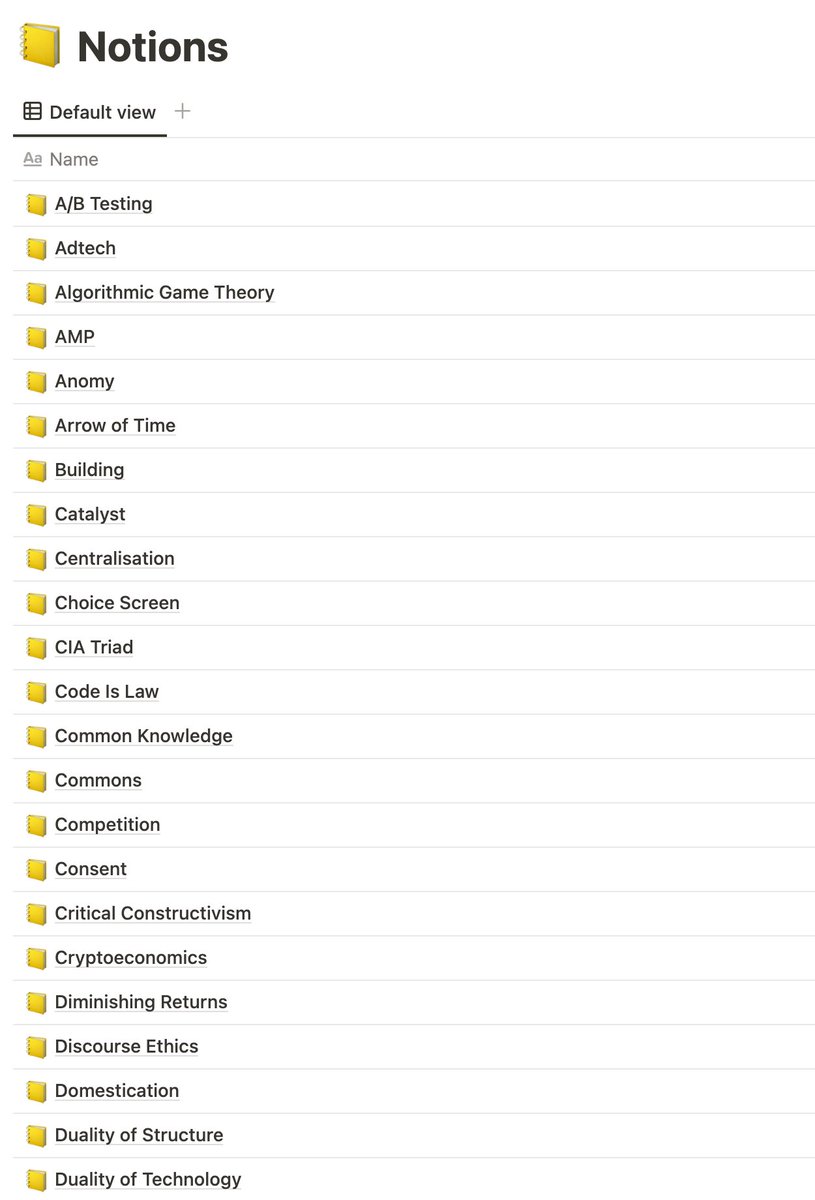
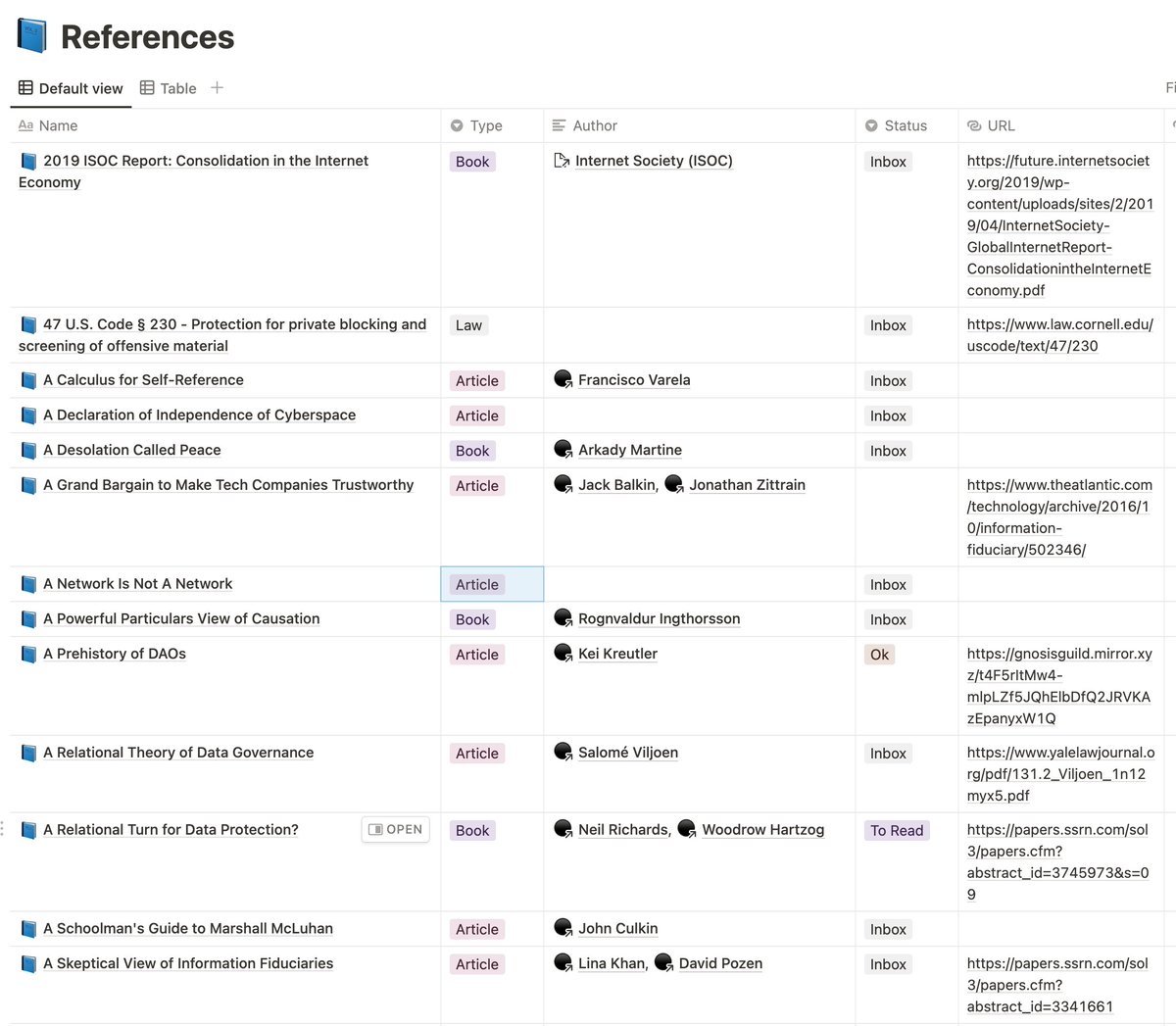
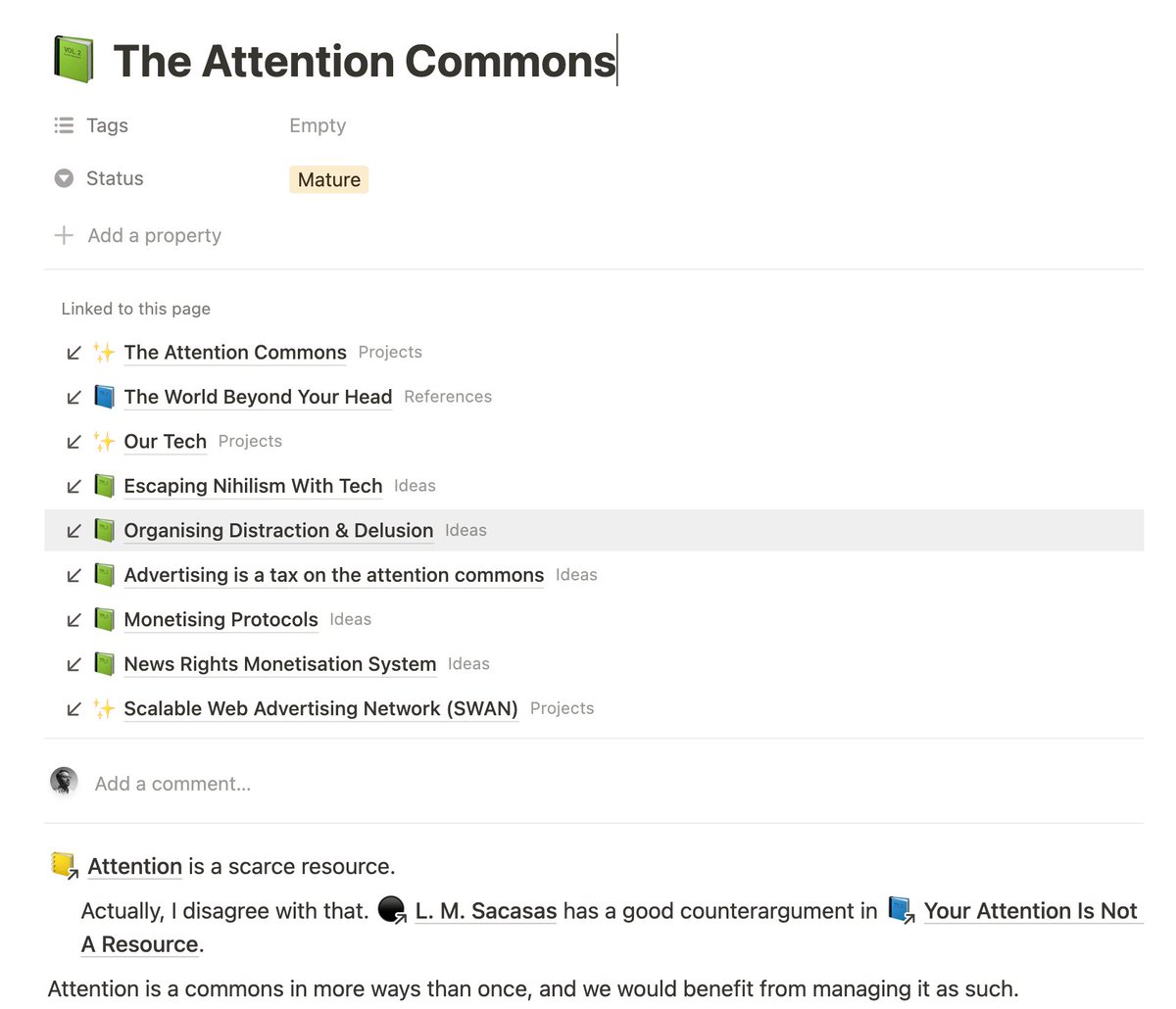
I basically have four types of entries (each as Notion databases, but other things work too).
* People/Companies
* References (books, articles, etc.)
* Notions: these are things that I capture a relatively straightforward definition for.
* Ideas: the opinionated bits that I want to do something with.
Then whenever I write in there I create as many links as possible.
The idea is to later use the links to build up ideas. (A system that lists backlinks helps.) Because the RTB notion is linked to the Butt Flap reference when I'm writing about RTB I have an easy way to remember butt flaps, serendipitously. (This may be a bad example.)
On a very regular basis I get sent to this page: notion.so/How-to-fix-Not…. I asked around me, some people get it often, others not. I was hoping to find a workaround since it's enough of a known issue on your end that you have a page for it.
I'm very interested in the compositionality of agency, I read both Apolito and Shin et al., I'll look at the others so thanks for the links! Is there a place where people discuss this? Even just sharing reading material (there's stuff all over) would be wonderful.
One aspect of interest is that I think that there is an immediate need to understand governance compositionality (which I think is the same problem if large-scale society is a major transition) so that we can implement some of it in software in Apolito-friendly ways.
Replying to @Chronotope and @MaxGendler, @swodinsky, @catthekin
Right, so different people will do better with different degrees of classification. I prefer fewer categories because I tend to shift my understanding of groupings over time and then I confuse myself. I am *almost* regretting separating ideas and notions…
What I layer on top of that is "Projects" and "Blogs". These aren't notes per se, they're where I list related ideas and iterate on them until I have something coherent(ish). berjon.com runs entirely off of that.
The big downside of my approach is that all my reading notes are on paper (see below), so I have to type them in. That's good in that I make a strong opinionated pass but it's painful and I'm about 100 pages behind. I sometimes stop reading for a week to catch up 😔
Replying to @RubSchreurs and @Chronotope, @MaxGendler, @swodinsky, @catthekin
If you're interested, it's been quite a while, but I have good memories of reading "Time Reborn" from Smolin and "The End of Time" for two opposing views on the matter.
Homelessness is likely part of it. A friend of mine worked on a napping booth that could be installed in offices but companies were unhappy that people kept having sex in them, so that's probably part of it too.
I'd like to hear about how privacy is a product question that is being treated as a legal compliance issue and how we fix that.
I'd also want to hear less about companies that enable privacy self-management (they matter, but it's not new) and more about collective privacy.
I think you're on to something with the link you draw between personal life and ideology on this. There's a blurring such that what is locally right must also be globally right, that something can't be good if you can't systematise, standardise, generalise it.
Stagefright is def weird — I get it after the fact, I know that happens to others too. I can more or less casually stroll in front of an audience and give a talk without thinking much about it, and then for weeks I get intrusive thoughts about all that I could've done wrong 😬
I have long had a theory that Gmail is what design interns at Google are given to learn how to push things into production before moving on to team that actually have a product manager.
Most technologies become useful when you figure out how to use them *with* other techs, but with sufficiently novel things people become obsessed with their specific properties and want those properties EVERYWHERE. Blockchains are becoming useful, but as components.
Also, the text isn't about free will. The incentives on hoovering up highlighted there are on businesses! I think that's the right focus.
People are (rightly) mad about period tracking apps, but few seem to ask how come they're *all* this bad. Who made those incentives?
We'll see what the reform brings, but I'd like to experiment with small steps to see if there's a possibility. I think that the TAG commenting on privacy could be one.
I love how they built this article, though it's almost impossible to focus on reading well and understanding while being monitored.
Monitoring supports control, understanding undermines it — you have to choose one.
What we have in mind when we talk of "democracy" tends to be bland, abstract, and simplistic. It's a rich and potent space, we've just grown jaded with a small subset of it.
We need to re-imagine what is possible. Thanks to @divyasiddarth for driving the way forward! 🧵
I might not agree with some of Divya's preferences, but that's kind of the point: the better the means of collective stewardship, the more we sustain a world of rich plural complexity.
And we need to remember that technology can help with that.
Years of domination by a tiny coterie of actors have disillusioned us with the liberation potential of tech. At best we get to speak to Pleasant Bureaucrats arguing that, unlike their competitors, they're the responsible totalitarians.
Mine too — and I got a job out of it! I often wish I could return to Balisage, but it's so often at a time of year that makes it complicated and I have no professional justification for attending. But wonderful event!
Is there a way to follow updates on this work stream irrespective of who writes where what (and catch up on things published elsewhere I may have missed)?
In-app browsers are highly deceptive to people and steal revenue from publishers.
In a just world they would simply die in a ditch, but as a second-best option why aren't regulators cracking down on this with extreme prejudice?
Yes! You could also see balancing tests, constant consideration for rights and freedoms as placing some broad if vague fiduciary requirements on controllers. But I'm not holding my breath for that kind of enforcement to happen...
Absolutely agreed. And it's not like it needs to be highly nuanced, there's no defensible reason for this processing, not even product improvement. It's pure surveillance from unadulterated greed.
I'm deliberately exaggerating (though I don't believe that anyone has made a dump of the data it does collect - it should be instructive). But it's the exact same kind of deception, the Sync UI is entirely built around tricking people into sharing their browser data with Google.
I wonder if it would be possible to argue that Art. 40 gives citizens the right to establish practices (that would need to be validated by the @EU_EDPB of course) when they find themselves confronted with issues on a regular basis?
Do you know that for sure? Also, tricking people into acquiring their entire browsing history is less dangerous but just as deceptive as doing the same for events.
Looking into details and writing them up (along with the beautiful succession of dark patterns) has been on my todo forever, but alas time for fun stuff is scarce.
I think that depends on what the leak is and how the patterns are deployed. We're talking about a funnel of dark patterns, applied in a context with high expectations of trustworthiness, to obtain whole-Web browsing data which is highly sensitive. It's at best irresponsible.
There's just so much overlap between Musk and those parts of adtech in terms of the promise/delivery ratio, it's a miracle that they haven't clashed in the hot air production market already.
Replying to @lilianedwards and @CatalinaGoanta, @RobertJBateman, @MissIG_Geek
One avenue that I've been wondering about is that of economic espionage. Those companies are acquiring nonpublic information about the behaviour of users of other companies' products, often at scale. That's a trade secret.
Sure, but we can't build a security system around good intentions. This thing just shouldn't be possible, even if on occasion someone might do good with it.
This co also be 5G, it can get quite precise. I assume that you aren't opted out of tracking by your operator (likely because they have no legal obligation where you are).
I think that seeing technology, when it becomes infrastructure mediating social interactions, as creating institutional arrangements is different from tech determinism IMHO. Institutions very much shape behaviour and being deliberate there is a net plus, no?
Yes, and I agree, but what I was trying to say was that I think the empathy can be taken further :) I think that trying to build infrastructure that has commons-like governance, even if it doesn't solve all the things, is worth a shot.
And while there is no shortage of naive token/voting governance proposals that are just waiting for plutocratic capture, the web3 world also has far more mature governance thinking and I see promise there!
I think that a lot there rides on the exact institutional arrangement? You can use tokens to reward reliable/interoperable provision but use a different mechanism for governance, eg. human consensus.
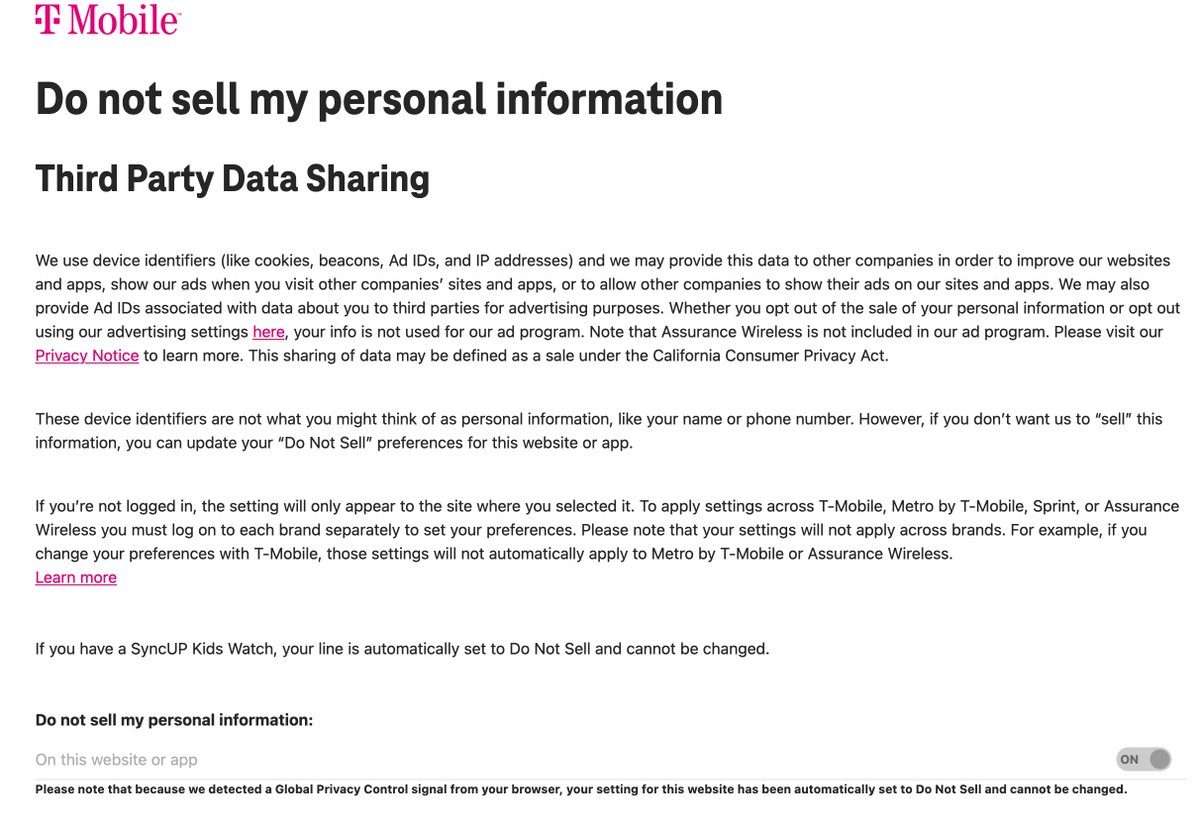
Sephora reached a $1.2m settlement with the CA AG for among other things failing to abide by GPC signals.
Active GPC enforcement is good news for two groups: people and publishers. Some notes for those who haven't been following this. 🧵
GPC is an extremely simple signal (it's one bit — you literally can't get any simpler) which the browser uses to convey a person's rights being exercised, for instance their right not to have their data sold. It's basically your browser hitting "Do Not Sell" for you.
For people, this is great: they get data rights that they can actually use instead of having to jump through hoops designed by deceptive UX lawyers on every single property out there.
Unusable rights aren't rights, and GPC helps a lot here.
For publishers, it's also great! Data is a dysfunctional market (pricing issues, property rights, externalities…) and as organised today it heavily favours intermediaries to the detriment of publishers.
Data governance mechanisms like GPC can help change that.
Put differently, for publishers to just give away data to third parties for wanton reuse in the way that is typically done today is economically irrational. But the way the market is structured now means it's that way or the highway.
The more people use GPC, the more publishers can sell *ads* without selling *data*. This is a major (and underdiscussed) business win particularly for journalism.
So tl;dr: if you like privacy and democracy, you're happy for more GPC!
I think that enforcement works best when it's progressive and gives people some time to adjust initially, work through the kinks.
Part of the problem notably in privacy is how many lawyers out there are giving really terrible advice and then aren't on the hook.
Replying to @swodinsky and @montezumachavez, @alextcone, @RobertJBateman, @Ryanbarwick, @aexm, @atgrote
It depends on reuse rights. If I hand you something that you need in order to provide me with a service but after the service you give it back, that's not a sale. But if I give you something, get a service in exchange, & you get to keep using that thing as you wish, it's a sale.
Replying to @RobertJBateman and @atgrote, @dmarti, @montezumachavez, @alextcone, @swodinsky, @Ryanbarwick, @aexm
I agree that there are issues with the text, but if their lawyer told them that an analytics company reusing data for unrelated targeting purposes wasn't a sale they really need to find someone better.
Replying to @alextcone and @swodinsky, @montezumachavez, @RobertJBateman, @Ryanbarwick, @aexm, @atgrote
The problem is that you need to have a contract to prove that you told the other party that they couldn't reuse the data, or had to honour opt outs. Again, if it's just illegal then no need for a contract!
Replying to @atgrote and @swodinsky, @Ryanbarwick, @alextcone, @montezumachavez, @RobertJBateman, @aexm
This is a classic platforms move. If you want better privacy/governance they will now begrudgingly give it to you but they'll also remove unrelated features just out of spite. Google's limited ads is the same.
It's the business equivalent of how Google punishes people for wanting privacy, for instance when you opt out of web & app activity and all of a sudden you can't have history in Maps. Gotta make privacy painful or people might want it.
Replying to @RobertJBateman and @Chronotope, @dmarti, @alextcone, @swodinsky, @montezumachavez, @Ryanbarwick, @aexm, @atgrote
In my experience, there is a *a lot* of bad legal advice being handed out around this. IAB counsel and friends have been sharing takes that are incredibly far-fetched even for them, and I think some think that if they're less bad than that they're fine.
Replying to @RobertJBateman and @Chronotope, @dmarti, @alextcone, @swodinsky, @montezumachavez, @Ryanbarwick, @aexm, @atgrote
The bit that cracks me up the most is the claim that opting out of sale requires GDPR-level consent. People need to GDPR-level consent to not have their data sold. I also saw a bit about how GPC would need to be manually activated for each site.
I think that depends a lot on your kids? There's drugs and (mostly implied IIRC) sex, which French kids would be fine with, but the violence would be too much for mine. Especially the 9yo.
Infrastructure-wise. Make it cheap and easy to start and run a journal, then start a migration of editorial boards, reviewers, etc. It won't get you Nature, but it can hit a ton of field-specific top journals.
I was also thinking that they don't have to put money towards this, they could mandate open access and cap how much fed-funded research will accept to pay for OA. That would shift the impact factor to affordable journals.
I know, the problem is with reputation stickiness. If you're tenured & funded and you can't publish a predatory OA levels, you're fine — and over time, as the big shots move that shifts impact factors. But while the shift happens, early career folks get lower impact.
It's not just magical thinking, it's how the risk structure is understood. If something bad happens, you don't want to be the person who said "don't buy the taser drones." If the taser drone kills a kid, then it's the vendor's fault. Buying is all upside to the buyer.
Neither of you asked me, but hey it's Friday night! It would be good to find a shared best practice here, but so far the alternatives I've looked aren't great.
Embedding has archival issues (Twitter could die, tweet could suffer takedown). It's also not great for privacy.
Copying can be tricky too, though. It may violate ToS. It could itself be subject to takedown.
Screenshots are terrible for accessibility (and responsive design), and lack the interactive bits that may be useful.
I *think* that a process that would repeat the tweet as if it were a quote made in public, reproducing some of the Twitter experience but being clear that it's effectively quoting a statement, might be the best option. But it'd have to be okayed by a lawyer I would think.
Replying to @amyoleary and @clancynewyork, @Chronotope
Exactly. I think there could be a stylish way of doing that, that looks nice, is legal, and doesn't have the downsides. I think @themarkup might have a library for that?
And part of the issue is that we haven't removed gatekeeping, rather we've replaced a largish population of gatekeepers in their own domain with a tiny number of gatekeeping recommendation algorithms. The loss of recommendation diversity is quite worrying.
Regarding the feeling that online is shrinking and stuck, I wrote berjon.com/retrofuturism/.
I'd be curious to hear if you have more to add on mesoscale coordination.
Replying to @megangrA and @benrossen, @ewlamy, @JoeBeOne, @adamkovac
So selling my presence at a sensitive location, which I can't readily prevent from happening, and with no clear overriding benefits? That doesn't seem impossible to establish?
Replying to @megangrA and @benrossen, @ewlamy, @JoeBeOne, @adamkovac
But they don't need to reach agreement on a list of sensitive places (for the case). They only need to show harm, no?
Inferences of sensitive data are a hard problem, but it's one we're going to have to solve. There's the exact same issue under the GDPR.
Replying to @megangrA and @benrossen, @ewlamy, @JoeBeOne, @adamkovac
That depends on how often you go, on whether the data can be intersected with spend volume, etc.
I honestly don't think that geo data can be safely sold, period. There's just no way to make it safe. It's not like we lose that much if that goes, anyway?
I haven't been close to this specific one so I don't know for sure, but we have been doing work around disparate impact. I hope we'll get to share that at some point soonish!
One issue here is people believing that the Facebook Pixel/Google Analytics are analytics. (Trust tech company naming at your own expense I guess.)
They're marketing tools and in their default configurations FB/G will wantonly reuse your data to make money off your audience.
There is a trend in regulation to try to fix the excess value that tech captures by organising collective bargaining and compensatory payments.
Real problem, wrong solution. I agree with Daphne's summary and some (but not all) of Mike's points. Some notes: 🧵
To get this out of the way, the capture is real. Digital infrastructure (eg. search, ads) is privatised and heavily concentrated, the companies that own it use it to extract rent from smaller productive companies, and they don't have much innovation to show for it.
There has been solid work measuring the value that is captured, and it's significant. No debate there from me.
The problem is: entrenching the system by layering payments on top of it isn't the best fix. Not everything is fungible! Structural fixes would be much better.
Right, though I'm less worried about the complaint getting it wrong (neither are exempted IIRC, so it's a sale anyway) than about people thinking that you can't do analytics under the CCPA/CPRA. You can, you just need to work with a service provider.
If you're looking for a coherent, integrated write-up of these ideas, I'm afraid I have nothing to point you to. A book may be in the works… I've cobbled this position together from other work on eg. infrastructure plus my own experience in tech, internet governance, then media.
I think that I largely agree with you, I'd like to think that I'm not yada-yadaing it away so much as limiting myself to 280 chars :)
I'm not interested in copyright maximalism, I'm interested in funding the provision of journalism.
I don't think that forbidding the reuse of professionally produced and checked facts is good. These should be in a commons! But I don't think that pretending that using these is "just linking" helps us get at the problem. That's the point I was trying to make.
A quick note on the "link tax" bit in case it helps.
There is a nice mutualistic model in which publishers make content, search engines index it and provide links back, everyone makes money and people get something useful — this is great! It would be dumb to tax that.
But mutualistic relationships only persist in the presence of a mechanism to maintain cooperation and prevent conflict. We don't have that, and as a result the search/publisher relationship has become far more parasitic.
I'm not claiming that I have easy solutions here, I think it's probably several different governance mechanisms to create balance. But irrespective of solution preferences I think that the "it's just links" analysis obscures the facts.
Yeah, I've wished for an HTTP header to distinguish between 3P/controller and service provider/processor. Then we could run analysis, have rules to gate, etc.
The problem is how that intersects with SEO incentives. Basically, the platforms are expert at creating prisoner dilemmas such that everyone has to do work to help them instead of coordinate and pick what's best.
If I *have* eg. to use schema.org to rank, then I'll do that even if I don't actually want the rich link. It's defection for survival.
But I agree that licensing metadata is interesting, there's stuff around rights reservation metadata that could be promising.