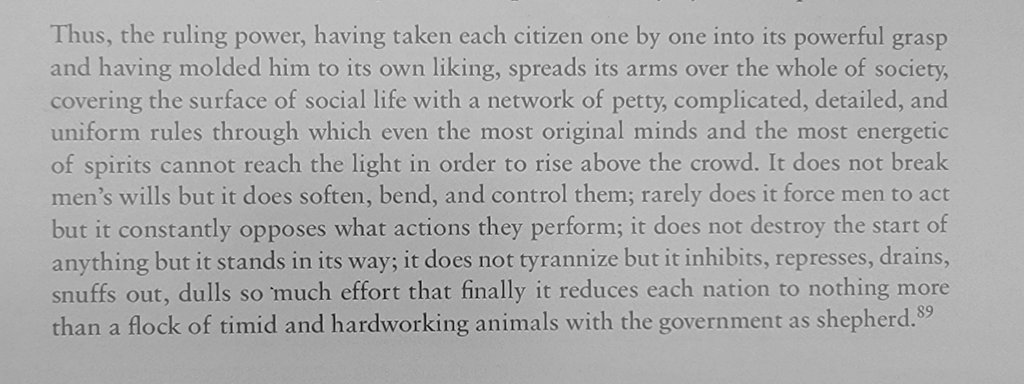
This is brilliant and prescient. However, I've been wondering if the "code is law" framing isn't too restrictive.
First, code isn't just law, it's judge, jury, and executioner. If law worked like code, we wouldn't like it much.
I wonder if the law-like nature of code isn't better captured by institutional analysis. Especially networked code. You have an arena actors, roles, rules about available actions, sanctions, who gets what information, how the rules get changed, etc.
Admittedly, the difference between the two angles isn't huge, and it certainly doesn't at all eliminate concerns of legitimacy (as @laurencediver mentions in thread). But different institutions require different legitimacy, and some can be quite informal.
Yes, I (1) didn't necessarily think you disagreed, I was just encouraging a broader frame and (2) the way that people imagine things matters! I think that law is smaller than institutions, even though I agree that people see law as even smaller still!
I think that's right, there's a sense in which libertarians are anarchists who don't understand institutions and power (insert troll.gif) and that reminder is needed.
See also:
That's not what I mean: assuming this is the ramp up to some kind of con, having bots follow people and push Elon content is a good way to find gullible people... whoever follows those bot accounts.
I suspect that's more common than we know. Most lawyers just crib from others' notes and never read the original. I haven't had time to dig well, but I think that the US Economic Espionage Act might also have some helpful parts.
Note that this is how big tech wins on this terrain. They have teams that actually read and analyse this stuff, whereas everyone else runs with Cliff's Notes.
Replying to @null and @HBWHBWHBW, @sanjuktampaul, @latimes
To perhaps clarify my thoughts a little bit (and they're not necessarily fully clear, like you I'm still thinking my way through this): the very short version would be "why negotiate over money when we should be negotiating over infrastructure?"
I'm extremely sympathetic to the fact that these funds are needed ten years ago and that we literally have democracy to save. I can see the case for a "pay now, fix later" approach. But I worry that this turns into a "pay forever, fix never" situation.
The way in which search works today gives massive gatekeeping power to the platforms, essentially trumping an EIC in determining what is most worthy of attention. I think that's very unhealthy. But once the money flows, who will want to fix the system?
Reforming the infrastructure (with collective bargaining) does not benefit: vultures, publishers with bad or no tech strategy (ie. most), or those too small to have the specialised staff that can work on those problems. These will all resist change if they get money.
We can see that with privacy. It's readily obvious that giving away data to third parties is detrimental to publisher businesses, but the alternative requires innovation at the edges. That *terrifies* some players.
As I said in the other thread, the concern isn't over providing funds over the next few years, the concern is setting ourselves up so that this arrangement doesn't become the forever option.
We could use collective bargaining *right now* to find alternatives.
What's more, there are issues that we could solve today given bargaining power. For instance, if publishers had bargaining power over how search works now, AMP would get sunset immediately — and that would be a huge win.
Replying to @sanjuktampaul and @pixelm, @HBWHBWHBW, @latimes
Doesn't this assume that traffic emanating from the platforms abides by market rules? Traffic is apportioned by a mechanism that could easily shape preferences much more than it reflects them.
Replying to @HalSinger and @HBWHBWHBW, @sanjuktampaul, @latimes
Right — I'm less worried about stripping down journalists than stripping down journalism by increasing incentives to write for SEO traffic.
Complete and maybe wrong speculation: could I not run a news business just on the JCPA payments, without eg. ads or other?
I ask because no ads and no paywall mean you can get stellar CWV and likely very low bounce rates. Throw in disinfo, clickbait, AMP, and fast low-quality reporting and you've got yourself a massive search presence that beats those who make money honestly.
Replying to @HalSinger and @HBWHBWHBW, @sanjuktampaul, @latimes
So, you might well want journalists to handle audience concerns like SEO, meaning that people who optimise to feed the beast count in (2).
I assume that (3) includes on-platform impressions with things like AMP/FBIA/etc.
If you put these together, there's a world in which newspapers do better the more work they do for the platform rather than directly to produce news or for their own readers.
Again, not denying the urgency of money but the platforms are going to lean hard into this.
We definitely need to do better on child privacy, but outside of child-directed services we don't have good options in play to tell sites when they have to apply child privacy rules. I think there's a way that is both safe and simple.
berjon.com/gpc-child-priv…
I don't think that your system works: you can only get full bad or a blocked site (which could be detectable and leak age), but no way to support differentiated processing for child privacy. I don't think that this is a good outcome.
I hear you on the censorship piece, but as far as I can tell there is real movement on child privacy qua privacy. I think we can ride that wave to design it well.
Right, and the same if eg. your browser has an account system that might know you're a child.
I think the alignment is feasible — in many ways it's already there or relatively close!
As discussed in one of the branches of the thread (Twitter isn't great at this…), we can have payment now but for only a few years that serve as time to finish structural bargaining. The bargaining power has the same source for both. If we don't tie them, the 2nd won't happen.
Replying to @null and @HBWHBWHBW, @HalSinger, @sanjuktampaul, @latimes
You will get no disagreement from me that the status quo is pretty damn dire!
Getting this money will be transformative. I'm only pointing out that the platforms won't wait to see what happens to plan out the next steps — we shouldn't either.
The former introduces consent banners (bad) the latter makes age detectable (just do a binary search in a chain of redirects and you'll get exact age). I don't like either!
IIRC it's illegal to decrease service quality for GPC users under the CCPA. It should be too with the GDPR but some DPAs aren't being smart about this.
Replying to @sanjuktampaul and @pixelm, @HBWHBWHBW, @latimes
I don't think that it needs to solve every problem with journalism today (and I don't think that that's a fair summary of my position), only that it cater to its own side effects. A provision adding collective bargaining over root causes would go a long way.
I think that the idea is that coordination rights for money are second-best to coordination rights over the root causes that lead to money transfers being needed in the first place.
(I don't want to put words in Hannah's mouth — at least that's my view!)
It only addresses so much in the CSAM space, but it enables child-oriented protections to be triggered without indicating that someone is a child, which I think helps.
I'm likely being thick but I'm not sure that I understand your disagreement well. This isn't so much about other sectoral reforms that could be obtained as it is about the scope of collective bargaining.
Maybe a comparison with worker bargaining would help:
The JCPA (if I understand it correctly) is a bit like restricting unions to negotiate ONLY on pay but not on other important aspects like safety, life/work balance, etc.
This could lead to jobs that are well paid but eg. for some reason massively overindex towards men.
Some years later, if you try to bring in reform that could help balance out gender representation, the field is now 1) well paid and 2) dominated by men who will more likely than not oppose reform.
Had collective bargaining been broad from the start, that wouldn't happen.
I guess what I'm saying might boil down to "hysteresis matters!!!" 😂 I think that publisher would do better, and society would be served better, with a mandate for collective bargaining that must include structural conditions of labour/production and not just pay.
Yes, success hinges on that. I think this is covered by provisions in privacy laws forbidding service degradation when people exercise their rights. Of course, that requires enforcement, etc.
If you've ever felt like privacy law rarely seems very effective or that much of what privacy compliance people do seems to be useless, you'll want to read this article.
And it's a thing of beauty!
One of the worst parts of this system is that for most people-facing businesses, this isn't good either. But they just tag along because they think that's how it works and most privacy lawyers just crib uncritically from each other.
Do you have good articles on political/militant/activist objects? My wife is starting to poke at the subject in curation grad school and is curious for input.
I unearthed a few treasures I love, sharing them here! 🧵
This is purportedly a can of French goose fat. In fact, it contains thousands of loose leaf bible paper samizdats. French trotskyists (LCR) printed these (on their press) & exported them to Poland during the dictatorship.
I can't believe they made the brand "Rougie" (Reddened).
This is a snow globe of the Sydney Opera House with "NO WAR" painted in red on one of the sails. It was sold to raise money for the cleanup fund of the activists who painted the same on the real Opera House to protest the invasion of Iraq.
(A present from @anaisrassat!)
And this is an MLF button I found at the bottom of my mother's jewellery box after she passed. It's undated, but given that she was particularly active as a trotskyist and feminist right when the MLF was founded, it's probably an early one.
Most businesses don't have anything that could qualify as a privacy strategy, and it shows in nonsense busywork, lower-quality products, and lost revenue.
How about we take steps to fix that?
berjon.com/privacy-as-pro…
It really does! No one can know it all. That's another reason I think product folks have the right approach: they're used to not being the expert in the room and can handle that gracefully.
(Say hi to Julia!)
Hahaha, I don't think that there's a real official definition. I think that the hard part is deciding what the taxonomy is for. If it's for laypeople it won't be the same as if it's for governance purposes.
Thursday Oct 13 — that's next week! — from 5pm until we run out of problems with tech, Tech Policy Princeton is *back* at the Ivy Inn. Join us! It's fun and friendly.
berjon.com/tech-policy-pr…
No — not like that at all. But I don't think further speculation in public is a good idea. I'll say this: market power is real, and assuming even the largest publishers can act freely will lead you to the wrong conclusions.
I'm not sure how you draw the conclusion that large prestigious publishers don't think it's harmful… have you spoken to folks there? I'd be happy to make a couple of introductions.
The right question is: "given that they know it's harmful, why do they stay?"
To add a bit to what Aram's saying, I don't think that you need to "change your mind" with respect to the Sandbox, but distinguishing between classes of features might help.
• Things that help prevent reidentification help.
• Things that support purpose-limited functionality without effecting a revenue transfer between contexts (eg. attribution) help.
• Things that transfer value between contexts (Topics, some of FLEDGE but that's complicated) hurt.
But the point is that the argument is the same: people are willing to put up with one excessive tax, it shouldn't be surprising that they're willing to put up with another one as well.
I'm sorry Jeffrey, I didn't have you down with the libertarian-why-don't-you-just crowd. If you don't understand the size of the power differential, yes even for large pubs, then there's a lot that's not going to make sense.
You jest, but driving opt outs of sale *is* an angle, it's the whole business justification behind GPC. If it were easier to get people to switch their browser to decrease 3P surface, that would almost certainly have shipped too.
I think the most serious that are public are NPÖ? Their revenue went up. I don't know if it's public yet but there's another big one that's going to send all its RTB through an anon proxy. I hear the tests were conclusive.
They limited what goes into RTB. I don't know that anyone has seriously limited what happens in creatives just yet… That's a hell of a job. I looked at using CSP for that but it's hard.
Replying to @Chronotope and @alextcone, @dmarti, @jyasskin
Yes, I'm aware that there's stuff, but so much of it is runtime or interferes with conversion in ways that will lead DSPs to target way — so you're back to market issues. This lives and dies by being a standard.
That sounds pretty nice to me, but then I'm old so places that don't have everything have a certain appeal 😁
But Glasgow has @WebDevLaw ,that's pretty unbeatable!
Sorry I took a while to respond, I was at a TGIF - hour Thank God I'm French - event last night, which is a highlight of the Princeton social life.
I know that's the use case but this is the web and you know as well, nay better, than I do that what matters is the abuse case!
If the market pressure is that you have to have Topics on to win auctions, it won't matter what you have technical means to turn off. Folks have technical means to turn a lot of crap off today and yet they can't!
Replying to @Log3overLog2 and @humanpropensity, @atgrote, @SteveMummey
This might not be the point that you care about, but I think that data leakage is broader than audience theft. It can also be used to inform competitors' substitutive products by informing them about what works or feeding into data decisions that aren't necessarily audience based
I wouldn't bet that premium pubs will never offer UID. I think that people underestimate the market pressure and the limits to manoeuvrability that come from so much revenue being captured.
I've had dozens of variants of the same conversation. Pubs understand the data tax today in a way that they didn't five years ago. People fully see that a world without would be much better. But the path from here to there is very tricky, especially without collective bargaining.
As the evening prepares to descend upon us, we wait with the same baited breath for an answer to the same question that haunts our every Sunday: is this the week that something will finally happen on #HouseOfTheDragon?
That's fair. I think that I would have loved the funeral as an atmospheric passage in a high-paced show like GOT. But after weeks of mostly-boredom I felt it came across as filler. YMMV!
Yup, both are big bets being boring because they play it way too safe. I hope that Witcher s03 won't make the same mistake. Surprisingly, Star Wars has managed to produce its first watchable material since Rogue One.
I can't find time spent stats more recent than 2019, but 2021 was the highest year for accident fatalities since 2015 and the highest year ever for used cars purchases — I don't think that people have stopped driving…
Replying to @null and @TrialByTruth, @RaviNa1k, @johnnyryan
This is probably not the answer you're looking for, but in the case of Meta… I'm not sure anyone knows. Including Meta. I'm not being flippant, the Vice doc from not long ago says something very similar.
vice.com/en/article/akv…
To be frank, and without detracting from Meta's turpitude, this is exactly what you would expect from experience with software/data projects at a large and complex company, especially a fast-growing one. It's not Meta-specific.
That's why I put very little stock in the ability of procedural requirements like Art30 or DPIAs to tidy things up. That's sort of an orderly imagined view of data processes as basically very big spreadsheets. The reality is that computer things become very chaotic very fast.
The only way this gets sorted is, in most parts, by preventing collection. Once it's in the system, you have to rely on provenance, lineage, and an understanding of processing purpose. That gets hairy faster than most can manage.
Embarrassing is a very kind word for it. I wonder what happens in the rationalist community that this is even a thing that doesn't just get laughed out the door.
I agree with Don, these aren't "restrictions," they just reflect a state of play that has been unfolding for years. CMOs that respond to this with tactical compliance will be making the same mistakes as those who've been ignoring the changes of the past five years!
Except that people don't barter PD. That would require a modicum of choice and some degree of pricing, even accounting for barter indivisibilities. Neither is the case.
More pointedly, the data economy is overwhelmingly about inferences and not about anything subjects bring.
If I get the time of day and your IP address, that might well be enough to infer that you dislike pineapple on pizza, own a leaf blower, and vote conservative simply because people from your area who read my content at that time of day heavily over index on those properties.
I stole a lot of this from you, I sure hope that you agree 😂!
I've been wondering if there's a useful model in which inferences = externalities (good or bad). It would make a very weird failed market, which might actually be right.
Right, I'm not thinking about it in terms of internalisation (though you would have to do that to make propertatian approaches work, which in turn creates all kinds of Arrow paradoxes). I'm more trying to figure out if that should lead to specific kinds of market failure.
For instance, if this market is all in the externalities, does this have consequences for the ways in which it may be more susceptible to manipulation from non-price signals, does it break concentration metrics, etc.
Well, nothing is ever purely descriptive, the next step is "ah, so how do we unfuck this" but the solution is unlikely to come from typical econ interventions I suspect.
Might you have a ref for "the ways externalities skew production in [network] goods"? Very interesting!
Replying to @alextcone and @montezumachavez, @RDBinns
I'd add that that text isn't much of a policy position, it's intended as a high level explanation meant to be clear to people. Are there specific variations you'd be looking for?
Reminder: tonight, in Princeton, at the Ivy Inn from 5pm onwards, we're meeting to talk about tech policy. Come! It'll be fun. berjon.com/tech-policy-pr…
I understand where you're coming from with this, but you're having "knowingly" do a *lot* of work there! Acceptance of ToS and PP are legal fictions through and through, building from them to establish that there is an exchange is to build on a fiction.
If I put up a small-font sign at every entrance into Princeton indicating that there are many pickpockets on Palmer Square, and you get your pocket picked while getting an ice cream there, were you party to an exchange?
It's cliché to point out that people don't read let alone understand privacy policies, but a fascinating study would be to look into how much the lawyers who write them understand what they're saying. I guarantee that in many cases they don't, not meaningfully.
Replying to @JulesPolonetsky and @RDBinns, @braedon, @alextcone, @montezumachavez
I'm not sure that web 3P on its own would ever be considered enough, at least not in cases in which the identity of the person is known (even if only an email address).
You might not know this but there's actually a Bogota (with no accent) in New Jersey!
Can you drive from Bogotá to Panama City? I can't seem to find a road that crosses the border and I don't know how to add a boat trip!
Reminder: tonight, in Princeton, at the Ivy Inn from 5pm onwards, we're meeting to talk about tech policy. Come! It'll be fun. berjon.com/tech-policy-pr…
Replying to @WolfieChristl and @TrialByTruth, @RaviNa1k, @johnnyryan
I agree — I'm not saying that I want to eliminate collection, only that no one has figured out how to keep things from getting out of hand, at least not at reasonable cost. Things are getting better in terms of data tooling, but we're not there yet.
C'est pas un mauvais club dans lequel être :) Je pense qu'il y a une différence entre être conscient de ne pas avoir été formé à une discipline (avec ce que ça peut impliquer de fondamentaux manqués ou de décalage culturel) et un syndrome de l'imposteur, non?
Replying to @pilhofer and @reckless, @kookster, @overlayered
AMP lives on Google same as IA lives on FB, AMP pages don't belong to the publisher (just using AMP licenses the content to Google).
AMP can easily account for ~half of search traffic, which is huge. It eviscerates header bidding, has much lower CPMs, and abysmal conversion.
Replying to @pilhofer and @reckless, @clockwerks, @ckrewson, @backlon, @spiritedmediaco, @billy_penn
Please Aron, this is detached from the facts. I've actually contributed to the AMP open source project and attended the AMP AC where someone from my team was elected. The contention that it was in any way outside of Google's control is simply completely false.
And there is absolutely nothing about AMP that's related to the web. In fact, people who work on AMP use "Web" to mean the non-AMP stuff. The content gets captured and served by Google.
Replying to @pilhofer and @reckless, @clockwerks, @ckrewson, @backlon, @spiritedmediaco, @billy_penn
(Sorry, not on the Internet much this weekend.)
I'm not implying that this is necessarily intentional, but open governance takes more than just going through the motions, what matters is whether the governance is open in practice (there are other ways to control things).
In the case of AMP, I speak from the perspective of a team with representation on both the AC and TSC, experience contributing code to the project, and decades of open source & open standards work. I'm just noting this to make it clear that it wasn't from lack of understanding.
In one instance we sought a simple change to enable CCPA opt outs. General AC agreement, TSC support. But we were told that the change wouldn't be accepted without Google's approval (and discouraged from making a PR). It eventually happened, but it took months.
In another, we wanted the AC to *recommend* a sunset of the cache. The goal was precisely to make the independence of AMP real, to cut off Google's power plays, to make it clear that AMP was *only* about good practices to make fast pages and should compete with React.
A majority of the AC agreed, but the situation turned into a continuous stonewalling of Google engineers reading legal-vetted statements. I've never had as strong an impression that I'd leant against the wrong wall in a Potemkin village.
Anyway, again, I'm not ascribing this to malice but the facts of AMP governance are: if what you want isn't a Google priority, it'll be slow; if what you want goes against Google, it doesn't matter how many elected AC folks agree it'll get blocked.
Replying to @pilhofer and @eric_young_1, @reckless, @clockwerks, @ckrewson, @backlon, @spiritedmediaco, @billy_penn
I think that characterising this as "for a time" is a bit off? IIRC that was the case from 2016 to 2021, or about 80% of AMP's existence. People started calling for AMP to stand on its own merits very early in the process, and it took years to get any movement whatsoever.
I would add: pending a comprehensive independent study, I would not accept the contention that AMP is no longer required at face value. I'm hearing very different stories coming from publishers who've made the switch off.
Given all-green CWV, some report no change in search traffic, others report immediate drops in the 15-20% range. This is still anecdotal of course, but it's not like Google has been honest in earlier stages of this (eg. the ranking/indexing sophistry) so this bear verifying.
Replying to @eric_young_1 and @clockwerks, @pilhofer, @reckless, @ckrewson, @backlon, @spiritedmediaco, @billy_penn
I have never seen a publisher ask for AMP. I worked for a publisher in 2016 and we definitely tried it (because carousel) but it was extremely brittle tech and we gave up because we could afford not to compete hard in search (it being scholarly publishing).
Replying to @eric_young_1 and @clockwerks, @pilhofer, @reckless, @ckrewson, @backlon, @spiritedmediaco, @billy_penn
No, as it became clear that AMP was required to perform in search, pubs switched to having all in AMP. It was expensive to do so because indeed it's brittle tech, but the effect on search didn't leave much choice. It ate resources that could have gone to useful work.
Replying to @pilhofer and @clockwerks, @eric_young_1, @reckless, @ckrewson, @backlon, @spiritedmediaco, @billy_penn
I think that that was true at some point, which is why people still cut them some slack until a few years ago. I think people inside G. still coast on the inertia of that being true. But it switched from "the Web is good for Google" to "what's good for Google is good for the Web"
This is a good point, and it's why you keep hearing me talk about governance (and that's only about to get worse).
AMP & CWV may well have been honest attempts to improve the Web. Instead, they've convinced most publishers that apps are definitely the future. Why? 🧵
A recurring frustration with apps is that decisions made by some random Silicon Valley product person — crosswords MUST have a night mode! — matter more than your knowledge of what your users need.
AMP & CWV bring the same meddling to the Web: now just a clunkier app platform.
Performance matters (a lot) but it might very well not be what matters *most* given your resources. It may be what matters most *across the whole Web* but that doesn't mean that it's better than the sum of the improvements made with the same resources and *local knowledge*.
Replying to @blaine and @clockwerks, @pilhofer, @eric_young_1, @reckless, @ckrewson, @backlon, @spiritedmediaco, @billy_penn
So, I've had Cambria open in a tab for quite a while on the assumption that there's thinking to be thought there. I haven't done that yet, so I may be off!
I think there's a there there, but I'd have to try it on real problems to be sure. It could be clunky.
From the perspective of producing multiple output formats (which is simpler than the general interop case) it's not very different from *cough* what XSLT was supposed to do.
The reason people find the switch clunky is because you don't have unified data for the semantics.
Basically, you'll have a data structure for the *content* of the site but all the other stuff (ads, paywall rules, analytics, template, etc.) will be in code. To make lensing work here, you'd have to switch all of that to a data structure.
I'm not saying that you shouldn't! In fact, that would make for much cleaner code and separation of concerns even if you only have one output format. But I think it's a bit of a mental adjustment. People hated it in XSLT (also because it was XSLT).
[SPOILERS]
I'm glad we can keep disagreeing on this :-D
I thought that it felt like the beginning of a pivot to better things. Insufficient, and with really clumsy bits (like, why the fucks does she just fly away?), and I agree with the fake feminism, but directionally better?
Ah, I hadn't thought of the just flying away as stemming from the connection with Alicent. I thought it was more, like, "okay, I've made my point, ciao." If she unconditionally comes back to fight Aegon, it'll make no sense either way.
Replying to @blaine and @clockwerks, @pilhofer, @eric_young_1, @reckless, @ckrewson, @backlon, @spiritedmediaco, @billy_penn, @timmyce
This atjson thing looks lit!
I think that a key issue with legibility in SLAS is the loss of local knowledge (mētis). It doesn't feel like that's what's happening here? Not all production of machine-readable data is a panopticon? (I hope!)
I think the conditions for SLAS legibility are:
1. Large-scale data collection.
2. Must involve categorisation or equivalent loss of individuality (to make 1 tractable).
3. Erasure of local knowledge (due to 2 at scale).
No?
Replying to @blaine and @clockwerks, @pilhofer, @eric_young_1, @reckless, @ckrewson, @backlon, @spiritedmediaco, @billy_penn, @timmyce
Thank you!
One of the difficulties with JSC is that he's a wonderful storyteller but not so strong on providing explicit frameworks (it's the same in Against the Grain). I'm hesitant in my formulation because I feel I reverse-engineered it from the text.
Writing something too complicated so I tried to structure it with pen, paper, scissors, and cat.
If my next blog post has amazing editing, you'll know why.
I think that "error stares" should really be a thing 😁
(I hope you do a talk, I know I've felt that this is important but haven't been sure how to do it well or even just improve.)
This too! I suspect that this is similar to the broad range of reactions to covid itself? I've had a bad reaction to every shot and when I caught it, it was pretty bad too. (I can't imagine what it would have been unvaxed.)
Me too! I think there is a lot of overlap with hypernudging, epistemic communities, ethical habits as a commons, probably the stability-flexibility dilemma in cogsci, etc. Lots to do!
Has anyone written anything good about teen use of Pinterest? All I'm finding is breathless marketer/investor stuff, and nothing about CoMo or the such. I must be failing to search?
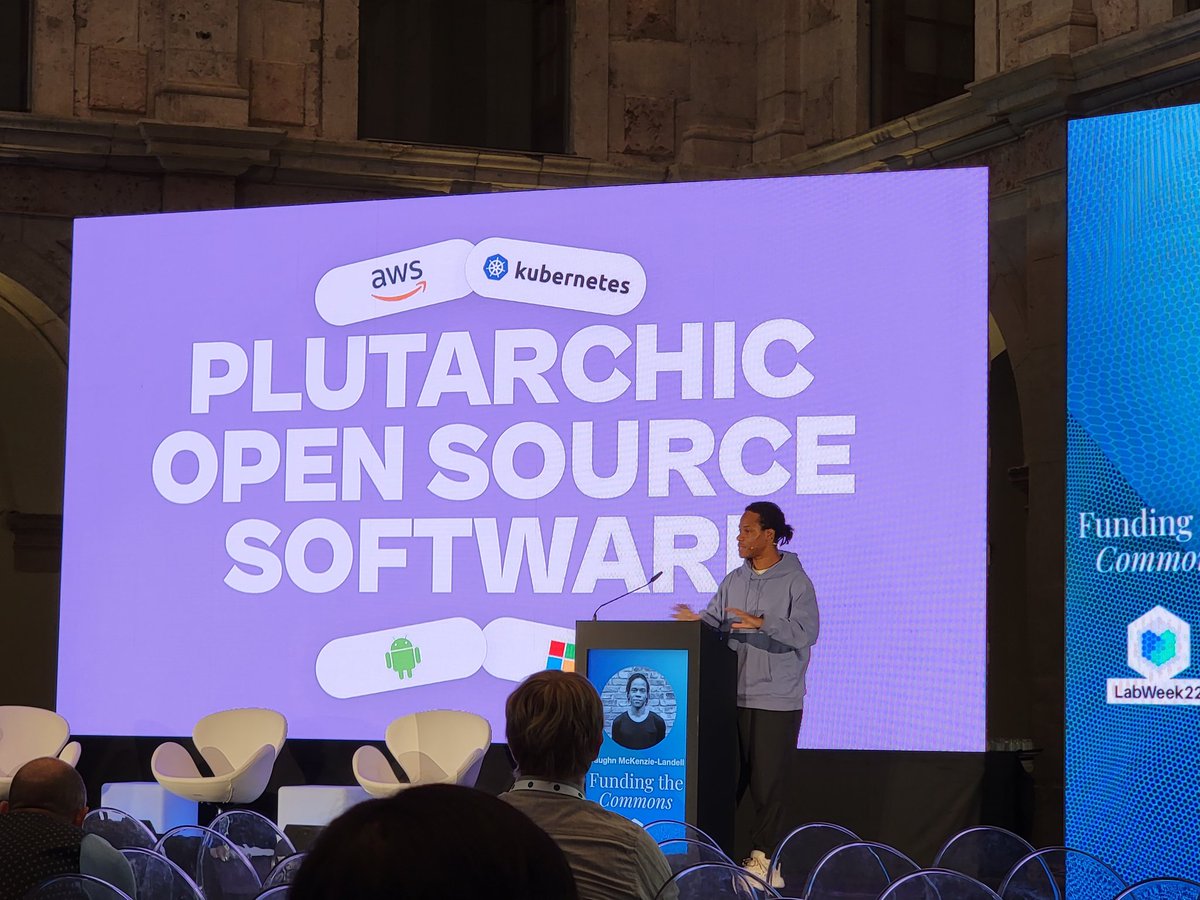
I'm delighted and extremely excited to share that I am joining @protocollabs to work on governance and standards!
"We build protocols, tools, and services to radically improve the internet" is very much the work that I feel is needed and want to be doing. protocol.ai
I'll share more details when I've figured things out more — there's a *lot* going on — but so far I've been consistently impressed with the people, the values, and the tech.
I haven't been this enthusiastic about the potential to do good with tech in a long time.
I understand the desire that some have to change some of those big beasts, but the question is always: who would you be accountable to? I'd only consider it if I were given power to make real change but accountable to the outside. Otherwise it's just more of the same.
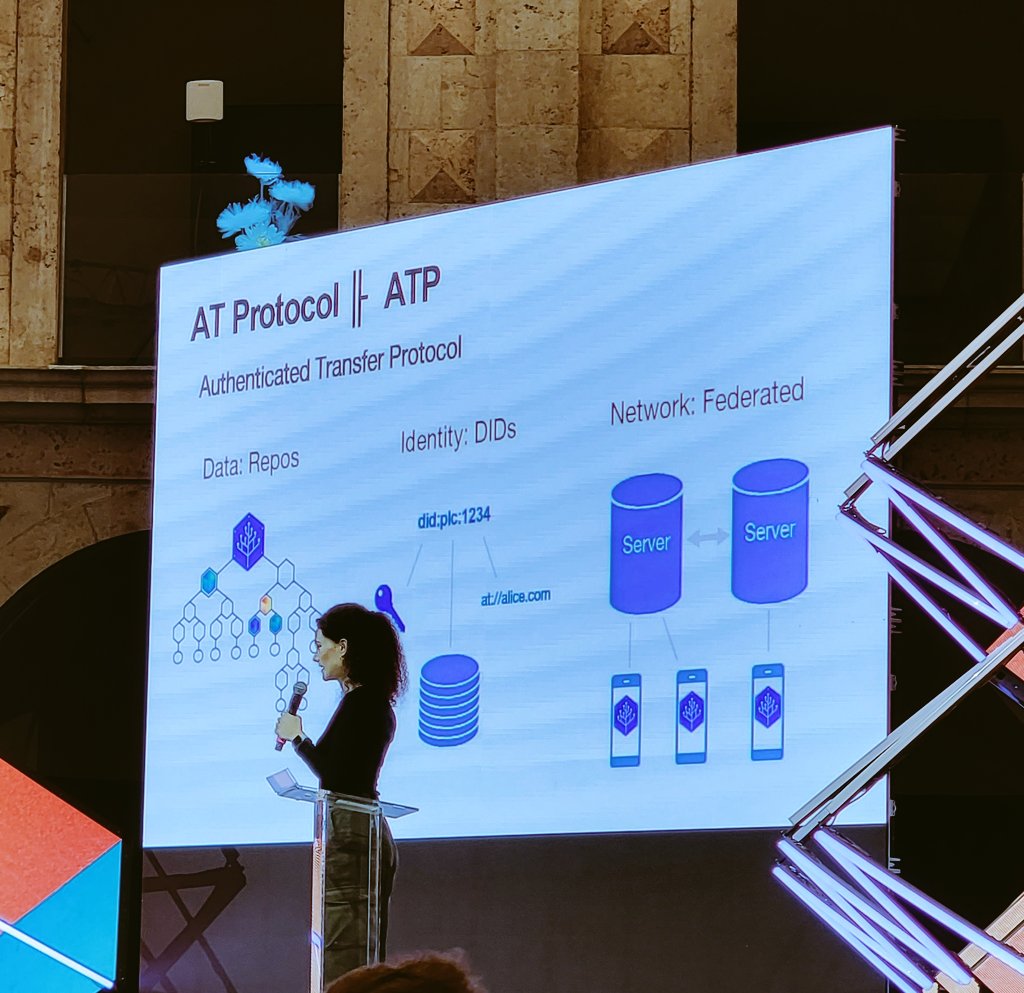
Mastodon is fine but still to some degree stuck in "Linux on the desktop" land. I think that it has created a lot of experience with and interest in federation though. I haven't looked closely at the @bluesky stuff but a skim looks promising.
Replying to @tim_libert and @protocollabs, @bluesky
I've been thinking that such a tool could be generic. Prove who you are on here and arbitrary new thing, and whoever else has done the same is automatically available as a follow.
Replying to @tim_libert and @protocollabs, @bluesky
If you go down that road you'll find more or less generalised notions of inboxes and data repositories. That's the kind of thing that people are looking at :)
I'm hearing similar anecdata. The interesting thing to look into is the ratio of GPC vs manual opt outs: even with limited market share for GPC products it's at a multiple of manual, and growing.
That's what choice looks like when it actually works.
Replying to @alexanderhanff and @alextcone, @montezumachavez
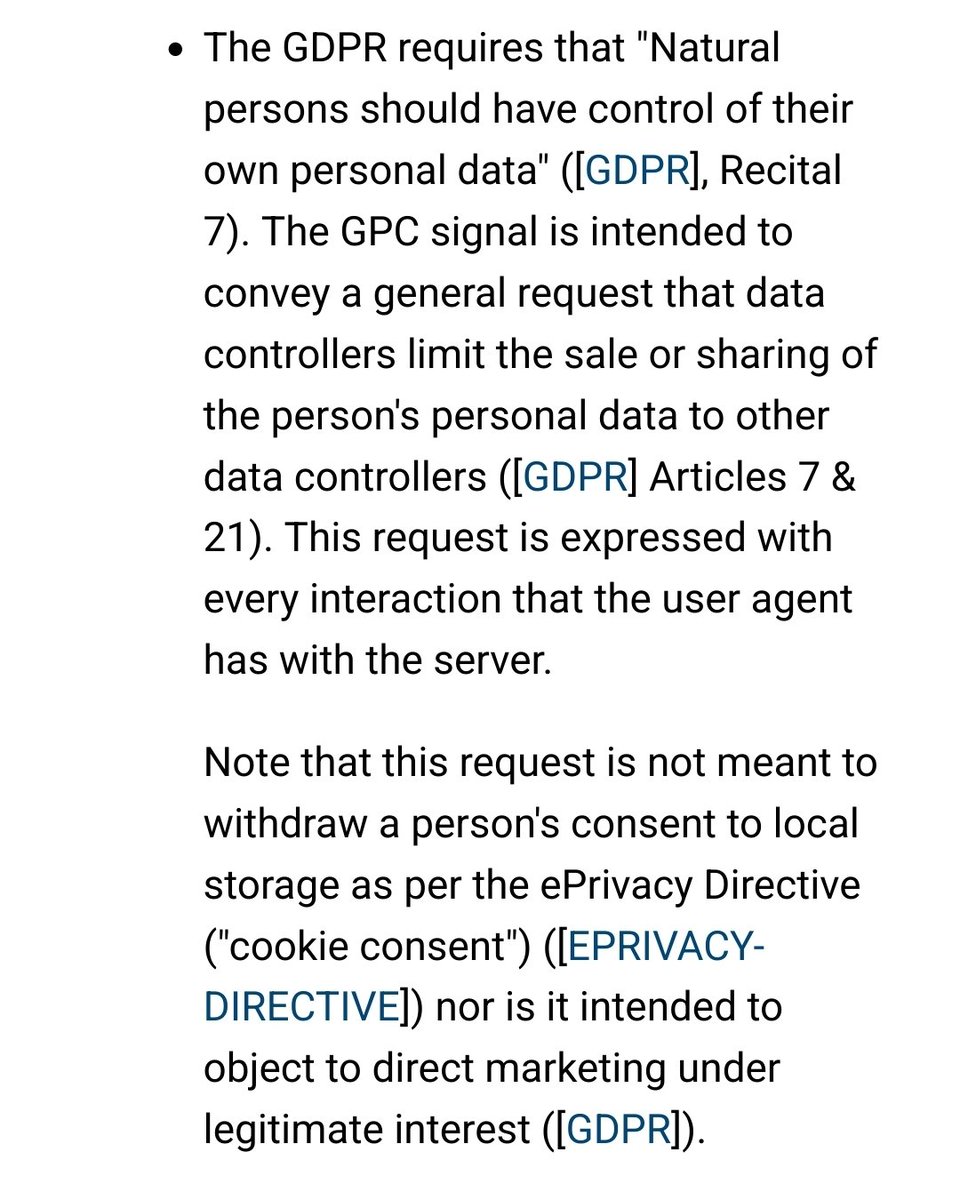
The semantics of the header matter a great deal. You can't just say "oh look there's a Content-Type header, that's a denial of consent!" GPC is specifically about controller to controller exchanges. Otherwise it's just DNT, which wouldn't be useful?
Oh, is that the one where neutrinos from the Sun somehow change nature and that screws around with the Earth? I love disaster movies but my brain has also edited them into one big movie.
Replying to @AureliePols and @alexanderhanff, @alextcone, @montezumachavez
I understand that. It's just that GPC does not convey a broad withdrawal of consent, that's all I'm saying. It kind of matters what it conveys on behalf of the subject.
Replying to @AureliePols and @alexanderhanff, @alextcone, @montezumachavez
I'm not sure what you mean by that? GPC conveys an exercise of applicable rights withdraws consent (and objects, for the fools who do that under LI) to controller-to-controller exchanges. If GPC is the only thing you support, then you won't be compliant, but it's not the point?
Replying to @Log3overLog2 and @alexanderhanff, @montezumachavez, @alextcone
I would take the statements made in this thread that the meaning of GPC doesn't matter with a pinch of salt... The detailed lawyer-level consequences have some thorns but the layperson semantics are IMHO reasonably clear across jurisdictions.
The idea is that the sites you visit can work with other companies that see your data, but those other companies can't then independently reuse the data. I'm a terrible UI copywriter but I think Duck/Brave/Mozilla have text ready if they need it.
Replying to @AureliePols and @alexanderhanff, @alextcone, @montezumachavez
GPC is an expression of specific data subject rights. It's a message from the data subject to a controller. That's a bit like asking if making an access request is enough to support compliance obligations in the EEA. I'm not sure what I would answer to that?
Replying to @simonhania and @montezumachavez, @alexanderhanff, @alextcone
GPC is, more than anything else, an action. In GDPR terms, it is triggering withdrawal if the consent was given (or objection, for the brazen). The absence of the withdrawal does not equate consent.
Replying to @null and @pixeldetracking, @AureliePols, @alexanderhanff, @alextcone, @montezumachavez
ADPC is great (I pimped it in my talk about consent). If you want a signal for the consent part, including granting consent and covering ePD, that's the way.
Well, I kept your ominous note on the pile of books that lives on my nightstand, which only made it more ominous thanks to its size and ability to strike in the dead of night. That worked!
This is a good intro, but this bit could mislead: "Publishers may see a decrease in revenue from the inability to sell data (…) sites can still earn significant revenue (…) by selling ad space for contextual rather than behavioral advertisements."
There is nothing, absolutely nothing, to prevent publishers from selling behavioural ads when GPC is on. The only thing that is prevented is third parties stealing that data to monetise it elsewhere. One of the values of GPC is that it aligns business and privacy interests.
Also: "Under the GDPR, there is no right to object to the sale of personal data." This is true in a strict sense, but selling data is basically a controller-to-controller data exchange.
For more details: berjon.com/gpc-under-the-…
Replying to @OR13b and @RichPitts, @amyssorrells, @chryswoods, @OracleResearch, @protocollabs
I know there are already folks looking at some aspects, but I'm interested in looking too. I think science over IPFS could well become a no-brainer.
In a previous lifetime, this is how I ended up co-author on nature.com/articles/s4159… so I'm definitely interested!
I think that the original point is that there is no specific right relating to sale, which is correct. But I agree with you that you can assemble it from existing rights, that's the basis for my argument that GPC works under the GDPR.
The difference matters to people doing compliance work, the implementation is different. Notably, if you do GDPR you probably don't have a specific code path that just handles data sale prevention. Or contracts to match.
Sure, but things you won't have include 1) contracts stating that a given third party is a processor rather than a controller when some flag is passed, 2) code to pass such flags or remove controllers specifically, 3) backend code to selectively process based on that state.
I completely agree that you can go nuclear and just withdraw consent/object to everything, and you'll be *legally* fine. But one of the values of the opt out of sale is that you get better privacy but can still run a business. That's a lot harder if you nuke it all.
I'm not familiar with your empirical work on this and would be interested in pointers. My (anecdotal) experience is that focusing on betrayal rather than creepiness, ie. how people would feel if they found out vs how it looks, actually gets better results.
Well, NYT would always say "The trust of our readers is essential, and privacy is about trust." 😁 In my experience, when you ask devs how people would feel if they found out, many will say variants on "angry" but commonly also "betrayed," "stabbed in the back," etc.