Yeah, I mean, I don't agree with all that Neil says. But the legibility angle is an important one which I am using as well, and I'm very interested in seeing how others put it to work.
@celiabelin covers the continued absurdity of the American travel ban and non-immigrant visas. It is causing needless anguish; it is also making it increasingly hard for businesses to hire qualified, specialised workers who would normally get such visas.
washingtonpost.com/outlook/2021/0…
has the power to fix this mess for people and help the economy — it's more than time to use it.
The ban and NIE system need to be lifted, at the very least for vaccinated visa holders. To clear the backlog, visa stamps and statuses need to be extended automatically.
I like the idea of what you're saying; at the same time I'm not sure that the French practice of thoroughly charring unmarinated meat and eating it with no sides other than wine strong enough to cover the taste should qualify as a "grilling tradition."
It is not without its charm! There should be tourist warnings relative to it, though. I was once at a French-American wedding in France that involved grilling, and significant conflicts have been started over less.
Data might have become grammatically singular, but personal data is primarily a collective concern that requires collective governance.
Read @salome_viljoen_, @mer__edith, and @jathansadowski as they make that case in @Nature!
Replying to @null and @MrsMRS_PhD, @BrettFrischmann, @profmadison, @EvanSelinger
I would be happy to, though I might not bring more than questions and coffee.
Seems like a networks/complexity angle could make sense? Maybe @msantolini, @jbakcoleman, or @manlius84 have thoughts?
Replying to @RDBinns and @Elibietti, @TrialByTruth, @sivavaid
A form of tenancy in common? (I think that translates the French "indivision.") You are the owner, but you can't cede without collective governance (in French indivision, it's even unanimity, but that's a whole other bag of problems). I think there could be something there!
Replying to @Elibietti and @TrialByTruth, @RDBinns, @sivavaid
I agree that we need more than a simplistic binary of property or not. The whole notion of controllership seems built to ascribe a form of property-like rights without saying it. It makes it hard to characterise theft.
To be clear, my thinking isn't that democracy will save us, only that it's credibly the highest collective cognition we can achieve, and we need to be putting the odds on our side. But we could still fail.
I'd also note in the condo story that, in a functioning polycentric system, decision-making failure at one level should be caught by other levels, in this case whatever city or state code inspection system has them in scope. The board failed, but not alone.
It is. I think the difficulties will be 1) making sure they apply the right values, and 2) holding them to not prefer big companies. For governments, it's easy to have just a couple of big cos that you can summon to your office and get some symbolic concession from.
I'm notably concerned about the latter after seeing the commitments @CMAgovUK secured on the Privacy Sandbox. They're directionally fine, but they are almost completely ineffective.
What's also hilarious is that they've been telling everyone since they introduced this API quite a while ago that it has terrible results and people should really only ever use it when there is no alternative.
Yeah, I'm sure it works to some degree, I'm more amused at the backpedalling from FB. I wonder how effective it is with IP & email masking, and loss of fingerprinting surface in the UA string. I'm pretty sure it's on borrowed time.
Let's normalise surveillance for kids so that they're better prepared for adult life... It's like someone found a copy of Discipline & Punish and thought it was a how-to manual.
NIEs are now automatically valid for 12 months. This is a good step forward, a great follow-up would be to grant a similar extension to visa stamps. travel.state.gov/content/travel…
As you hint at, I think that the path forward is semantics. It would be great to have a way to mark that something is an ad, and something is an offer. Then we could establish reader mode best practices for those.
My assumption is that they wouldn't be invasive: ads with zero animation, just inserted, and offers included without overlaying atop anything. There are ways to make this work without breaking it.
I would also love if we could target it with media queries with a very minimal set of properties, perhaps no positioning or colour, but at least fonts and typesetting. Indicate a logo to use. Keep some soul to it.
Your work is amazing AND your dad jokes are an inspiration. (Or maybe it's the other way around?) Either way, I don't know what I can do to help, but I would love to if I can.
Journals can fix this. I forget which journal (maybe @PLOS?) started doing peer reviews as a group. Reviewers can be anonymous to the authors but see each other and need consensus on feedback. It's harder to be that guy in front of witnesses.
Just like that "webs that spiders will weave under different drugs" paper, except with kids aged 2-6.
(OK, that's not *quite* the research, but it looks close enough 😛.)
Very weird: has spam stopped working to the point that snail mail scamming works better? I just received this 12 page invitation to a secret society in Utah and it's wild.
I know, I remember seeing some as a kid — but I thought they had disappeared. Maybe it's just that some marketer now has me in their "old person" segment.
Replying to @null and @Carnage4Life, @slightlylate
I don't think we can keep those two entirely separate, restricting one makes the other even more problematic than it already is on its own.
Policy option: papers.ssrn.com/sol3/papers.cf…
Inclusion in Web privacy model (draft, more to come): darobin.github.io/pup/
Replying to @null and @Carnage4Life, @slightlylate
I look at it even outside anticompetitive concerns, real as they are. The amount of sludge choice architecture in the Chrome Sync consent funnel should not be possible in a trustworthy environment — even if the data were only used for saintly purposes.
If we lose the assumption that browsers are trustworthy then there is literally nothing left that works on the Web. The architectural bottom falls out on the whole argument from RFC8890 and values-based protocols. The fiduciary model seeks to make the foundation work (again).
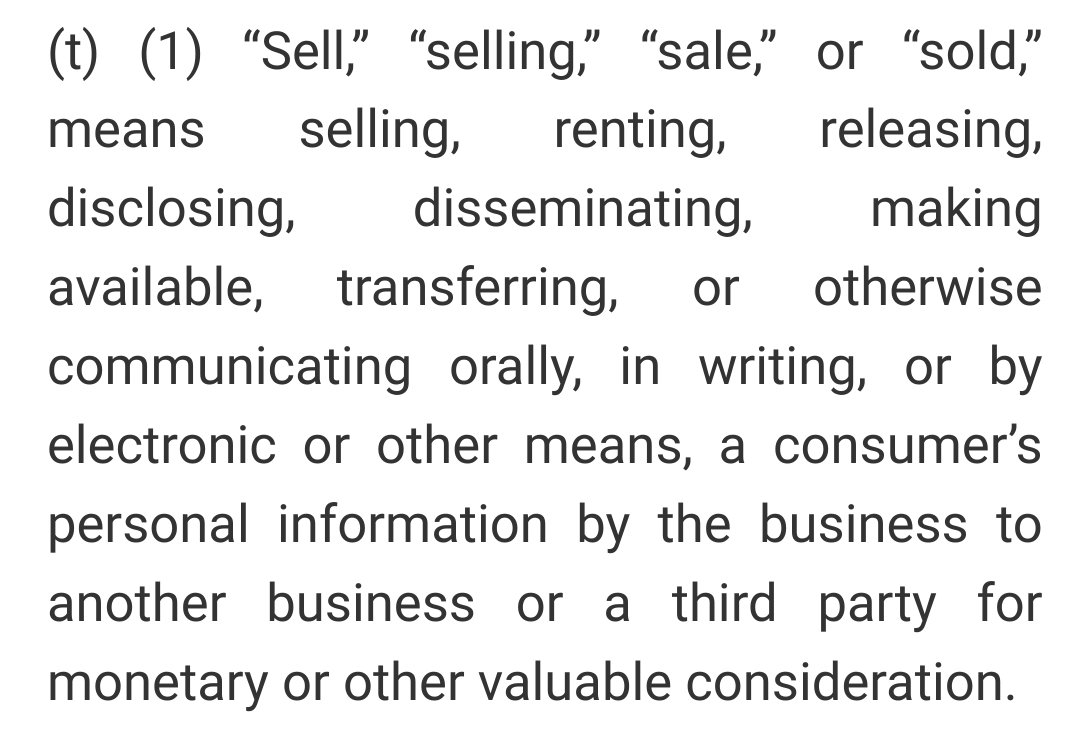
I'm thinking of this bit: you're in scope if you provide the data for any kind of consideration. (Can't seem to link to sections.)
leginfo.legislature.ca.gov/faces/billText…
What interests me here is how to get to a situation in which there is only one controller, which is what GPC is going after. I'm aligning Do Not Sell with a withdrawal/objection (depending on basis) to processing by other controllers.
Replying to @Forsheit and @AGRobBonta, @globalprivctrl
I'm not sure what your expectation of a "recognised standard" is? In standardisation, adoption is the key metric, and GPC has more than enough of that.
Replying to @Forsheit and @jason_kint, @AGRobBonta, @globalprivctrl, @w3c
But that's the thing: this isn't how Web standards work. As per Process §6.2.2 you cannot advance without implementation experience, which means the standard needs to be adopted *before* it is ratified.
But differently, it's a question of fact and not a question of rubber-stamping. That GPC can demonstrate implementation experience, including now by being adopted by major jurisdictions, is exactly the expected order of execution.
Replying to @Forsheit and @jason_kint, @AGRobBonta, @globalprivctrl, @w3c
We're talking about a boolean flag available over HTTP and the DOM — it's been tested through and through. That it works for legislation is the relevant criterion to look for, and it seems the AG has found that it works.
Replying to @Forsheit and @jason_kint, @AGRobBonta, @globalprivctrl, @w3c
I don't at all understand this idea that we should only respect consumer choice when things are made as painful as possible for consumers. GPC *is* consumer choice, it's just consumer choice designed with consumers in mind.
Replying to @Forsheit and @jason_kint, @AGRobBonta, @globalprivctrl, @w3c
That's an easy fix for businesses that wish to make things clear to their users: just display an indication that the user is opted out, as per their browser preference. We do that.
Replying to @Forsheit and @jason_kint, @AGRobBonta, @globalprivctrl, @w3c
There is absolutely nothing "large" or "sophisticated" about this. Any off-the-shelf CMP can support this trivially. Anyone who rolled their own can implement this in well under a day.
I think sticking to the facts creates less confusion than fear-mongering.
Replying to @fatemehx2 and @Forsheit, @jason_kint, @AGRobBonta, @globalprivctrl, @w3c
I mean, there's a whole W3C workstream that's exactly about making advertising work in a way that doesn't require treating your readers as the enemy. Maybe people should pay attention :)
The beauty of the market, as clearly described by Hayek, is how the price mechanism can encode local information that can never be effectively shared to everyone or efficiently processed by some big centralised entity.
The idea of broadcasting local knowledge or handing it all over to a couple of big inefficient engineering bureaucracies is, on paper, a recipe to create inequality, poverty, inefficiency, and a highly distorted market and — lo! — that is what we observe.
Yeah, I looked up how sensitive it is and apparently it's one millionth of a volt, which sounds pretty sensitive. I have no idea if undersea cables leak current and if so how much, but it's a theory!
I got the impression that he was talking about inexpressible rather than inexpressed? There's a huge amount of tacit, implicit, craft knowledge that isn't or is only poorly captured in text, not just from evolution.
I mean, there could well be a text about the exact experience of hammering in a nail, or the precise amount of time and intensity to make eye contact when crossing someone in a given city, as modulated by perception of social status, etc. but there probably isn't.
Sadly, there seems to be no illustrator credit, but I would like to thank whoever decided to illustrate California enforcing GPC — a protocol flag to indicate privacy — with a bear looking at a literal flag reading "DENOTE PRIVACY." Strong allegory vibes! Cc @KateKayeReports
You can read the rest of this great news below.
One take-away from the article is that no matter how simple you make something, if it favours consumers there will always be a lawyer to call it confusing.
digiday.com/marketing/cali…
I don't disagree on principle — but not everything can be solved technologically, and in some cases we have to rely on legislation.
My view: We should use every bit that helps, and if that includes sending a signal by default, then so be it.
Or even just logging in with email and having that used for web-wide tracking. I love what Apple is doing to help address that, but it's only going to work for a limited number of people. Why not help plug that hole? It's a pretty big one.
We do — but IE also had no law that said they could do it and gave teeth to that choice.
Also, it's not my preferred option but this could be a one-off ATT-like decision.
Having been quite active on the GPC work, but also being European, people often ask me how I see GPC working under the GDPR. I wrote it up! berjon.com/gpc-under-the-…
(Note: this is not legal advice!)
It's great that people are discovering CI, but it hardly counts as "alternative." Outside of industry corners where people still see "transparency & choice" as a real thing, it's largely the standard. I cover it in both darobin.github.io/pup/ and open.nytimes.com/how-the-new-yo… :)
Replying to @null and @pes10k, @johnwilander, @ashk4n, @Chronotope
I am not a lawyer, etc. but the law/regs indicate that if users pick a tool that's privacy-supportive, then it can be on by default. For Apple, well, that's on billboards all around the world. For Mozilla, they've been advertising their privacy too.
Both Chrome and Edge have been active in privacy, even if more recently. I got an ad about how Google care about privacy now this morning. They might have to prompt, but I think they could consider the default.
I would also add that Ethical Web and a couple of RFCs clearly document that privacy is an essential component of browsers. Browsers are meant to be PETs — that should count for something!
That's the part I don't understand: separating the interpretation of the signal from enforcement. Are you saying that we should basically have my blog in the spec, that will say what it means but it'll need another step for enforcement? Is that better?
Thanks! I'm not sure I fully get your question? Under the GDPR, there is an explicit allowance for direct marketing under legitimate interest. GPC is about data transfers to other controllers (including under LI). So LI is in scope for 3P controllers, but not 1P direct marketing.
It's powerful infrastructure technology, the hard part with these is always figuring out what is a good way to use them.
I don't know if you know ReSpec, but all the docs it makes are monetised to support its development. It's small but neat!
Thanks!
WRT direct marketing under LI, I think I'm the one who's unclear because I am taking shortcuts through assumptions. Let me try to unpack this and see if I can make more sense to you two!
Under Recital 47, DM may be done under LI. It's not restricted to the 1P.
The GDPR doesn't have much in the way of a built-in 1P/3P distinction anyway.
However, R47 does place some restrictions on that, and frankly unrelated to GPC if there is a 3P carrying out its own DM (not on behalf of 1P) under LI, I'd *love* to see that LIA!
With that said, I turn to GPC.
There can be DM of the 1P under LI. GPC explicitly does not touch that as you point out Maximilian.
For 3P, either they are controllers or they are processors. If they are controllers, GPC just shut them down — so they can't be processing.
If they are processors, they can't be processing the data for their own purposes (lest they be requalified as controllers, then go to previous point). So they can't be carrying out their own DM *unless* the 1P were to instruct them to.
So, I load you as a tracker and then I instruct you to go direct-market yourself with that data. It would be weird! But if it did happen — why not? — then the legal basis would be contract and not LI I think.
As usual, I'm not a lawyer so I may be full of crap :)
Yeah, those are the docs, they're not actually built with ReSpec. Here is one example: darobin.github.io/pup/ (It's my draft but the money goes to the project.)
Full disclosure: I did start ReSpec, but they added this after I left so not plugging my stuff :)
This is built on the assumption of a legal decision, not for firms to call it. Otherwise nothing works!
The problem with banners is that the GDPR default when they are rejected is useless, and I'm not sure that they have the right granularity to automate something that works.
I used to think that a relatively piecemeal approach might work, but I'm a lot less sure now, so I'm back at the drawing board. I wrote a bit about some of it in berjon.com/stewardship/.
At heart, it's a problem of unfettered power and gatekeeping. We had a world of many gatekeepers, we wanted to have more (or none at all), and instead we have two or three. It continues because they are allowed to extract resources from everyone else and no one stops them.
So the question is: what's the smallest number of moves that breaks the algorithmic media duopoly?
Sorry I don't have better solution yet, I have just started rethinking the approach!
Opt in is a good system when there is a good definition of what is optional and what is essential, basically when it is grounded in a strong theory of privacy rather than trying to mimic human subject research informed consent!
It's depressing that the problem is hard, but I think that it's encouraging that we actually have powerful intellectual tools with which to investigate it. Just like with smoking or chemicals (the history of Dupont is interesting here), there'll be denialism but we're equipped.
Indeed! But the definition of essential that DPAs use is smaller than what is essential. So you end up obligated to obtain consent for essential purposes.
I think that's not the answer to the specific question I had at hand, but it looks like it's actually *super* relevant to the line of thinking that I'm tinkering with so I'm definitely getting it. Thanks a lot!
Actually, my point is that that's why we *should* regulate. What we have right now is not regulation, it's offloading the work of defining what's right to data subjects, who are rarely equipped to do it well! I would expect regulation to do that work rather than cop out.
I don't have an up-to-date written version, and I think it has to be context-dependent. But it's work I had looked at with the people looking at "Acceptable Ads" and there's a new line of work coming up to define that better for news.
Heh. @CT_Bergstrom: you might want to consider putting a definition up somewhere that search engines will pick it up, maybe on the Calling Bullshit site?
I'm looking at the similarities between traditional and algorithmic media, and why the latter are a lot less different than they like to claim they are. Maybe I should, like, ask Dean for a quote instead of probing Twitter :)
I would say there are several levels: some things should not be consentable (organ sale), some things should be consentable but hard to consent to because risky (research on human subjects), anything that has to be fluid should not involve consent.
If we architect a regulatory system that will make all kinds of processing, from the trivial to the risky, look the same to subjects, then we're really hurting people. Sadly, that's the GDPR as currently semi-enforced. It's a bad system.
Thank you! This is super helpful. The only one I'm familiar with is the work of dear colleague @JamesGRobinson (and glad to see it recommended in good company).
The industry is full of shit, but the situation isn't helped by privacy folks with completely unrealistic expectations of what should be consented to. Regulators and legislators can't figure out what to do when everyone is unreasonable.
I don't think we should remove consent entirely either, but if it's not rare I don't think that it can work. Basically, if a site asks for consent and you don't already know why, that should be a big red flag.
As I said, lawyers expect that you have to be specific in objecting but I have yet to see any supporting evidence for that view. And I don't see why: the data subject should be empowered to just object, it's their data.
For the folks looking for a solution to the FB/YT/etc. problem: there's a platform out there that has 4.1 billion MAU, everyone can write to it, everyone can share. Sure, it has some issues and some disinformation — but not anywhere near the same scale.
It's called email.
I mean it. I'm not saying that we should use email as is. SMTP is from 1981, a lot of the other technologies in it are similarly dated. It's lacking some features and has some architectural issues, and the fact that most know it through Gmail makes it look even less usable.
But the principle that makes it work is simple and can be reproduced: instead of having the Google/Facebook algorithmic media duopoly serve as gatekeepers deciding for everyone who gets amplified and who doesn't, everyone can decide locally who they personally amplify.
I don't think it's principal agent, everyone knows this is bad. But you can measure mailing retention easily, it's harder, more expensive, and more deliberate to measure the impact of this kind of trick on the brand. This would be a cool study to do at scale.
Say what you will about how boring Facebook is on the tech side, their lawyers definitely know a thing or two about innovation.
"Facebook said the consent clauses must be seen as a "contract" where users "ordered" personalized advertising." 😂
Replying to @swodinsky and @bigblackjacobin, @Chronotope
Yeah, no, you have the informed take, that's the take. People care a lot about privacy. They care when you ask, they care when you give them a real option. If it's lose privacy or live in a cave, they don't go live in a cave. That's called having "transparency and choice."
People also complain that I throw books and references at them, but that's life. There's a bunch of good references about this in bookshop.org/books/big-data…
OK ♥ Here's a copy of an email I sent on the same topic, it has a bunch of links many of which are directly about this. I edited the context out because it's W3C-internal, so it kicks off a little weird.
gist.github.com/darobin/d39eb7…
Replying to @Chronotope and @jathansadowski, @swodinsky, @bigblackjacobin
Yay! Which reminds me that before this thing, we had talked about doing a get-together of the people who discuss the garbage jungle. I don't know about Melbourne, but for those closer to NYC we could do that soon?
Yeah, I mean, if I'm serious it's not even the most egregious use of a legal basis I've seen. @rubin was sharing examples of sites asking users to agree to legitimate interest recently, I thought that was pretty creative.
Replying to @Chronotope and @jathansadowski, @swodinsky, @bigblackjacobin
Same! All vaxed up and doing meetups in Princeton, so it should be pretty easy to do the same in NYC. I'll let you pick where since I'm no longer local — I'm very open with when!
When people suggest that tech meant to replace third-party cookies should be thoroughly evaluated before they can be phased out, I always think: against what? It's not like the current system works.
The spec has a few names on it, for instance: globalprivacycontrol.github.io/gpc-spec/ ;)
But anyone can implement (and, for California at least, people really should).
The initial group is as described on the site; the spec is by the people listed as editors and it's an open process so others are participating with issues, suggestions, etc.; browsers, extensions, CMPs I think are all listed too; sites can be a bunch, the NYT is one!
I think the IAB is evolving. There are still some conservative voices there who haven't noticed that the world is changing, but there are folks who've been paying attention and know this can't and won't go on. We'll see!
You haven't missed it: it's tonight! I don't know if they still serve 16yo, I haven't been 16 in a while, and when I was 16 pretty much any bar would serve us so I wouldn't notice ;)
There's a lot of debate around privacy, which can make it hard to find a path forward. But if we stick to discussing opinions that have some grounding in reality, there's a lot less doubt to sow around.
berjon.com/privacy-realit…
I started answering your rant but then the tweets were gone :)
I think we agree on much here though perhaps not details. I like automation (see GPC) but that too needs defaults — then you're back to deciding what's good without user intervention, no?
DuckDuckGo launches a public beta of their single-origin email system, with tracker removal. It integrates with their browser and extension.
With the push to use hashed emails for tracking, this is going to become common practice.
spreadprivacy.com/introducing-em…
Following topics might be one of the least useful @Twitter features (it's better to follow people), but it would be great to be able to *block* topics. Same tech, better design.
The imprecision is real, but statistically measurable. It's not like I read everything here anyway, not even close. The benefit from not seeing stuff I don't care about would outweigh the cost.
"The commitment to the better at any cost makes the good impossible at any cost."
A/B testing has been more harmful to product development than anything else, as we switched from industrial design to industrialised designers.
It's not just designers, but also developers who are being automated. From standardised coding style to agile methods, it's an entire industry that is gladly Taylorising itself.
The decreasing variety and complexity of the digital world is almost certainly making us collectively dumber, right when we need to be smarter.
I often wonder if that's the bottleneck that explains the Fermi Paradox. berjon.com/stewardship/
The problem is how fast that happens. It's probably good that there's only one design for a hammer. It probably took a while to get there. When we take the time to explore an iteration, we have more chances to find its side effects before they become entrenched.
With data-driven design, we settle on a local maximum and entrench it, all with habituation and the sticky effects of maxima, before we know what it does.
So much of the narrative is that it's great tech that just happens to have harmful side effects, as if that position made sense.
"It's a great bridge, it just happens to collapse when people are on it."
"Top notch car, it just catches fire when people drive it. People amirite?"
If you build tech at social scales and it has bad social effects, you're just bad at what you do. The number of users you have may be much more strongly correlated with your company's market behaviour than its technical proficiency.
There are Pareto frontiers in most problems I guess? But I'm not sure what you're saying, exactly. There can be negative consequences from tech that we can collectively decide to accept. But if something is unsafe at scale, we need not accept that it run at that scale.
I don't believe that I assume bad faith, though I have often noted a lack of self-awareness in such cases.
I'd be curious to hear what obstacles to scale you have in mind. I've been looking for some too. At least some involve better behaviour with data, I reckon!
I don't think that's bad faith but I do think that it's worth reinforcing that if you build big and it comes out bad you're bad at big, no? I see a lot of denial that the fault is structurally in how the tech is set up.
Oh there's more! I love how when some part of the UI is conditional, it does a slow server roundtrip for it and will wipe out anything you entered after the conditional point because you hadn't seen that it was doing something else.
A few months back they also introduced a bug in which it would prompt a confusing save dialog onbeforeunload on EVERY page. It was brutal. It also shows that someone is actually maintaining that system, which is terrifying in more ways than one.
Also, having done this in parallel with someone else: the session timeouts are for everyone at the same time. Clearly sessions are in-memory (because why store?) and either it regularly crashes or there's a memory leak and they force-restart it every ~twenty minutes.
Thank you! I think it came out relatable because it's actually a lightly edited email rant I sent to the W3C Advisory Committee in which I was tired of people shamelessly peddling the same BS they have been peddling over the past couple decades. We've all been there :-D
Replying to @null and @amelia_acker, @muira_mccammon
I keep ideas, definitions, references organised separately from writing (in @NotionHQ ,but whatever works), and then to write something I list the bits from that which I want to use (on paper). It has worked with shorter texts, in the process of seeing if it scales to a book!
Replying to @jyasskin and @TzviyaSiegman, @hober, @Catfish_Man
The one thing I don't know about levels is how well it keeps track of inflation. From what I'm seeing in tech hiring right now, salaries are trending up at an insane pace. If you're in tech and you checked a year ago, check again!
Dude, everyone knows that you can't get to the top decile unless you uppercase your tags.
Wait till they quiz me on <BASEFONT> or where best to include <BGSOUND>. Or on the exact parsing rules for <SARCASM>.
There's a lot that's fair in the criticism here, but let's be blunt: can anyone honestly point to a single major browser vendor that's not a problem?
I mean, you know I love you folks but this is some shit show. 👇
I spent literal years working to get the Web to native parity. WebAPIs, WebApps, DAP... In the early 2000s I built an engine that could build TV apps with SVG and JS. I still think it's a future we could, nay should, get to.
But not now, not from here. Fugu-taboutit.
The Web has much more urgent needs than emulating native right now. Making it look, as the Chrome folks do, as if that's the priority is part of the problem.
The Web should compete on what makes it fucking awesome rather than on monkeying what it's bad at.
Can you separate the two in any kind of way that works? I've heard a lot of arguments against engine governance; I'm increasingly of the mind that they nevertheless seem better than the alternative.
I agree that the engine feels like the right level, the reason I was asking is because Chrome breaks that at the browser level. I hesitate between thinking we should solve for that and thinking only Google can look at that and not see the problem.
What really sucks is that the mailing list modals are there because of the privacy: removing third-party cookies means hashed emails are the new trackers.
We're going to have to get rid of email now...
There's also a lot less riding on Node, and the forking costs (if it became necessary) would be manageable. The same for engines would be very hard to get right and to keep right.
In a world of infinite resources, I wholeheartedly agree. But we're not in that world?
There are also differences between native and Web that we should proactively not fix, like app stores, unified identity, untrustworthiness.
Hey, as I said, I spent years working on that and I built phone & STB apps from a homegrown SVG+JS+native APIs because that sure as hell beat Symbian development.
I don't need to be sold on the value; it's the prioritisation I find problematic.
But having Apple+Google define the platform isn't a marked improvement over just having Google define the platform. These are not the only 2 companies.
Should Apple do a chunk more? Fuck yeah. Lots. But parity? So long as the Web keeps the problems it has, it won't make a dent.
From a publisher's perspective, the advantage of the Web should be that we can have control and independence, whereas on native we have to play by someone else's rules.
But in today's Web we have to play by someone else's rules anyway, and give them data and content.
Again, I'm talking about priorities. Sure, APIs are nice, I need zero convincing of that. But the top priority is a Web that isn't Google's other proprietary platform — which is where we sit right now. There's as much value in improving that as there is in improving Android.
I think it's kind of assumed. Also, you never know, someone might have a "what's special about the web" two-liner. But I really don't, I'm mostly trying not to turn it into a small book.
This is true, but it is true of any language well taught. In Latin we teach poetry, for other languages we teach practical use. I'd wager that if you'd taken A level Business Latin it'd be a fair bit less alive to you today.
Therein the rub, maybe.
What is the best corpus to study the link structure of the Web as it changed over the past ~25 years? Or is there a study of that change over time? I haven't been able to dig up anything that isn't dated, introductory, or a static view.
Thanks — that might be the fallback, but I would prefer to find 1) just the links and 2) something that goes back farther in time. Even getting *only* the WAT to extract the graphs for the years they have would be near 200TB, give or take :)