AMP is problematic in theory, in practice it's already such a train wreck for publishers to recognise their own users who think they're on the publisher site that I'm not sure it would justify postponing.
Replying to @JonasKuske and @rjonesy, @backlon, @pierce, @slightlylate
But that's okay because it would *never* happen, we all know what Apple and Google do an *excellent* job of policing their stores against privacy violations. Otherwise they'd be profiting from it and that would be bad, of course.
Are you talking about a WKWebView? It’s been a long time since I’ve done anything with apps, but last I checked you could do all kinds of things including evaluate JS in the page…
Well, even without the meetings a core value of standards is to prevent monopoly capture, and then caring about accessibility and people who speak weird languages, so... yeah.
A tiny fraction of services require building an app. Then the vast majority of the rest do it because Apple and Google have made it the only way to be discovered in their little walled gardens, and because you can track users way more thoroughly.
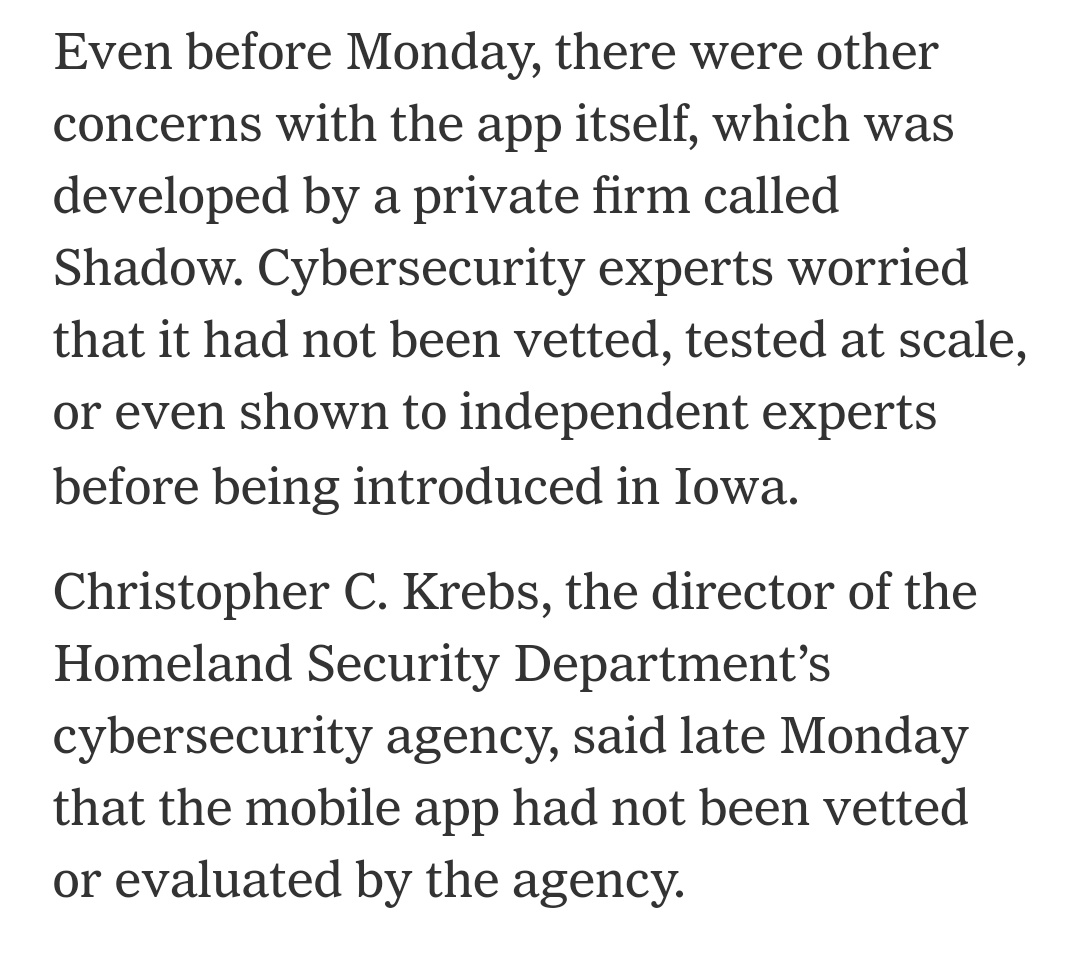
But #IowaCaucuses? Dumb choice.
"innovative web visitor identification technology and advanced data and analytics to identify previously unidentifiable customers"
So, uhm, fingerprinting?
There are options that sit in between killing and maintaining. The current system in which platforms are rewarded for irresponsible behaviour is untenable. I don't think that platforms should have publisher responsibilities, but distributor ones make sense.
That the app is bad is one thing, but even before looking at that I don’t even understand why you would want to do this on an app at all in the first place.
If you really must use tech (which is already questionable), a website would be a much superior option.
I love the spirit here, but as far as I can tell this is only messing with Instagram’s recommendation algorithm. They all still have Ad IDs and are still individually tracked.
What I wonder is if we're going to see a sudden collapse as it becomes clear that these business models are unsustainable or if it will be a more gradual correction as some figure out how to adapt.
Companies that fail to innovate beyond copied-to-death surveillance-based targeting are having a hard time.
Now it would be great if Apple brought some privacy to the iPhone by getting rid of IDFAs!
1) IANAL but there's a good case to be made that UAs are data controllers when they determine processing independently from the user and without technical justification. Chrome's decision to share cookie data broadly is one such. Articles 5 and 25 come to mind.
2) Chrome does a whole lot more data sharing, like sending Google your geolocation in headers and generating cookies on iOS. A version ID isn't great, but hardly top priority? To their credit it's all (lightly) documented at google.com/chrome/privacy….
Wow, @netflix seems to have finally decided to improve its usability! help.netflix.com/en/node/2102 (via @benlikestocode)
Next if they could stop changing the EPG to show randomly different layouts every day that would be 💯!
On the contrary, it's meant to allow online services to moderate content without incurring publisher responsibilities. In practice, it just allows them to profit from harm without liability.
In practice it is providing protection for the monetisation of all sorts of bad actors that wouldn't exist otherwise. But, hey, let's praise the law because you found a useful moderation experiment.
Replying to @donohoe and @mmasnick, @willikampmann, @EFF
I'm familiar with the @EFF's position on 230, I read the amicus they filed in the Herrick v Grindr case in which they defended Grindr's complete denial of responsibility in enabling serious, life-threatening harassment even though Grindr's competitors moderated effectively.
I thought that @EPICprivacy's position was much more in line with holding profit and power to account and much less "ZOMFG! 230 is like 1A that farts unicorns!!" epic.org/amicus/230/gri…
We've moved on from dialing each other's modems, it's not crazy the law would too. There are plenty of useful moderation experiments compatible with distributor responsibilities, they might even fare better if they weren't outcompeted for price by the don't-give-a-fuck phalanx.
Replying to @mmasnick and @donohoe, @willikampmann, @EFF
I honestly have no idea what you're talking about. Why would there just be one bad actor? Why would monetising harmful content not make you more liable than, say, comments on someone's personal blog?
Replying to @mmasnick and @donohoe, @willikampmann, @EFF
Also you're replying to a tweet in which I cite a second bad actor? Besides, no one is talking about burning down the system, I'm just talking about putting out the fire.
This is a business model that structurally advantages only the biggest trackers, since scale dictates value. The only change here is that the model moves from sharecropping off-platform to sharecropping on-platform.
I worry about "Any privacy control developed in accordance with these regulations shall clearly
communicate or signal that a consumer intends to the opt-out of the sale of personal
information." Is DNT in accordance? Is it *that* signal?
Indeed. The terrifying things you investigated last year were with a dataset that's a tiny fraction of what even some small unknown actors collect. The size of what we don't know is staggering.
Other question: the counterfactual of interest is what revenue is lost if 3P targeting vanishes. You tested what revenue was lost if some have 3P targeting and some don't. What is your reasoning for using the latter to jump to conclusions on the former?
Replying to @Log3overLog2 and @kyotonio, @thezedwards
Behavioural inside walled gardens is not the invasion of privacy it is when it happens across all behaviour. Of course there's a point at which policy has to take over from technology to handle purpose limitation, especially with horizontal monopolies.
Replying to @kyotonio and @Log3overLog2, @thezedwards
That's a big, unproven "if". If walled behavioural performs that well, why do the ad companies with the largest gardens spend so much effort acquiring 3P data, often at high legal and reputational risk? I don't think that anyone knows if FB's effectiveness comes from 1P or 3P.
Having said that I'm not opposed to client-side targeting, but building it on machine learning strikes me as a great way to make both fraud and discrimination simultaneously easier to implement and harder to audit, in exchange for unproven value.
Replying to @Log3overLog2 and @kyotonio, @thezedwards
Michael, I understand what you're trying to do and if there is a way to make it safe and respectful of users in certainly open to it, however that's not what I meant! The walled gardens I refer to are eg. FB or G Search, not us! We're much smaller and it's just our content.
Replying to @Log3overLog2 and @thezedwards, @kyotonio
You'll notice I have never used that article to support my position, even though it points in the right direction. Ads are highly complex and there are way too many confounding factors to draw any conclusion from that article!
Replying to @Log3overLog2 and @thezedwards, @kyotonio
It's Google's right not to release data, but you can't then expect people to be convinced by a study that is missing too much to be useful to us. You cite it as empirical evidence but we have to take it on faith. Yes, they have experience doing A/B: to support your business.
At the very least we would have to know what the "contextual" options were. I mean, programmatic contextual buys are a very specific segment of buys today! Is this mostly buys intended for Search but mistakenly sent to AdX from the GDN default? It would explain a lot.
Replying to @Log3overLog2 and @kyotonio, @thezedwards
It says nothing about what was running in the treatment group! "Such as contextual" is not enough to go on. I'm not aware that Google has a strong programmatic contextual offering?
Client side retargeting would be cool! The hard part would be proving creative delivery in a privacy preserving way. You could push the creative to a special browser cache upfunnel, clear from that on the conversion page, and have the means to trigger the retarget later.
You already do. My French phone plan was €15, and it was far, far superior to what T-Mobile offers for $60. When a friend came to visit for a few months, I could get her a second number on that account for €2.
One of the things that America sucks the most at is free markets.
I recall something like that but I don't know that it caught on much. Texting from my phone was unlimited anyway! I sure miss my €29 Internet access that actually worked!
That is to some extent a fair point, but conversely the simple suggestion that people must not be trackable (short of non-dark-pattern opt in) is met from adtech with nothing other than "ZOMFG! It's the nucular zombie apocalypse! We all die!" So what's the next step?
It's also hard to take the IAB seriously when today's privacy crisis is largely a consequence of its utter lack of leadership and honesty over the past two decades. If the Rearc intent is sincere, a leadership change might help make it credible.
It's even harder to take the IAB seriously given blatant efforts to undermine privacy like @privacy4america. Or discussions around universal IDs somehow improving privacy.
When I got the Rearc email I thought "Hey, that would be cool if true." but it's really hard to imagine the IAB creating something:
* user-centric,
* good for publishers,
* sustainable business,
* technically sound,
* with good governance.
That's five things to change at once.
Replying to @pbannist and @kyotonio, @privacy4america
There are things to salvage in the Sandbox, but given the risk profile it doesn't seem like a short term thing to me.
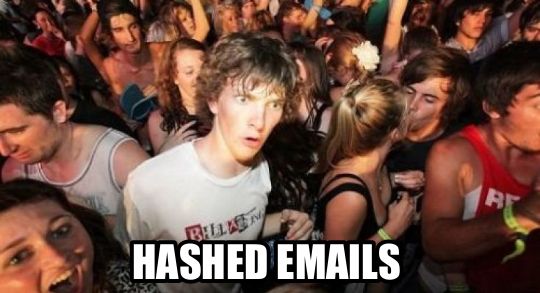
Hashed emails are problematic. Not resettable, too easy to get ahold of without the user knowing, plenty of fraud opportunities...
But users who want to be tracked could install an extension, auditable, with genuine and centralised user control. It could make the ID available to DSPs that commit to rules and auditing.
Replying to @null and @pes10k, @kyotonio, @pbannist, @acfou, @jason_kint, @random_walker
One problem is that there is currently no easy way to buy at scale from publishers, while relying on their abilities (eg. contextual, 1P). Technically, that seems solvable, and it can bring the scale back.
Has anyone started doing writing challenges based on @NYT_first_said? Like, every weekend write a story using ten words from that account in the past week?
Replying to @pbannist and @kyotonio, @privacy4america
Well, that's what self-regulation is understood to be outside the IAB! It needs to be more than CYA contracts and pinky-promises, and yeah it's difficult to get right.
Replying to @jarroddicker and @pes10k, @kyotonio, @pbannist, @acfou, @jason_kint, @random_walker
To the best of my knowledge you can buy from a limited taxonomy (eg. IAB's) but not topic clusters or sentiment (or indeed domain-specific extensions). What do you have in mind?
Replying to @jarroddicker and @pes10k, @kyotonio, @pbannist, @acfou, @jason_kint, @random_walker
I've been wondering if it might make sense to use property inheritance, as in schema.org, to help create topics. That way you can expose hammers but it still shows up for people looking for tools (OK, shite example, it's bedtime!).
Replying to @mchowla and @pbannist, @kyotonio, @privacy4america
No 3P behavioural. It's up to the adtech world to become serious about end users. So long as it stays too far removed it'll be in battle with them. That's not sustainable.
Please, can we lose the framing that this is basically a public service charity? I mean, if it is, great, but then it could afford to be a lot less obfuscated in its practices.
Replying to @kickstand and @aripap, @ewlamy, @SarahSluis
I really don't want to be mean, but... what is a "consumer-provided identifier" that isn't an email, phone number, or something of the sort?
I know you're trying to clarify, but reading this I honestly have no idea what this is describing.
Also: "The identifier is sufficiently encrypted so that it cannot be reverse-engineered to identify the person." What is an identifier that doesn't identify?
If you're sincere about this I'd be happy to engage, but the track record from your coalition is essentially promising self-regulation and shipping AdChoices instead. Have you had a genuine change of heart?
If so, again, I would be happy to engage in a public discussion about your proposal.
I'm curious about it being the strongest: in what ways does it improve on the GDPR or CPREA?
Replying to @kickstand and @aripap, @ewlamy, @SarahSluis
What difference do you make between opted-in and consented, and how do consumers know who to trust? And, still, how does this identifier not identify? Or is that a typo?
Replying to @kickstand and @othermaciej, @BrendanEich, @aripap, @ewlamy, @SarahSluis
And I need to figure out if it's worth dedicating resources to such discussions. The IAB has a track record of:
* hostility to users and publishers,
* poor tech solutions,
* being in denial about privacy.
So I'm reading the blog looking for signs that this may have changed.
But I already see several statements that, honestly and without malice, don't make sense from a technical or privacy standpoint. So why do this in the IAB instead of a place that has a track record of getting this roughly right, like the @w3c?
I've been wondering the same. I think one trick might be sticking to principles. Tech doesn't change that much, it's largely superficial dynamics being rearranged.
Replying to @samtingleff and @kickstand, @othermaciej, @BrendanEich, @aripap, @ewlamy, @SarahSluis, @w3c
At this stage I don’t think it is about the sausage factory, it’s about going back to the drawing board on fundamentals. Asking very basic questions about what privacy is and what the threat model should be could be a good step given the constituency, no?
Replying to @kickstand and @thezedwards, @samtingleff, @othermaciej, @BrendanEich, @aripap, @ewlamy, @SarahSluis, @w3c
I don't think that the "it's free, therefore it has to be this way" is an argument that is as strong as it's made to be. Free and unsafe, free and unsustainable just entrench models that will hurt more the longer they last.
This isn't to say that we shouldn't try to maintain free services, just that's it's not a no-brainer. In some ways it is similar to countries that have subsidised the price of gas. They all suffer when reality comes calling.
I haven't read it yet! I will, soon, but was reacting to the description in Anti-Social. That said my sense is that we are in a more technocratic world now than then. Then, technocracy was the stuff of government or stuffy corporations. Now it's all that's touched by tech.
Replying to @publictorsten and @johnnyryan, @iab, @Chronotope, @washingtonpost, @brave, @BrendanEich, @s_englehardt
Not speaking officially for The Times at all, but my guess would be: if it drives subscriptions and we can tell which campaign it comes from that would be enough?
Replying to @johnwilander and @johnnyryan, @iab, @Chronotope, @washingtonpost, @brave, @BrendanEich, @s_englehardt, @Gartner_inc, @fatemehx2, @othermaciej, @Apple, @IABTechLab, @kickstand
I know I can be a foolish optimist, but I think this could finally be a reckoning for them such that they stop pretending everything is fine and move on to actually innovate in ad technology.
Replying to @publictorsten and @hashoshi4, @BrendanEich, @johnnyryan, @iab, @Chronotope, @washingtonpost, @brave, @s_englehardt
You’re not entirely wrong that there are parts of the industry like that, but I know it’s not the entire industry and alternatives are proving themselves.
I think the French use it to mean "French as seen endearingly by les Anglo-Saxons". I don't think they integrate the fact that not all views of the French are of endearment 😁
It cracked my wife up because I'm really not very French at all but French standards.
Replying to @Paul__Walsh and @kickstand, @othermaciej, @BrendanEich, @aripap, @ewlamy, @SarahSluis, @w3c, @BIMA
It's definitely been an insular org and has developed a strong groupthink in which people say "anonymous identifier without noticing the oxymoron or claim those identifiers are safe just as they're being used to put kids in cages.
And everyone outside that bubble who so much as cocks their head at such weird views is a "privacy advocate" (whatever that means). This short-sightedness has caused a lot of damage to brands through fraud and unsafe contexts...
...and to publishers through stolen audiences, bad ads, and getting mired in an unsustainable business model.
Orgs are hard to change, it might be better to put this one out to pasture. But I'm hopeful that there's a genuine awakening in the adtech community.
Replying to @kickstand and @Paul__Walsh, @thezedwards, @samtingleff, @othermaciej, @BrendanEich, @aripap, @ewlamy, @SarahSluis, @w3c
A bunch of us have been doing this for a while! I think the question people have is whether the IAB is the right place to do this, nor that it should be done in the first place. Best of luck to whoever tries!
Replying to @kickstand and @Paul__Walsh, @thezedwards, @samtingleff, @othermaciej, @BrendanEich, @aripap, @ewlamy, @SarahSluis, @w3c
I'm sorry if you feel offended, I believe that you are sincere but I equally believe that you cannot succeed without reckoning with the problems that have brought us here from twenty years of the IAB's stewardship. This is not a cookies issue.
Replying to @kickstand and @Paul__Walsh, @thezedwards, @samtingleff, @othermaciej, @BrendanEich, @aripap, @ewlamy, @SarahSluis, @w3c
I am not saying any of this to hurt. But:
* Kids in cages: see recent WSJ reporting on use of adtech datasets to hunt down immigrants.
* Insular: when I was HTML editor the IAB came to ask that we *decrease* iframe security. That's quite detached from the world, no?
Fraud, brand-unsafe, etc. This was all debated extensively in the early days of programmatic and it turned out pretty much as expected.
I understand that this is unpleasant, but I don't think candour is unwarranted.
At any rate, have a great weekend!
Replying to @kickstand and @Paul__Walsh, @thezedwards, @samtingleff, @othermaciej, @BrendanEich, @aripap, @ewlamy, @SarahSluis, @w3c
Sorry, I'm confused. What is the relationship between the IAB and the open Web? I've spent a lot of time in the open Web world and the IAB was never a part of it.
Replying to @kickstand and @Paul__Walsh, @thezedwards, @samtingleff, @othermaciej, @BrendanEich, @aripap, @ewlamy, @SarahSluis, @w3c
Well, I'm sorry you feel this way. If only because I think it seriously harms your chances of success and those of us who've been trying to figure out how to improve this mess would welcome the help.
As I said, have a good weekend, whether you think it's BS or not!
Replying to @Paul__Walsh and @kickstand, @thezedwards, @samtingleff, @othermaciej, @BrendanEich, @aripap, @ewlamy, @SarahSluis, @w3c
Oh yeah, the web is totally in a fucked up place right now. One of the problems is that the structure of personal data markets is inherently monopolistic due to the nonrival nature of data and network effects in the value of datasets.
So the tracking industry trends towards monopoly. Removing the ability to track cross-site is a big improvement there.
Of course, the web has other problems in parallel so it's to just jump out of the frying pan.
Replying to @kickstand and @Paul__Walsh, @thezedwards, @samtingleff, @othermaciej, @BrendanEich, @aripap, @ewlamy, @SarahSluis, @w3c
I'm just going to stop bothering because you don't seem to u understand that I am not being sarcastic or intentionally insulting.
But... That blog post has issues. It skips over the battles to prevent 3P cookies from existing at all and considers AdChoices to be a good try?
And then it moves on to propose one of those universal ID schemes? I'm dead serious: if you don't perceive just how deeply that's IAB groupthink I just don't know what to tell you. It's just not going to happen, no one outside of intermediaries sees any value. Seriously.
Is there a specific nuance behind "international boundary" instead of "border"? @grlneric's is correct assuming "border", but indeed it's hard to guess at subtleties.
Just made my first order, will let you know! Some small kinks ordering on mobile but nothing bad. I buy books a lot and love the idea of an alternative to Amazon that covers the weirder stuff that my local bookstore doesn't.
Replying to @torgo and @jyasskin, @gsnedders, @yoavweiss, @AutomatedTester
Is Mozilla the only one to have published an assessment of developer needs? It would be instructive to see others'.
In terms of governance we could run this as a Constitutional Oligarchy of sorts.
Basically have the major engines/browsers propose a plan for the year, then we kick them out of the room and a bunch of representatives from all the smaller stakeholders hash out consensus between the positions.
Frankly, though, this thread makes it sound like their W3C work is Chrome's biggest issue. I don't think it is. Chrome's biggest issue is Google.
Without permanent badgering from Google properties, being default on Android, and assist from Google identity it'd be much smaller.
Replying to @kinu and @johnwilander, @yoavweiss, @AutomatedTester, @jyasskin, @gsnedders, @marionpdaly, @w3ctag
Publishers need to exist on AMP, it's a huge chunk of our search referrals so for many it's life-or-death.
AMP is, shall we say, idiosyncratic to deal with. It had a substantial cost in engineering.
That's engineers who aren't making things fast.
So I don't think there's much of a path to a fast Web that doesn't include nuking AMP, or at least Search accepting to promote the nonproprietary option as well instead of its walled garden.
Replying to @kinu and @johnwilander, @yoavweiss, @AutomatedTester, @jyasskin, @gsnedders, @marionpdaly, @w3ctag
I know! 😁 That's why I said (elsewhere in the thread) that Chrome's biggest issue is Google.
That said, I do believe that there is a path out of AMP. Happy to take it offline!
The less the US deals with its market failure in tech, the more others will have to compensate with increased sovereignty.
This isn't protectionism, it's market prophylaxis.
Where's the innovation, though? What little innovative tech I've seen in the past decade has almost entirely come from outside the monopolies. There's a lot of innovation theater, but really tech is one big killzone.
That may be true and I certainly remember why I went into tech 25 years ago! But you can't innovate if you can't build a self-sustaining business, and in this environment you mostly build for an acquisition exit.
Agreed, but even without looking at the ethical side, I think it's fair to question whether we're seeing much innovation at all. A lot of the disruption is just massive VC funding of ideas that aren't that new to compete for the market.
I think that removing the existing incentives to compete for rather than in would lead to far more tech progress. For instance, there are better ways to organise Uber, but they can't surface under the current setup.
Replying to @briankardell and @cwilso, @pes10k, @wicg_, @yoavweiss, @marcosc
I don't think that it was me, but I'm happy to check when I'm back home.
The goal of the WICG *was* to bring in more developer power as explicit counterweight to Big Web, but when you fluidify, power actually goes to the already powerful. That fuck-up's on me.
Oh - more than 64 campaigns I can see. If someone were saying that it should be 128 or 256, I would see where they're coming from. But 64 bits? That's a crazy big number!
InfoSec has definitely improved a *lot* but so has our individual exposure, in part through more devices and services, in large part through surveillance. It's possible for defence to improve and harm to increase.
Hey privacy friends! Would you mind sharing your favourite sources showing that the news/media sucks at privacy? I'd like to put together a comprehensive list.
This is one on my list:
“Good News for People Who Love Bad News: Centralization, Privacy, and Transparency on US News Sites“
timlibert.me/pdf/LIBERT_BIN…
Actually, email filters work for a single user. But Gmail has a near-useless filtering mechanism and instead has Clippy sort your email.
It turns out, Clippy likes Pete Buttigieg better.
Yes, I’m well aware — which is one of the reasons I’d been waiting for @themarkup to get startup with the excitement of a 20 year old watching petals spin.
It could be the sender's fault to the extent that these messages go to spam, it's pretty standard practice to work to avoid that.
But when Clippy decides to sort your ham mail for you how can it not be on them to do it without harm?
Replying to @nabihasyed and @dancow, @masooga, @themarkup
While we’re admitting to things — I also had my messages set to yellow Comic Sans atop dark green. And yet, I miss it!
Let us know when’s a good time and we’ll absolutely come! And likewise, if you want to chat with the data/privacy people here please come visit.
In the article, they signed up for this — so it is in fact ham.
You don’t need magic to keep track of all major political campaigns worldwide, a well-resourced organisation can curate this.
Putting it all in one place is fine from a fairness view (we can debate product design decisions, but that’s a completely separate concern). The issue at stake here really is disparity of impact.
Replying to @knowtheory and @ranimolla, @Chronotope, @jarroddicker
Oh yeah, as one of those biz side people I can confirm ;-)
That said, a *lot* can be observed openly and there are a number of studies showing that news sites are markedly worse.
There are people who don’t? ;-)
To clarify: I know *who* to go to (and in fact I don’t really need to go to anyone to know how bad things are), but I’m looking for studies, articles, etc.
Yes, that’s definitely for the list!
There’s a ton of stuff I “know”, but having it written down and centralised to reuse is different from having it in a corner of my brain.
Hmm, the fact they not just wrote it but actually paid to research and write it shows how much people here care. And I'm meeting with the owner to figure out how to make things yet better.
Note to future self: don't assume that because Pittsburg is "not all that far from NYC", then the weather there should be "not all that different from in NYC". ❄
I don’t think it’s entirely informal, but I completely agree that the business side of our houses need to do more to discuss these issues with the public. Even when real improvements are made, they aren’t discussed. I would like that to change.
Speaking strictly personally, I know how people behind the scenes think and I have zero personal doubt that this was intended as a user-friendly thing. But I know that intentions don’t matter and everyone in tech needs to do better [queue my broken record sound].
I can't make random public comments on behalf of my employer but I am working on being more open about what is going on, what has changed, what we still need to do, and what barriers to improvement we need to lift.
We are moving ahead and have made substantial changes, there is still quite a road ahead but I'm hopeful!
I'm travelling so I may lag, but my DMs are open!
Neither of those is the right question. The right question is "how do we get to remove the crap and keep making money?" Some of us are not just asking it but figuring it out!
A different way to look at it is that a $200 million fine would be quite a lot if the US telecoms market were free and competitive.
For all the lip service paid to hating socialism the American economy is centrally planned by a few corps — socialism without the human values. t.co/wgEp6qZJyW